Thursday, June 24, 2010
The Evolution of Emperor Worship
Thursday, June 10, 2010
Culture Wednesday: The Early Republicans
Friday, June 4, 2010
Scipio Africanus: A New Kind of Roman
Friday, May 28, 2010
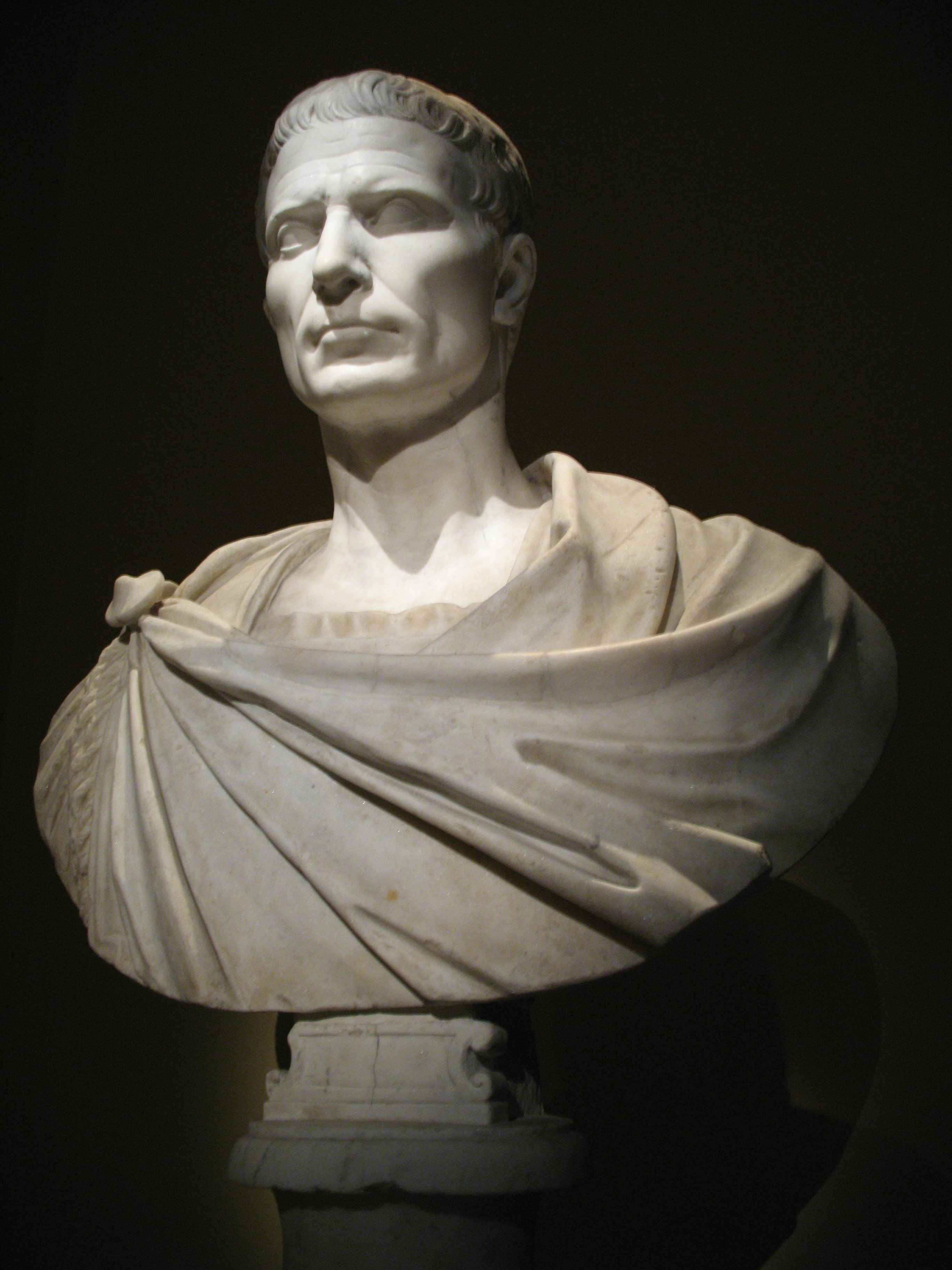
Hail Caesar! - Rome's First Emperor
Pax vobiscum
Thursday, May 27, 2010
For the Love of God - How Christianity Changed Everything Part I
Friday, May 21, 2010
Julius Caesar Part II: The Later Years
Wednesday, May 12, 2010
Women in Rome
One of the more famous Roman myths is the story of the Sabine women. Romulus, Rome's founder, gathered outcasts from neighboring cities to Rome to populate it. Unfortunately, they were mostly men and had been exiled from the other cities for fraud, theft, and other bad behavior. If Rome was to have a future, they would need to find women and reproduce. The nearby tribe of the Sabines had plenty of women, but they were unwilling to allow their daughters to marry the scoundrels that lived in Rome. So Romulus hatched a nefarious plot.
He invited the Sabines to a massive feast just outside the city gates. Since it was an all-you-can-eat affair, they brought their children, daughters, wives, and sisters along for the party, and it carried on for some time. When the Sabine men had become drunk, the Romans seized every unwed woman they could find and carried them into the city, locking the massive gates behind them. There was war with the Sabines, and the story goes that it was the abducted women who prevented all out slaughter on both sides, agreeing to live in Rome. Since they had been raped, they were considered ruined for other men, and they knew that their best bet at survival lay in submission to their newfound Roman companions.
This story seems so repugnant to modern sensibilities that it's hard for us to imagine how any culture would place it in their oral history and public record. However, it certainly helps to shed light on the position of women in the Roman world. For the most part, women weren't permitted to hold office, own property, or choose a husband. Their family structure was such that the father or Paterfamilias held legal power over life and death for all his children. At least for the young boys there was an age of independence, but a girl might live in her father's house all the days of her life.
It was assumed that marriage would eventually lead two people into a deep romantic friendship, but first and foremost, marriage was duty. They needed to continue their family line, and they were very often betrothed from birth. As a result, marriage became a burdensome chore and many soldiers and aristocrats started putting off, visiting prostitutes and keeping female slaves and concubines instead. Augustus Caesar, desiring to preserve Roman culture despite helping to destroy its Democracy, passed a series of laws and regulations governing betrothal, marriage, and success.
He promoted soldiers who fathered many children, fearing that Rome was becoming dangerously underpopulated. He gave the best seats in the Coliseum to married men, and granted some say in property disputes to married women who bore three or more children. He penalized wealthy bachelors and single women by heavily taxing their inheritance, and made it illegal for husbands to murder adulterous wives, preferring that they divorce them instead.
Despite all these reforms, women were a far cry from men in terms of power in almost every measurable criteria. Though they could sue for divorce themselves, the courts often ruled with the father, giving him custody of their children. And if their husband was involved in a war, there was always the chance that he would return with a German or Phoenician slave girl whom he would take as a concubine. However, since the earliest Roman wives were brought to Rome in a similar fashion, it was hard to argue that things should be any different. After all, only barbarians allowed their women to have the same rights and privileges as men.
Tuesday, May 11, 2010
Why do All Roads Lead to Rome?
The simple answer is that the Romans built them. There. Satisfied? I didn't think so. We see in the Romans a penchant to absorb and syncretize the things that they admired from other cultures, and in one respect, roads were no different. Government building of roads has been with humanity since at least the Ancient Persian Empire, and it is likely that the Etruscans brought a road-building ethic with them from Asia Minor, and that the Romans appropriated this idea. And if there was one thing that the politicians could all agree on, it was roads.
The Romans didn't just level dirt paths; they had a method of paving these roads which made them durable and easy to drive on. Merchants from all over mainland Europe used carts to transport goods, and sturdy, flat roads ensured that their more expensive breakable items would remain intact on the way to market. Travelers and pilgrims eager to visit the famous Temple of Saturn in the heart of Rome could now make the trip without fear of getting lost, since Augustus made the Temple the starting point for the marker stones. If the numbers on the stones got smaller, you were heading for Rome, hence the famous saying.
The politics of roads was always contentious, with many Patrician Senators using their vast treasuries to pave large, wide roads and name them after themselves. Like the Gladiatorial games, this was a good way to endear themselves to an underrepresented populace of mostly Plebeians. However, anyone who built a road in the early Republic was required to pay for its upkeep, which could be a problem if a wealthy Senator got involved in shady financial dealings that went south.
Eventually, the Roman Empire was connected by a large system of roads, which were eventually all made public property. Armies could march over the roads very easily compared to marching through dangerous forests and hunting paths. While this also helped the enemy armies of 'barbarians' to invade, the Romans made a habit of building a system of outposts and forts near choke points, and had a swift communication system to help ward off the smelly hordes. The roads lasted for centuries, some of them being preserved up to this present day.
Friday, April 30, 2010
Famous Friday: Tiberius Gracchus
While Rome was busy establishing dominance over the Mediterranean in the 200's BCE, there were problems on the homefront. Various enemies had abandoned fighting toe-to-toe with the legions in favor of hit-and-run ambushes and guerrilla warfare. However, Roman pride would not allow them to disband a legion until its campaign was finished, so many of the legionnaires were fighting for ten years or longer in places like Spain, Asia Minor, and North Africa. Meanwhile, back on the farm, their wives and children were tasked with caring for their estates, which often fell into ruin.
The wealthier land owners had plenty of money to buy or make slaves (by calling in debts), and they could leave their expansive vineyards and ranches in the hands of capable servants, paying them only food in return for tending their property. Soldiers at the lower end of the middle class who had smaller farms and no money to hire hands or purchase slaves would return from a long campaign to find their animals poached or rustled and their orchards gone to seed. Some tried to make the best of it, seeking work to earn money and reinvigorate their family farm, but work became very scarce with every new batch of conquered slaves that arrived from wherever there was a campaign. These men were unwittingly putting themselves out of work.
This economic crisis is one of the many factors in the Republic's ultimate death, but it is a significant one. The droves of people who later supported Julius Caesar and Augustus after him were the disenfranchised middle class whose farms had been plundered by greedy oligarchs who took advantage of their absence while they were defending Rome from the Barbarians. To my mind, it is the chief failing of the Republic's political structures that they didn't adequately address the needs of those they derisively referred to as “the mob.”
However, some within Rome's political elite tried to enact land and economic reforms before it became such a widespread problem. The Gracchi brothers were two such Patricians who attempted to reverse the injustice of losing one's home while fighting for the Republic. Their payment for these attempts was brutal death.
Tiberius Gracchus, born sometime between 168 and 163 BCE, and served as a military tribune in Spain. Plutarch tells us that while returning to Rome after a campaign, he began to notice the need for reform. He saw the huge tracts of land throughout Etruria (northern Italy) which were being tended mostly by foreign slaves, as well as the smaller farms which had gone into ruin. When he came to Rome itself, he saw several large mobs of unemployed and homeless men wandering the streets looking for work. He knew something had to be done, so when he was elected as Tribune of the People in 133 BCE, he went right to work campaigning for reform. In one of his fiery speeches, he said, "The wild beasts that roam over Italy have their dens, each has a place of repose and refuge. But the men who fight and die for Italy enjoy nothing but the air and light; without house or home they wander about with their wives and children."
This made him popular with the people, but very unpopular with the other Patrician families and Senators, who were all enjoying the benefits of the situation, paying meager sums of money to gobble up the small farms around them when they came to ruin while their owners were away at war. In retrospect, it was quite a nefarious scam that the Senate was running on the people; sending them to war for years so that they buy the land cheap, staff the huge farms with slaves which were captured during these same wars, and profit from the whole scheme. Thus, as they were benefiting so much from the system as it was, they were more than eager to douse this fire of reform.
Believing that the Senate would never pass his reforms, he planned on submitting them instead to the Plebeian Council, since they had some legislative power. The Senate learned of his plan and was deeply offended. In fact, some of the moderate Senators who may have supported these reforms were now firmly against them and against Tiberius himself. They somehow persuaded Marcus Octavius, another Tribune, to use his veto against Tiberius and make him a lame duck. Tempers ran red hot at the Council assembly, as it became clear that Octavius was acting as a tool of the wealthy. The people voted to depose him, and he vetoed them, which probably didn't help matters. Tiberius therefore ordered that Octavius be forcefully removed so they could have a proper vote. In a moment of horrible clarity, Tiberius realized that he had violated the law by using force against a Tribune, something which was very illegal and severely punished since the formation of the Council. So instead of moving forward with voting on his reforms, he moved to basically shut the entire city down until the Senate passed the bills themselves. Businesses weren't allowed to open, temples were closed, and all commerce ground to a halt until the Senate decided to approve his reforms, which they did, but used a parliamentary trick to give his newly-created agrarian commission only minimal funding.
Later that year, King Attalus III of Pergamum died without an heir, leaving his entire kingdom and vast fortune to Rome. Tiberius jumped at an opportunity to give his reforms teeth and claimed part of the inheritance for his commission. The Senate, who was constitutionally in charge of the treasury, saw this as a direct affront to their authority; a check without a balance. They also sought to prosecute him for his unlawful and unconstitutional expulsion of his fellow Tribune Octavius, and waited eagerly for his term to end.
Knowing that the end of his term would likely mean the end of his life, Tiberius ran for re-election as Tribune, making outlandish promises, including giving Roman citizenship to foreign allies. Neither side much liked that particular idea, since the poor were already competing with slaves and didn't want to share the rights of citizenship with a bunch of smelly Barbarians. Quintus Pompeius told the Senate that, since he was Tiberius' neighbor, he knew that the populist Tribune had received royal gifts from a Greek named Eudemus of Pergamum, who prophesied that he would one day be the king of Rome. This, coupled with the testimony of one of Tiberius' cousins who claimed that this Gracchi was amassing power for himself in a play to become King, led the Senators to do something that most of us today feel was a bit . . . drastic.
During the re-election vote, the well-groomed and cultured Patrician Senators followed the accusatory cousin down to where Tiberius was, beat him to death with their chairs and threw his body in the the river Tiber. About three hundred of his loyal followers tried to protect him and were also killed by the malevolent politicians.
Since they had now also violated the law against harming a Tribune, the Senators worked quickly to mollify the Plebeians, who were ready to take up arms against an upper class that was entrenched within the status quo. They agreed to fund the land reform commission, and this satisfied the mob for the moment. At least, until Tiberius' younger brother Gaius came upon the political scene ten years later.
Pax vobiscum
Wednesday, April 28, 2010
Culture Wednesday: Democracy, Roman Style
Friday, April 23, 2010
Famous Friday: Pomp(ey) and Circumstance
Toward the beginning of the 100's CE, the Roman army was radically redesigned by Gaius Marius, who changed the rules and forever changed Rome. Prior to these reforms, in order to serve in the Roman army, you had to be a member of the upper class, own a significant plot of land, and provide your own weapons and armor. Marius opened the ranks to all classes of Romans, promising land and plunder to whoever signed up. The army was thus transformed from an elite institution into a social ladder by which “new men” could earn money and fame for themselves and climb the class structure. One of these new men was Gnaeus Pompeius Strabo, the father of Gnaeus Pompeius Magnus, known by his more common title, Pompey the Great.
Pompey was only nineteen when his father was killed during a Roman civil war. He inherited a massive and wealthy estate and after two marriages, was swiftly climbing to the most powerful ranks of Roman society. His father-in-law, Lucius Cornelius Sulla, had distinguished himself by winning the first Mithridatic war in Greece and Asia Minor, and had several uses in mind for Pompey. Sulla became the Dictator of Rome and sent Pompey to secure the empire from further rebellions and civil strife.
First on the to-do list was Sicily, which supplied Rome with necessary grain. Next was North Africa, Numidia to be specific, where Pompey excelled at achieving victory with his legions. However, this presented a problem when he returned to Rome wanting a triumphal entry because he was a privatus, that is, just a private citizen with no Senate-seat or Senate-given titles and for him to be granted a parade was actually illegal. Sulla decided to allow it only after he and another general were finished with their own parades. When the day arrived, Pompey was embarrassed by a late start because of an incident with an elephant-driven chariot. It seems that the gates of Rome were too narrow for the elephant to fit, so he had to make a few last-minute changes.
A few years after Sulla's death, he asked for the title of Proconsular Imperium of Hispania (that's Spain and Portugal) so that he might crush an ongoing Roman rebellion in that area. The Senate was beginning to fear this young upstart who gloried in military triumphs but seemed to have no interest in becoming a Senator or going the traditional rout of Roman leadership. They also didn't wish to offend the general in Hispania who already held that title, thus giving them another rebellion on their hands. However, as he refused to disband his legions until they agreed to his title, they acquiesced, hoping that perhaps he would meet his end in Iberia. They were mistaken, of course, and Pompey destroyed the rebellion in five years.
Enter Spartacus. While I do plan on writing more about this slave-general in future weeks, this will be minimal. The Third Servile War was underway in Italy, with Spartacus as its leader. Crassus, another future Famous Friday subject, had faced the Gladiator/Slave army and defeated it, killing Spartacus in the process. Pompey was making his way back to Rome, and encountered the remnants of the enemy army, capturing about five thousand of them. He brought them into Rome as his slaves, and claimed credit for wiping out the rebellion for good. Crassus, needless to say, was not amused.
Pompey was then granted his second (but still illegal) triumphal entry by the Senate, who continued to fear the influence he had with the common people of Rome, the mob. In an attempt to domesticate this brilliant warrior, they elected him Consul, despite the fact that it was a Senate-only office and Pompey had never even been elected Senator. He ruled the Senate as a Consul right alongside his fellow Consul and longtime anti-fan, Crassus. It seems that the Senate believed the two would cancel each other out, their fame would fade with time, and they could be swept from office in a few years. Unfortunately, Pompey and Crassus both desired power, and they proved willing to work with even each other to attain it.
Just when it seemed like Rome's enemies had all been contained, the problem of piracy began to re-emerge in the Mediterranean. Two years after his Consul-ship, Pompey was given command of a naval task force designed to obliterate piracy completely. It was another controversial appointment for the still unelected general, but it passed through the Senate albeit by narrow margins thanks to Julius Caesar (who hadn't become Caesar yet). Whether they liked Pompey or not, they couldn't argue with results. Short version of Pompey's naval command: Pirates lose, Pompey wins, no more pirates for awhile. This, of course, made him popular with the masses once again and left his Senatorial enemies wringing their hands over what to do.
Meanwhile, back in Pontus, the third war against Mithridates the Great was going swimmingly well for one Lucius Lucinius Lucullus (who, I'm guessing, didn't appreciate being called 'Lucy'). However, his troops were growing weary and insubordinate after years of fighting without much to show for it, and Rome was starting to doubt his ability to subdue Asia Minor and the East. He had been chasing Mithridates VI around the countryside, only to learn that he had sought refuge at the court of Tigranes II, the king of Armenia. So he sent an arrogant letter to Tigranes demanding that he produce Mithridates, which Tigranes refused. Then, after fighting with the Armenians for a few years, he also failed to capture Tigranes. Thus, he was replaced by Pompey, who chased Mithridates all the way to Colchis, in the northern Black Sea coast. He still didn't capture the last Pontic king, but he didn't waste any time. He set up Roman-style governing authorities to replace the Pontic nobles and went about conquering Syria, Palestine, and Judea. Afterwards, he returned to Rome, had some more parades, and allied with Julius and Crassus to form the Great Triumvirate which would eventually bring an end to the Republic and usher in the age of Emperors. I'll write more about this in a few weeks when we take a look at Julius Caesar.
While Pompey was certainly skilled at all matters military, politics brought about his eventual undoing. The Great Triumvirate worked well while it lasted, but just like the Highlanders, there can be only one. Caesar practically chased Pompey out of Rome, and once he secured his family, he debated where to go next. He decided on Egypt, which was being ruled by the Greek Ptolemies, and fled there with Caesar's Triremes close behind. When he set foot on the shore, he was stabbed to death by the Egyptian “welcoming party.” The Pharoah thought it best to dispatch Pompey and present his body to Caesar, thus preventing a large-scale pitched war in their country.
Caesar, so the story goes, was not happy about Pompey's death, even though they had become enemies. He put his assassins to death and gave Pompey's remains over to his wife, who took his ashes back to his country home in Alba. His reputation was that of a great and famous general who fought for Rome and whose life ended ultimately as a tragedy.
Pax vobiscum
Monday, April 19, 2010
Military Monday: The Early Army of Mithridates VI
The army of Pontus reflected the Kingdom itself, and even its king: it was a mixture of different fighting men with different styles, cultures, and ideas. In the best of circumstances, this mix led to sweeping victory, but in the end, it led to ultimate defeat. Fancying himself the heir of Alexander the Great, Mithridates VI followed Alex's tendency to augment his army with whatever kind of troops he conquered along the way. While this worked well for Alexander, it should be noted that Mithridates lived considerably longer and this region had been changing for almost three hundred years since the young Macedonian conqueror.
Asia Minor was and remains a land of many peoples. Considered prime colonial ground by the Greeks, it had an unmistakable flavor of Hellenist-style learning, fighting, and worship. However, there were also Persian colonists there, left-over from Darius' invasion years before Alexander. And this is all in combination with the native peoples, who were primarily tribal, though growing more and more agrarian and urban, forsaking their nomadic ways. In order to unite these people, Mithridates would often resort to xenophobia, at least the anti-Roman variety, thus giving them a common enemy. Here, truly, was a wise student in the art of war.
After he had conquered some of the Balkan region to the North, Mithridates looked to securing his borders in the south. So he made plans, along with Nicomedes III, the king of western neighbor Bithynia, to divy up the area called Cappadocia, just south of Pontus, between the two of them. Mithridates' sister was ruling as regent because her husband had just died. Nicomedes, being a cunning king himself, decided to marry the sister instead, leaving one of his sons in charge of the region.
The two men sent representatives to Rome to resolve the dispute, leaving Nicomedes in a position of comfort, thinking that there would be no battle until their dignitaries returned. Mithridates waited for a time, then invaded Cappadacia outright, and its puppet king was killed in the ensuing fight. This enraged the Romans in the area, who helped Nicomedes raid and burn several towns and settlements in southern Pontus as punishment for his invasion.
Mithridates was more than capable of stopping this looting, but instead he allowed it to happen. Nicomedes ravaged the countryside while the Pontic king merely took reports and made preparations. He knew that the Romans would likely move against him on the pretense of aiding Bithynia, and so he spread word far and wide that those villages had been pillaged under Roman advice, thus uniting the varied people of Pontus against Rome, and Bithynia, her handmaiden. Raising an army was easy for him at this point; those who had their crops and livestock stolen by the Bithynian raiders were only too happy to take up a spear and get some of it back, with interest.
Sure enough, the three Roman generals whose armies were in various parts of Asia Minor all moved against Pontus with the hope of quelling Mithridates VI. The three armies were probably about forty thousand each, along with Nicomedes' army which was reportedly fifty thousand foot, six thousand horse. If they had all joined together to take on this rogue Pontic despot, they may have had a chance. But in their anger, and without waiting for orders from the Roman Senate, they took him on individually, along with his army of two hundred and fifty thousand foot and forty thousand horse. He crushed them one by one, capturing their generals and subjecting them to horrible, humiliating treatment.
His footmen were likely Phalanx pikemen at the core, along with lighter armed auxiliaries and javilineers. The javelin-throwers of Pontus were legendary for their accuracy, and the deadliness of their weapons. The horsemen he employed were mostly, probably all, javelin-armed and heavily armored, capable of forming a kind of highly-mobile Phalanx which disrupted enemy formations with missiles before charging home at their flanks. His tactics were most likely pin-and-fork, using the heavy spearmen to hold the enemy in place while his horses harassed their flanks and caused a rout. He may have also had some Scythian horse archers in his ranks, recruited when he defeated them in the Bosporus up north, and if that were the case, their contribution would have been immeasurable. They were a Steppe people; born in the saddle and taught to ride and shoot from a very young age. Their accuracy was high, and their tactics were notorious: they would pretend to retreat in a panic, only to outrun their pursuers while shooting them with their poisoned arrows. No matter Mithridates' tactics, the comparatively small armies of Rome and Bithynia didn't stand a chance.
Because of this conquest, all of Asia Minor was under his control. He moved swiftly to secure the loyalties of Greek colonies in the western regions, and sent representatives to gain alliances with the Greek cities, who had been living almost a hundred years under Roman hegemony. They eagerly agreed, giving Mithridates a buffer region with which to hold back immediate Roman retaliation.
Unfortunately for him, when Rome did retaliate, they took all of Greece back, but signed a treaty with him that left him in control of Asia Minor. Though he accomplished much and did a lot to unify such a diverse group, it seems that their divisions were stronger than a mutual hatred of Rome. Mithridates the Great himself spoke at least twenty-two languages, which apparently was necessary just to communicate with all the captains in his army!
In the ensuing Mithridatic Wars, the Romans repeatedly punished Pontus with their manipular legions and flexible tactics. Eventually, trouble within his own household was Mithridates' undoing as he was betrayed by Pharnaces, his illegitimate son.
Opinion of this warlord varies, depending on the source. Some look upon him as just another petty king trying to build an empire and advance his own name. Others see him as a kind of freedom fighter against Roman imperial oppression. Personally, the jury's out for me. I think he was much smarter than the average despot, yet his cruelty toward Romans, both military and civilian, cannot be overlooked. It should be noted, however, that he never referred to himself with the surtitle “the Great.” That was something the Romans did shortly after he died. It seems that though they were enemies, there was something about this man that they deeply respected.
Pax vobiscum
Friday, April 16, 2010
Famous Friday: Mithridates VI, Alexander's Last Heir
I don't blame Rome for conquering the world. Sure, they did some terrible things along the way and their very name became synonymous for oppression, but I don't really think it was all their fault. Rome, not unlike Sparta, had the practice of ensuring its security by serious, disciplined military training, and using slaves to handle the menial work of growing food and tending to the livestock (although Rome's slavery was nowhere near the scale of Sparta's!). This meant that, in the same way that the Peloponnese city-states all wanted to be Sparta's ally when it was strong, the emerging powers of the Mediterranean wanted to be counted among Rome's friends. When a conflict would break out involving one of Rome's allies, they would often call for help and Rome would send and army. Eventually, to save on time and travel expenses, the Romans just built an outpost nearby and eventually saw to all that nagging day-to-day governance stuff.
Ergo (+100 Latin bonus points!), if there was a destabilized area in the Mediterranean from about 200 BCE onward, you could bet that it wouldn't be long before the Romans would lend a hand. Asia Minor circa 90 BCE was one such area where local conflict and civil strife were both common. It was a land of many cultures, having been conquered by both the Persians and Greeks respectively over the previous 500 years, and there was still a significant local population who had their own customs and philosophies. To the Romans, who admittedly had begun to look toward the expansion of their already impressive empire, it looked like a good land for up-and-coming politicians to get noticed through conquest.
So it was that Lucius Cornelius Sulla found himself far from home on the Asian frontier facing off against a mighty Pontic king who had somehow unified these diverse people and formed an army. Mithridates VI, also called Eupator, stood before him proud and defiant, refusing to repent for his slaughter of Roman civilian colonists in the terrible massacre that Appian refers to as the “Asiatic Vespers.” It is important to note that though this act certainly qualifies Mithridates VI as a cruel, petty despot, it was not without pretense from the Romans themselves
Though they admired Greek thought and borrowed their mythology, the Romans were notoriously merciless in their dealings with Greek settlements. In 167 BCE, the Greek colony of Epirus was sacked and all its inhabitants enslaved. In 146 BCE, they destroyed Corinth. Not to mention the slaughter of Archimedes at Syracuse. Though I don't believe the Romans always sought the wars that entangled them, they certainly didn't go to war without real commitment.
Before continuing our tale of the small kingdom of Pontus versus the mighty empire of Rome, let's explore Mithridates as a person, that we might better understand this man and why he did such terrible things. First of all, let's explore the area where he was born.
The light purple is his empire at its most expansive. The dark purple represents where he started. Clearly, this was a man who knew how to exert his influence without the aid of Roman interlopers. His heritage probably has a lot to do with his disdain for all things Roman.
Mithridates was a descendant of Alexander the Great on his father's side, and this was a fact he took great pride in. It helped him to recruit the Greeks living in Asia Minor, as they grew up hearing stories from their parents about mighty Alexander and how he conquered the world. On his mother's side, he was a descendant of Darius I, a mighty Persian conqueror. This helped him to win support from Persians, and also from the Asians. Thus, Mithridates set himself up as the heir of both the Macedonian empire and the Persian empire, which was a powerful political and rhetorical weapon.
His father died when he was only 14, and it is believed that he left his home soon afterward for a time. His mother ruled in his stead as a regent, and meanwhile sold large portions of the Pontic territory to Rome, who was eager to stake their claim on the East. The city of Laodicea is named after her.
Six years after his father's death, Mithridates VI either came of age or returned to his throne (since it's unclear whether he ever really left) and threw his mother in prison. He did not approve of the partitioning of the kingdom, and he especially didn't want to involve the Romans. He desired to defeat them, to overturn a hundred years of virtually unchallenged Mediterranean hegemony and establish a new Helleno-Persian Empire that would rule in its place. But first, he would have to unite Asia, carefully maintaining a balance between diplomacy and outright conquest.
First, he turned his eye to the north, knowing that it would be impossible to reunite Asia without a base of power in the form of money. So, in exchange for protection, he raised and sent an army to drive the Scythians out of Crimea and the Eastern Baltic region. The Bosporans, who lived in that area for many years, eagerly accepted this help because the Scythians had long been their bitter rivals; mostly horse archers who fought with poison arrows and had a raiding-based economy. They were kind of like ancient land-based vikings. Mithridates' army succeeded, thanks to the leadership of Diophantes, one of his greatest generals. Thanks to him, the Rhoxolanoi, a Scythian ally, also accepted Pontic rule. Now that he had cut his teeth on northern politics and warfare, he was ready to mix it up with the locals.
Nicomedes III ruled Bithynia at the time, and Mithridates initially meant to ally with him. Nicomedes proved himself a friend of Rome, however, and so a war broke out between them. Mithridates met Nicomedes on the battlefield, and the Pontic army consistently defeated the poorly-trained Bithynians, who were scattered like chaff in the wind. So it was that Nicomedes chose to enlist Rome's help directly, corresponding with them and begging for relief from the Pontic tyrant. Rome, having received a request for help, gladly obliged and thus began Mithridates' direct struggle with the Empire.
Next week, we will take a detailed look at the tactics and customs of the Pontic peoples, with their Greek Phalanxes, Peltasts, and Scythe Chariots. As this week turned out to be a “Greek Week,” next week will be mostly a “Mithridates VI Week.” Stay tuned, and stay safe.
Pax vobiscum
Technorati Tags: ancient, history, Mithridates, Eupator, empire, Rome