Showing posts with label religion. Show all posts

Thursday, June 24, 2010

The Evolution of Emperor Worship

As you may have read a few weeks ago, Augustus Caesar was the first Emperor, whose authority was more of a subtle, de facto kind of rule, rather than the flamboyance of his descendants. He was also the first person to introduce the concept of a living divine leader into Roman politics, which had for almost five hundred years avoided deifying their leaders, unlike the Greeks and Egyptians. When Julius Caesar was deified post mortem by a guilty Senate, Augustus wasted no time in adding “son of god” to his list of many titles. As such, people were much more hesitant to go against him, for fear that their anger at his naked power grabbing might be perceived as impiety by the masses who adored him.

This is not to say that the Romans were all Agnostic pragmatists before Augustus Caesar, far from it. Many a popular assembly was disrupted or canceled because some appointed Pontifex claimed ill omens, signs which only seemed to appear when the assembly favored policies which the Senate opposed. Sometimes, this was seen for the crass undemocratic interruption that it was, but other times it succeeded.

Gaius Marius claimed to have found an eagle's nest with seven baby chicks in it – a large number of baby eagles for a single nest. He and his followers claimed that this was a sign from the gods that he was meant to serve seven terms as Consul, something that helped to sway Plebeian support for the unorthodox multiple terms that he served. The people of Rome recognized, for better or worse, that there was a law higher than the Roman codes.

Augustus took things a step further by claiming to be God's son, since God was Julius Caesar. By endowing himself with divine status, confirmed by the Senate's own apotheosis, he set the stage for the later Emperors and the Popes after them to claim infallibility. He also removed a key element to becoming a deity within his culture: dying. He was to his people a living, breathing divine entity, capable of bringing great good to his allies and terrible wrath upon his enemies.

It is really no wonder that this sort of thing got carried way too far by those who came after. It wasn't long before people were required to burn incense to the images of the sitting Emperor in order to enter local marketplaces as far away as Palestine and Asia Minor. But even deification couldn't save some Emperors from disfavor and assassination, as it seems even Roman piety had its limits.

Pax vobiscum

Tuesday, June 22, 2010

Adequate Aqueducts

In my study of history, it seems that there are at least two kinds of empires: the conquest empire and the sustainable empire. Famous warrior-kings like Alexander the Great forged conquest empires by marching their armies into foreign lands and conquering everything in sight. Alexander's in particular is an impressive conquest empire, but it fell apart as soon as he died, splintering into petty kingdoms ruled over by his former Generals. Sustainable empires, on the other hand, outlast their conquerors and fall into a pattern of subservience and reliance on their master kingdom. Rome had its share of both over the years, but places like Spain, Germany, Asia Minor, Sicily, North Africa, Greece, and regional Italy itself gradually fell into a permanent territorial status.

How does an army win a battle? Tactics. How does a nation win a war? Logistics. How does a country maintain a far-reaching empire? Engineering. Yes, if there's one thing the Romans had a monopoly on, it was practical engineering. Where the Greeks and Egyptians saw religion, the Romans saw potential. They specialized in making mysterious concepts like pi work for both their citizens and their conquered clients. One of their most amazing achievements was the Aqueduct.

In Rome alone, there was probably 500 km of aqueducts, allowing the city to support a million people. Throughout their empire, they regularly built and maintained these massive pipe and stone structures in order to ensure a potable water supply, as well as control over where the local went and who got to drink. When a city rebelled, step one of retaking it was taking the head of the aqueduct and cutting off their supply. Likewise, when Rome was attacked, the first step in defense was deploying the most elite troops to guard the water supply and ensure that a siege would prove too costly to maintain, especially if the attackers could not find a supply of their own.

In order to build a proper aqueduct, the surrounding land needed thorough surveying and measurement. The angles employed to ensure a 'just-right' flow of water were often very subtle, and the slightest overcompensation in the grade would either slow the supply to a trickle or cause an overflow which could lead to a nasty flood.

It is easy to find remains of the aqueducts in many parts of the ancient empire, including Spain and modern-day Turkey. What we see is only a fraction of what existed, and what still exists beneath our feet. Of all the aqueduct and piping laid by the Romans, most was underground and only a small percentage used those famous arches that we see still standing today.

Pax vobiscum

Thursday, June 10, 2010

Culture Wednesday: The Early Republicans

For those of you rooting around teh Interweb for American political posts, welcome! This blog is about the ancient world, but hey, stick around and you might learn something new.

During the early Republic, Rome had certain ideals which its citizens, for the most part, tried to uphold. This young, upstart city-state was based, like most ancient economies, on agriculture first and foremost. The ideal Roman, therefore, was a farmer, regardless of social status, personal wealth, or fame. Land ownership was key to obtaining respect, political office, and financial independence, and the ironically egalitarian rhetoric of the Patricians often praised the Roman farmer-soldiers for their simplicity of lifestyle, expertise with weaponry, and willingness to fight for the city and put her needs above their own.

Not unlike Sparta before it, or even America much later, the early Roman military system was militia-style conscripting with annual training during the slow winter season. If you owned enough property to qualify for the fifth census class, you were not only eligible for service, you were required to report for duty. Those in the lower classes were expected to obtain work as farm-hands, house servants, or really any menial work.

Scipio Africanus, who I so recently covered, served as a great bad example by the conservative Senators of his day for his tendency to wear his hair long, spend huge amounts of money on lavish parties, and generally live a life of excess matched today only by rock stars, royalty and professional athletes. Despite his unique lifestyle, he still restored Rome's honor by defeating Carthage, though the Senate was largely displeased at his decision to parlay with the residents rather than simply burning their city to ash and putting its citizens to the sword.

The Senate's desire to see Carthage destroyed seems an unspeakable war crime to us today, and became a famous warning when it did happen after the Third Punic War. Their other imperial-style cruelties would certainly horrify us today, as well as their military discipline, which included killing soldiers who drew a short straw. However, what set the Romans apart from the Greeks and other peoples was their practicality. This may have come about because of their farming ethic, but regardless of its source, it was their most powerful weapon.

While other 'great' civilizations were concerned with the true meaning of love or which day is proper for worshiping Athena, the Romans concerned themselves with supply lines, siege engineering, battle tactics, and in general, how to ensure victory. They learned well the lesson of the Second Samnite War: either destroy your enemy or forgive them, but never humiliate if you intend to let them live. Their world and culture, heinous though some of its elements may seem to our modern sensibilities, was born out of necessity and practical reality.

The Republic had its triumphs along with its faults, and lauded the heroes of old who were granted temporary Dictatorship and did what was necessary to resolve whatever crisis led to their election only to relinquish power when their term was up. Cincinnatus was a one such hero, who went right back to farming after he had served Rome and defeated its enemies.

What happened to the noble Roman, the farmer-soldier who was as skillful with a sword as he was with a plowshare? He was out-sourced. In short, the Patricians and wealthy Plebs utilized slavery so extensively that it became impossible for the working class to find work. The excesses promoted by Scipio Africanus became commonplace, and politics became overly corrupt. The Senate, having grown powerful since the Punic Wars, desperately tried to restore the old ethics of a hard day's work and a simple lifestyle, but even they had grown used to living in great estates with their every need attended to by slaves from every corner of their colonies. Their conservatism was short-sighted at best; treating symptoms instead of stepping back to understand the problem. They sacrificed their hard-nosed practicality for selfish, soft living, and many of them paid the price in their own blood.

The biggest danger to representative government, historically, is itself. The poor Plebs became frustrated at their lack of power and representation and turned to liberators like Lucius Cornelius Sulla, Gaius Marius, and Julius Caesar. The cult of personality toppled the old rhetoric of freedom and shared power, replacing it with hero worship, mob rule, and might-makes-right style politics. The old Romans eventually faded into the annals of history along with Romulus and the kings of old, their lifestyles gradually viewed as quaint instead of inspiring.

Pax vobiscum

Wednesday, June 2, 2010

Phoenician Artifacts

We owe more to Phoenician culture than we'll probably ever know. They colonized the Mediterranean, developed the first widely-used phonetic alphabet, and developed one of the earliest urban civilizations west of the Fertile Crescent. It is thanks to them that the Romans began developing their massive Empire – most of which they took from the Carthaginians in war. Let's take a quick look at some of their more interesting artifacts.

This ceremonial mask of Ba'al Hammon was likely used in various rites and rituals designed to curry the favor of the Carthaginian chief deity. It is made from Terra Cotta. Date unknown

This coin dates somewhere between 310-290 BCE, and features the moon goddess Tanit, the highest of the goddesses worshiped in Carthage. She was the patron of life, fertility, and war, and is closely linked to Artemis of the Greeks, Diana of the Romans. Her symbol is very similar to the Egyptian Ankh.

This statue is meant to represent a man praying. It comes to us courtesy of the Phoenician colonists in the Balaeric Islands (near Spain) and is made of Terra Cotta and gold.

This is either a pendant or a brooch, and was discovered on the site of Carthage itself. It dates to the 3rd or 4th century BCE, and looks pretty cool. Whether it is meant to represent an average Carthaginian or is some kind of divine image remains unknown.

Pax vobiscum

Friday, May 28, 2010

Hail Caesar! - Rome's First Emperor

When Julius Caesar was stabbed to death during the famous Ides of March assassination in 44 BCE, he left a power vacuum big enough to suck Rome into yet another Civil War. After some initial sieges and skirmishes, which resulted in the deaths of the two sitting Consuls, this vacuum ended up being filled by three unlikely allies who were appointed to a kind of co-dictatorship in October, 43 BCE in hopes that they would check and balance each other over the course of their five-year term. What ensued should be no surprise to anyone who's been paying attention to the politics of the day: a temporary and uncomfortable alliance followed by massive Civil War.

Gaius Octavius Thurinus was Julius Caesar's grand-nephew, and renamed himself Gaius Julius Caesar after his great uncle adopted him, and I assume to confuse the later students of history. In any case, Octavius, as we shall call him, proved a worthy adversary for the other members of the Second Triumvirate, leading armies to victory against both the rebel armies of Caesar's assassins and Marcus Antonius.

Like many ancient people, the Romans would occasionally deify their dead leaders, and Caesar, though he was objectively ruthless, self-seeking, and a dangerous consolidator of power, was declared by the Senate to be a patron god of Rome on January 1, 42 BCE. Octavius, capitalizing on Caesar's honor, began referring to himself as the 'son of god' and no doubt won over several followers from Rome's middle and working class through his relationship with their late champion.

After Marcus Antonius was defeated at the Battle of Actium, Octavius was in a position to increase his influence and forever alter the Roman Republic. His power as Consul increased gradually, and he was smart enough to periodically return control to the Senate, as he did in 27 BCE. However, this Oligarchical body was made up of mostly sycophants and Caesarians, since the civil wars purged most of the old Republican guard. Plus, the soldiers in the provinces, over which Octavius had been named governor, were loyal to him personally and cared nothing for an ineffectual Senate that could not deliver on land reform or veteran benefits.

In January of 27 BCE, the Roman Senate bestowed the title of Augustus upon Octavius, a name which he would carry long after his death. The word Augustus comes from the same root word as Augur, a diviner who observed the flight of birds. The title was much more than a simple political office: it meant 'illustrious one,' and carried implications that Augustus Caesar not only held power over the politics of Rome, but over nature itself.

It is from these roots that all future Emperors of Rome would reign. And though Augustus Caesar's example was full of concessions and the avoidance of appearing supreme, his descendants would of course focus on his title, which implied that the Emperor was not merely a man, but a god.

Pax vobiscum

Thursday, May 27, 2010

For the Love of God - How Christianity Changed Everything Part I

In the interests of full disclosure, yes, I am a Christian. That being said, I don't think my faith hinders my view of history. Sure, I probably have some bias when it comes to history that involves the Church, but I do my best to put personal opinion aside and truly examine the facts alone, allowing them to determine my ultimate opinion. So while this article is favorable toward Christianity, rest assured, I have plenty of critique for the ancient Christians, which will come to light in the next few months' worth of Thursdays.

Religion, as it was understood by the Pagan world, was something that the State controlled. The Pontifex Maximus, chief priest of the Roman religion, was appointed by the Senate, and not by either the mass of believers or some religious institution. Any worship outside of the state-prescribed deities was usually either syncretized or forbidden, and Christianity was not the only religion to be persecuted by the authorities. As far as the Romans were concerned, religion was a way of currying favor from the gods or preventing yourself from falling under their wrath. Their gods, after all, were not typically benevolent or altruistic; they were petty and concerned first and foremost with their own fame at any cost.

Christianity, that is, Apostolic Christianity, taught that there was one God, who was not only all-powerful and all-knowing, but full of love and compassion for mankind. This quality was an aberration when it appeared in Pagan myth, like in the story of Prometheus, and what usually confounded the Pagan powers-that-be more than anything else was that Christians did not merely fear or obey their God; they loved Him!

Ultimately, it was that love for God that drove Christians to refuse to burn incense at the Emperor's altar, or to have their hands marked at the market in Ephesus. This religion, after all, was founded by a martyr, who was not believed to simply be a good teacher, but God's very son! When persecution came, as it did sporadically throughout the next three hundred years, Christians reacted, most of the time, by silently going to their deaths.

Pax vobiscum

Wednesday, May 26, 2010

The Other Italians

Before the rise of Rome and its Empire, Italy was filled with a multitude of people groups, mostly tribal and nomadic, but united in themselves by common language and culture. One such people was the Samnites, whose culture was a combination of urban and tribal elements. They maintained their political independence until the Third Samnite War circa 290 BCE, when their land was taken by the Romans for good.

The Samnites worshiped the typical Greco-Roman Pantheon, especially Mars, Athena, and Hercules, and had the same tendency toward divination by birds and animal entrails. Their cities were surrounded by well-tended farms, while their shepherds would lead their flocks along a pre-determined grazing trail throughout the year.

Warfare was of utmost importance to these Latin tribesmen, and they had a reputation as ferocious fighters. Many believe that the Manipular system adopted by the Roman legions originally belonged to the Samnites, and they certainly understood the importance of army flexibility on the rough terrain of their homeland. They knew their lands well, and often used them to their advantage over the Romans and other peoples with whom they came into conflict.

Bravery served a dual purpose for these rugged shepherds as it directly affected their choice in marriage. Men who had performed great acts of bravery on the battlefield got first choice among the eligible women for a bride. Emotion in the ceremony itself was strictly forbidden, and men were expected to simply choose the woman they wanted with the approval of the tribal elders and priest.

Samnites fought with many weapons similar to Roman arms, including the javelin, spear, and rectangular shield (though theirs were tapered toward the bottom). However, they also excelled at using slings as well as the bow-and-arrow, crafts they no doubt perfected while protecting their herds from wild beasts or neighboring tribes. In one encounter with the Roman army, the Samnites had trapped several legions in a narrow pass called the Caudine Forks and positioned their archers high upon a nearby mountain to keep their enemy hemmed in.

The story goes that Gaius Pontius, the Samnite commander, was at an impasse when that Roman army surrendered to him. He dispatched a letter to his father, Herennius Pontius, a statesman and politician, to pick the old man's brain. Herennius responded in a letter that the Roman army should be freed, for which Rome would be grateful and possibly become an ally. Not liking this idea, Gaius sent another letter to his father, and this time the reply came back that the entire army should be executed, and Rome would then cease to be a threat for at least a generation. Gaius Pontius foolishly decided to try and have his cake and eat it, too, disarming the Romans and forcing them to pass under the “yoke”- a sort of doorway made of their own spears. The army returned unarmed and ashamed, but eager to have revenge and win back their lost honor. After honoring a five-year peace that they agreed to in their terms of surrender, they struck back hard at the Samnites and won the war, executing Gaius Pontius in the process.

Though they showed great promise as an up-and-coming civilization, the Samnites fell prey to their divided, tribal nature, and the Romans were able to play one family against another, successfully subduing their southern neighbors and incorporating them into Roman society as slaves, soldiers, and farmers.

Pax vobiscum

Thursday, May 20, 2010

The Ultimate Sacrifice

This story from the Greek oral tradition stands out as one of the most heinous crimes of the Trojan War. King Agamemnon made a foolish boast against Artemis after shooting a stag through the heart with a single arrow. She cursed his upcoming expedition against Troy unless he made a sacrifice: his eldest daughter Iphegenia. He obliged, and the war was ultimately successful, but the cruel king himself was murdered when he returned home by avenging family members. There is a similar story in the Bible's Old Testament centering around Jephtha, a Charismatic Judge who swore to sacrifice the first creature that approached him when he returned home if God would grant him a victory over the Philistines. The first creature was his daughter, whom he sacrificed to Yahweh, an event that stands completely alone in Judeo-Christian scriptures. The Greeks, Hebrews, and Romans had come to feel that human sacrifice was wrong by the 500's BCE or before, and kept it out of their worship, exiling it to their oral traditions as cautionary tales rather than promotional stories.

All this is to say that the Phoenicians were not alone in sacrificing people to their gods, but they were getting lonelier when they extended that practice into the early 100's CE. Carthage was the most powerful of the old Phoenician colonies, and by the 300's BCE its power was slowly being crushed under the weight of political corruption and a vacuum in leadership. Having almost no native military power because of their tendency to hire foreign mercenaries to do their fighting, they could only appeal to their gods when Scipio Africanus was at their gates.

The Phoenician deities were of a much older variety than the Greco-Roman gods, being much more like the savage Titans than the diplomatic Olympians. Ba'al was their chief deity, and his very name is derived from the Semitic word El, which means god, and is used in Hebrew words like El Shaddai or Elohim, referring to Yahweh and his angels. His partner goddess was Tanit, whose symbol included a crescent moon and star not unlike the modern Islamic symbol. The Romans identified Ba'al as Saturn, the father of Jupiter who had been usurped by the Olympians years ago, and it seems likely that they factored this into their ideas of superiority to the Carthaginians.

To me, the evidence of child sacrifice in Carthage is very clear. There are mass graves filled with children whose bones have been charred by sacrificial fire. Those who try and make the case that the children had already died of some disease or natural cause before being cremated are ignoring the fact that no evidence of any disease has been found among the remaining bones. I know very well the desire to demonize the Romans and try to rewrite history based on how we would have liked it, but the facts are the facts, and I see no benefit to these attempts at making the Carthaginians into something they are not.

In the cult of Ba'al, children were sacrificed to gain special favor from the gods. The idea was that only blood could show your true devotion to the gods' fame, and what better way to show your true devotion than giving your own child? The Romans and Greeks certainly were no strangers to the idea of blood sacrifice, often killing bulls, birds, and other animals in acts of worship and for divination, but human sacrifice of any kind had long since been outlawed by the Punic Wars.

That is not to say that the Carthaginians always sacrificed their own children. There are accounts (from 800 BCE) of aristocrats buying slave children to sacrifice in place of their own, but in times of famine, war, and hardship the priests would encourage parents to give their youngest child to the fires of Ba'al. Ba'al was associated with the sun, and by extension, fire, which is why the children were killed with a ceremonial knife before being thrown into the blaze.

One bit of evidence that often escapes Carthaginian apologists is the account of young Hannibal joining his father for a campaign in Iberia. It is written that he begged his father repeatedly to join him, and that his father, bitter from the recent defeats in the First Punic War, agreed to take Hannibal only if he would swear an oath against friendship with Rome. Hannibal responded by placing his arm over a nearby open firepit and swearing that he would use fire and steel to arrest the destiny of Rome. While this story is probably mostly fiction, it displays a practice that seems logical for a people who worship a god of fire. What better way to swear an oath by such a god than by allowing the fire to singe you just a little bit to prove your devotion?

No matter how antiquated or barbaric it seems to us, sacrificing animals to appease gods can certainly be said to contribute to the later spread of Christianity, which presented Christ, the sinless man who served as a blood sacrifice for all who believe.

Pax vobiscum

Thursday, May 13, 2010

A Kinder, Gentler Paganism

One of my favorite video games, as many of you have probably guessed, is the Rome: Total War series. In the expansion Barbarian Invasion, the game begins with the announcement that Paganism is the most popular religion in the known world. This always gives me a good chuckle because it is similar to saying that Soccer is the most popular sport in the world. While it is technically true, it doesn't mean that fans of rival teams are united in their love for soccer and agree on everything. The term Paganism is a bit misleading because there were so many different deities and forms of worship that to group the Roman practice of sacrificing bulls to Jupiter or Mars with the Germanic practice of sacrificing people by drowning them in a bog seems a little bit uneven. Thus, even the label Pagan itself becomes somewhat fluid, under the proper microscope.

The Gauls were a constant thorn in Rome's side, always pillaging and competing with the northern Italians for food, water, trade, and money. The Romans never really forgave them for sacking their fair city around 390 BCE after the crushing defeat of their Phalanx at the Battle of the Allia, and many young politicians would cut their teeth by campaigning against the savage barbarians to the north. When they finally conquered most of the Gaul territory, as seen in the image below, they syncretized their religion to match up with the Greco-Roman Pantheon.
Yellow=starting point
Light Green=furthest expansion
Dark Green=areas where languages
descended from Gallic are still spoken

Because we have few written records of the Gallic religion before the Roman conquest in the 50's BCE, it is difficult to assess their exact rituals and procedures. We know they engaged in human sacrifice, and Julius Caesar himself would have us believe that a funeral for a Gallic noble involved his family and slaves being burned with their deceased patriarch inside a large wooden man. However, the Romans are fond of exaggeration, and since they were hostile to the Gauls, we can't completely trust their historians to shoot straight.

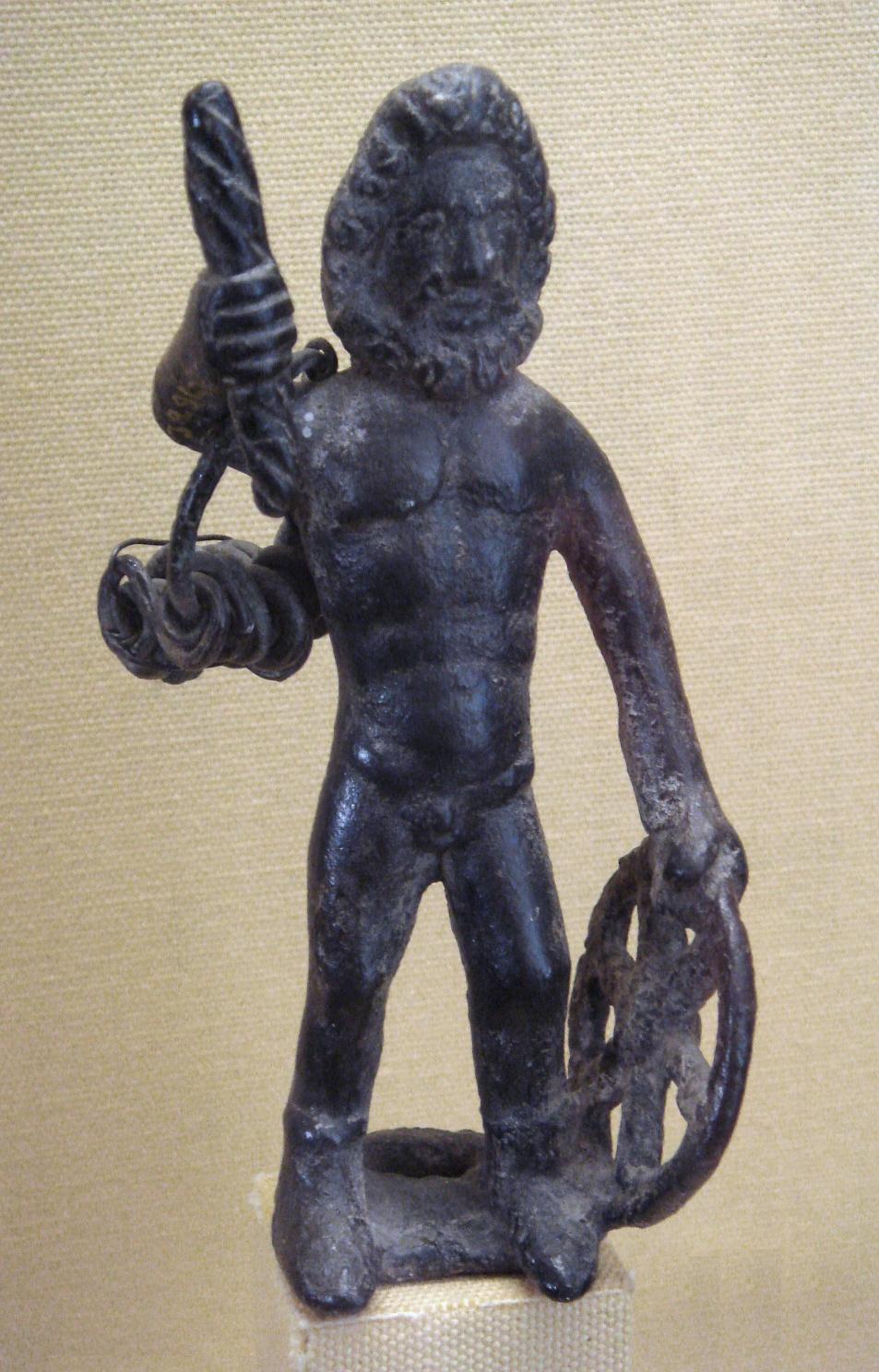
We do know that there were some gods who were 'national' in the sense that Gauls from Spain to the Balkans would worship them. These included Toutatis, Esus, and Taranis, who were transformed into Mercury, Mars, and Jupiter after the Roman conquest. However, they also had regional deities and familial patron gods to choose from as well. At its core, this religion was animism, but it evolved over time to include anthropomorphic gods as well, largely thanks to Roman influence.
Taranis Jupiter, holding a Gallic chariot wheel in one hand
and a lighting bolt in the other - syncretastic!

After Rome conquered, the Gauls submitted and ceased their human sacrifices. Druids, the mysterious oracles of the Gallic religion, fled to Germania and Northern Britannia to continue their strange and unrecorded practices. The conquest of the Gauls and the destruction of their religion marked the end of the old days of Western European nomads and the beginning of a more urban, administrative era. At least, until the Eastern tribes migrated toward the Atlantic, bringing with them a similar form of Pagan animism and mysterious ceremonies.
Pax vobiscum