Showing posts with label Celts. Show all posts

Monday, May 31, 2010

The Genius of Hannibal

I thought I'd take some time out today to simply marvel at one of history's most famous tacticians. Hannibal's genius cannot be understated, in my opinion: he was a man far ahead of his time and culture, and had his family been positioned a little more favorably within Carthaginian politics, it seems likely that history would remember the Second Punic War as the event that ended Roman expansion and brought the rogue Italian superpower to heel, paving the way for Phoenician hegemony throughout the Mediterranean.

The Barca family had a reputation as fierce fighters and noble warriors. However, Carthaginian culture was largely based on trading and the mighty city trained only a small percentage of its residents as professional soldiers, hiring most of the work of battle out to mercenary groups. Hence, though Hannibal's father Hamilcar fought the last eight years of the First Punic War with virtually no support from Carthage itself, his sacrifice and continual victories counted for little in the eyes of Carthaginian politicians, who allowed him an expedition in Spain after the war mostly to get rid of him. Young Hannibal joined his father in this conquest, and spent most of his adolescent years encamped with the soldiers, who took a liking to the young warrior and trained him in every weapon they could. Thus, when Hannibal one day took up his father's reigns and led the army, he commanded strong personal loyalty from them and there is no report of mutiny among his troops to be found in recorded history.

I like to believe that Hannibal's military education was two-fold: he likely learned about the more efficient “guerilla” tactics from his father, and the more practical, battlefield realities from the encamped soldiers. Thus, we have events like the Battle of Trebia, in which Hannibal hid some allied forces to execute an ambush against the already engaged Roman infantry, whom he had also deprived of their morning breakfast and forced to walk through the freezing Trebia river. That battle alone combines many elements from Hannibal's likely upbringing: the ambush tactics his father perfected, plus knowing that an unfed army poses little threat to a well-supplied force.

The biggest innovation in Roman tactics of that time was the maniple system, which allowed different lines of infantry to assault the enemy's front lines while having an avenue to fall back should the battle prove difficult. While they did deploy cavalry on their wings, their only purpose was to engage the enemy cavalry. This helped to win many battles, but was still essentially focused on the enemy's front. Hannibal knew that his forces would eventually be facing larger numbers, and so he focused on mobility, harassment, and flanking.

His wisdom in fighting battles also extended to knowing when he could not win. While Fabius was struggling to contain him in southern Italy, Hannibal tricked one of the containment armies by attaching torches to a herd of oxen and driving them through the forest at night. Thinking it was the enemy army preparing an ambush, the legions followed the torches, determined to out-ambush this troublesome Carthaginian. While they were busy chasing oxen, Hannibal led his forces through the now undefended pass and made for resupply in the north.

The saying goes that amateurs study tactics, while professionals study logistics. Unfortunately for Hannibal, he never fully secured supply lines from Carthage, and had to repeatedly fight for resupply from the Gauls or whichever Italian city decided to join him that week. Though he spent an impressive ten years in Italy campaigning successfully against the Romans, it was only a matter of time until the Romans took the war to Carthage, giving command to the unorthodox general Scipio Africanus, who would use Hannibal's own tactics to gain a victory over Carthage and Hannibal at the Battle of Zama.

Pax vobiscum

Monday, May 24, 2010

The Battle of Alesia

In 52 BCE, the Gauls had united in a last-ditch effort against the invaders. Any one tribe who stood up to the Romans in recent memory had been utterly defeated, but now there was a new hope. The tribes had convened a council and selected one man to lead the rebel army to victory and restore freedom to their war-torn homeland. And that man's name was Vercingetorix.

Using hit-and-run cavalry tactics while taking refuge in well-defended forts gave this rebel leader a few victories over the Roman army, led by the famous and able Gaius Julius Caesar. In one such engagement, Caesar's 12 legions had attempted to storm his position at Gergovia, Vercingetorix drove them back, killing 700 legionnaires in the process and nearly causing a mass route of the entire army. Caesar was clever, though, and chose from then on to hunt down small detachments of the larger Gallic army, whittling their forces down to a more manageable size. Vercingetorix went with his typical play of strategically withdrawing his troops to a fortified position: the town of Alesia, atop a small hill.

I can only imagine the thoughts that must have consumed this last, best hope for Gaulkind watching helplessly from the city walls as the Romans built their own walls to solidify their defense. He had to witness the slow deaths of the women and children of the city, who starved to death after being expelled from the city and were then forbidden to pass through the Roman camp. He dispatched scout cavalry in an attempt to slow the construction, hoping to last until the relieving Gallic army arrived. The situation was desperate, and his men growing close to insubordinate treachery when a Gallic army of 100,000 arrived to relieve the siege. Hope was in the air that at long last, the Romans would be driven back and they would be free once again.

The Romans were now facing a battle on two fronts, but they had the luxury of their two walls, which kept them very well protected from the combined forces of 180,000. Their own 60,000 legionnaires were disciplined and well-armed; their foreign auxiliaries ready to do their part. After a few skirmishes and one night attack, the Gauls took a few sections of the Roman trench. They prepared for an all-out assault on the weakest point of the fortifications – a section where the two walls met with boulders and other natural hindrances to construction, a place Caesar had attempted to conceal.

The relieving force assaulted first, charging straight into the infantry lines and meeting the Romans steel to steel. Caesar ordered his men to hold the line while riding behind their ranks and cheering them on. He then led a counter-attack which drove off Vercingetorix's besieged men, who had sallied out of Alesia to support their Gallic compatriots. His line, weakened by the men that Caesar took to defend their rear, began to fall back and Gaius had to roll the dice. In a move both brilliant and incredibly risky, he took 6,000 cavalry with him and circled around the massive Gallic horde of 60,000, flanking them and cutting deep into their assault line. The Roman infantry, seeing their commanders risking their necks, were inspired by their bravery and pushed forward, pinching the Gallic line and causing the undisciplined tribal army to rout. Roman cavalry took over from there, hunting the fleeing soldiers down without mercy and laying waste to any hope that Vercingetorix maintained of being freed from this terrible siege.

A few days later, the mighty Gallic warlord surrendered, giving up his sword and armor to Caesar, who gladly accepted. With this defeat, Gaius Julius Caesar would forever solidify Roman domination over the Gauls.

Pax vobiscum

Wednesday, May 19, 2010

The Iberians

The Gallic Celts who settled in Spain and mingled among the natives to create the Iberian culture changed very little about their culture in comparison to the Gauls who settled in modern-day France. So, rather than pick through the minutiae of differences between them and their north-eastern neighbors, I will give a short summary of their history and importance before showing several interesting pictures to display some of the more brilliant and unique aspects of the Iberian peoples.

The city of Gadiz was founded in 1104 BCE, according to tradition, and is therefore the oldest continually inhabited city in Western Europe. Its people were Phoenician colonists originally, but over time its population grew to include some local tribes who decided to give up nomadic herding for urban life. This seems to be a trend among the Gauls worldwide, that they eventually decide to build settlements instead of continuing to roam. The Phoenician-Iberian-Celts did very well for themselves, and Gadiz as well as other Spanish settlements became some of Carthage's most prosperous colonies. That's not to say that it was all fuzzy hugs with the Carthaginians; securing their cities from raiding tribes who were competing for resources meant conquering much of Spain, ensuring a healthy supply line for continued prosperity.

The Carthaginians were notorious for farming their wars out to mercenaries. Carthaginian soldiers would form the main line of their army, but they lacked the martial culture of Rome or even their more ancient colonists in Palestine (which you may know as the Philistines). They were much more interested in trade than war, so when war came about, they hired the mercenaries they needed to pursue their military agenda. The Iberian tribes which continued to live outside of Phoenician hegemony were offered a deal during the Second Punic War: fight for us and gain spoils and honest pay. However, try as he might, Hannibal did not have the logistical support necessary to successfully subdue Rome and the Second Punic War ended Carthaginian control over Iberia as part of the terms of peace. The Romans set up shop and used the massive, underpopulated region as their bread basket and plentiful source of metal.

This sword is called a falcata, and its weight is distributed in such a way that swinging it creates the same force and impact as swinging a larger battle axe. It dates to the 4th Century BCE.

The most useful of their weapons was adopted by the Romans around the 300's BCE and utilized more heavily in their army after the Second Punic War. The Iberian version of this sword was around 5 feet long, which the Romans shortened to 2-3 feet for the practical purpose of stabbing someone by going around their shield

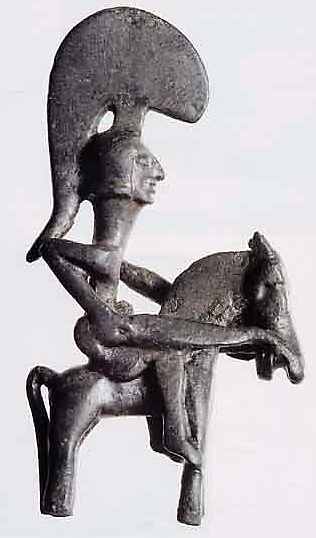
And lastly, this little bronze statue shows an Iberian knight on his horse, gladius in hand and plumed helmet looking very Greek. Clearly the Iberians had an equestrian class capable of purchasing and maintaining horses, indicating some level of class structure.

The Iberian peoples were Romanized at the first available opportunity, and lost most of their connections to the culture of the Gauls, who would not be conquered until Julius Caesar put an end to them once and for all in 50 BCE.

Pax vobiscum

Saturday, May 15, 2010

Julius Caesar Part 1: The Early Years

 The Roman Republic had several huge problems by the time young Gaius Julius Caesar was born in 100 BCE. The Patrician Senate was in the midst of a conservative freak-out, fearing the now armed mob that Caesar's own uncle, Gaius Marius, had created by recruiting soldiers from the poor. Though they had fought hard against any reform that would give the Plebeians equal power, they couldn't stop the shift that was occurring right before their very eyes. And when Caesar was about 12, a wholly unprecedented and fearful thing took place: Lucius Cornelius Sulla, incensed at the Senate for trying to grant his command against Mithridates VI to Gaius Marius, used his army to lay siege to Rome and enter the city by force. Caesar later referred to this event when he was looking across the Rubicon years later, pondering the same course of action.

Caesar's early life was probably fairly easy, coming from a wealthy Patrician family and inheriting a massive estate at the age of 16 when his father died suddenly while tying his shoes. However, the social and political unrest in Rome which so frequently erupted in violence soon engulfed even this promising young man, who married another wealthy Patrician and had been named the High Priest of Jupiter. Sulla returned from Asia Minor only to fight another war at home; a purge of the Marian supporters who still opposed him. Because young Gaius was Marius' nephew, he was stripped of his inheritance and his wife's dowry, as well as his office of priest. If not for the pleading of Caesar's relatives who were loyal to Sulla, he may have even been executed. Though he was born a wealthy Patrician, he was now a man with no titles or inheritance to rely upon. So, he did what many young men without title or prospects continue to do today: he joined the army.

He won the Civic Crown, the second highest honor available to fighting men, during a campaign in Asia Minor, and after Sulla finally stepped down as Dictator and restored Consular rule, Caesar felt it safe to return to Rome, though he was little better off financially than when he had left. He entered the legal profession, having a natural gift for public speaking, and made quite a name for himself as a skillful prosecutor. He took on several high-profile cases involving corruption by retired Governors and other officials, gaining convictions most of the time and gaining the adoration of the masses, who were growing ever-weary of the corruption of their leaders.

While sailing to Rhodes to study under a skilled rhetorician, he was kidnapped by Cilician pirates and held for ransom. He continued to act the part of the superior Roman in captivity and even swore to his jailers that he would have them all crucified for this act. They believed he was joking, but after the ransom was paid, he raised a fleet of warships and hunted them down. While they were being held prisoner in Pergamum, the local Governor thought that it made more financial sense to sell them as slaves, but Caesar caught up with the traders who purchased them and saw to it that every last one of them hung on a cross. He had their throats slit beforehand, which is a kindness compared to the slow death of crucifixion. Nonetheless, the message was sent that Gaius Julius Caesar intended to crush his enemies completely, no matter who they were or what efforts were required.

When he returned to Rome he decided to take up politics and was elected Military Tribune, and over the next ten years he continued to climb the political ladder, gaining higher and higher appointments in the Senate. He made many of them nervous with his constant outward support for the memory of his uncle, the late Gaius Marius. In 63 BCE, he convinced a Tribune to prosecute an optimate Senator for a political murder which took place 37 years before. The case ended in a verdict of guilty, the crime itself being treason, and the Senator desperately appealed. During the opening of the appeal, one of the Praetors adjourned the trial temporarily, and Caesar told the Tribune to let the matter drop. His point had been made: do not mess with me.

Unfortunately, the Optimates continued to harry his every step, bringing in accusations of bribery and involvement in coup attempts. The Optimates and the Populares were kind of like political parties, but much less unified than those of today. Basically, the Optimates favored laws and policies that benefited and empowered the Patrician class and the Populares gained power and popularity by supporting policies of reform that could benefit the Plebeians. Remember that Patrician doesn't necessarily mean rich any more than Plebeian means poor. This was a kind of Republican monarchy, with the Patricians claiming descent to the original Senate as their right to rule. It might seem strange that Julius Caesar, a Patrician of the very aristocratic family Julii, would court Plebeians for power, but he was not wealthy like most Patricians. In fact, when he was appointed the Governor of Hispania Ulterior, the southern part of modern Spain, he was up to his eyeballs in debt and wasn't allowed to leave until he had satisfied it. Along came Marcus Lucinius Crassus, a copiously wealthy Senator who wanted Caesar's support against Pompey, the young upstart army commander who refused to play by traditional rules. Caesar agreed, and Crassus paid some of his debts and guaranteed the others, allowing Caesar to enter his new commission.

He secured his province well, defeating many local Celtic tribes in battle, and even earning the right to a Triumph parade back in Rome. However, he had his eye set on Consulship as well, and could only muster enough political clout to enact one of the two. Keeping his eye on the prize, he chose Consulship, and earned it through an election that was dirty on all sides.

We'll talk more about old Gaius Julius next week, but for now let's critically analyze this guy. I have to look upon Caesar with some admiration purely for his ability to rise to the top, regardless of negative personal situations. After all, he was stripped of land and titles by Sulla, and had to re-make himself if he hoped to even survive, much less gain any power. If not for his public speaking skills, we probably wouldn't even know his name. But he took what skills he had and put them to good use, using his status as a Patrician to borrow money and pull strings when he needed to.

That being said, I don't think he is quite the 'pull-yourself-up-by-your-bootstraps' example that some historians have made him out to be. In truth, if he were a Plebeian Tribune and all of this happened to him, he would surely have been killed, not having the family connections to keep him alive. He may have been able to borrow money, but he certainly would have fallen into indentured servitude without a wealthy guarantor. He would probably have been killed or sold as a slave by the pirates who kidnapped him, since he wouldn't be worth a ransom.

Though he was an impressive individual who made the best of his situation, we should not ignore the impact of his title as a Patrician, nor the involvement and help of his family. The fact was, though you didn't need to be a Patrician to be wealthy, you did need to be one in order to be powerful, and all the reforms that the Plebeians had been fighting for politically were still coming to naught because the aristocrats in Rome did not want to really share power. Their stubbornness was their ultimate undoing, as was their use of violence to make political gains. Caesar can hardly be blamed for some of the more thuggish tactics he took later on, since he was not the first Senator to resort to violence when Democracy failed him.

Ultimately, I see Caesar as both an impressive individual and a product of his time. Next Friday, we will look closer at some of his later career and you can decide if he is truly the hero who saved Rome from corruption or the villain who killed the Republic when it no longer suited his political ends.

Pax vobiscum

Thursday, May 13, 2010

A Kinder, Gentler Paganism

One of my favorite video games, as many of you have probably guessed, is the Rome: Total War series. In the expansion Barbarian Invasion, the game begins with the announcement that Paganism is the most popular religion in the known world. This always gives me a good chuckle because it is similar to saying that Soccer is the most popular sport in the world. While it is technically true, it doesn't mean that fans of rival teams are united in their love for soccer and agree on everything. The term Paganism is a bit misleading because there were so many different deities and forms of worship that to group the Roman practice of sacrificing bulls to Jupiter or Mars with the Germanic practice of sacrificing people by drowning them in a bog seems a little bit uneven. Thus, even the label Pagan itself becomes somewhat fluid, under the proper microscope.

The Gauls were a constant thorn in Rome's side, always pillaging and competing with the northern Italians for food, water, trade, and money. The Romans never really forgave them for sacking their fair city around 390 BCE after the crushing defeat of their Phalanx at the Battle of the Allia, and many young politicians would cut their teeth by campaigning against the savage barbarians to the north. When they finally conquered most of the Gaul territory, as seen in the image below, they syncretized their religion to match up with the Greco-Roman Pantheon.
Yellow=starting point
Light Green=furthest expansion
Dark Green=areas where languages
descended from Gallic are still spoken

Because we have few written records of the Gallic religion before the Roman conquest in the 50's BCE, it is difficult to assess their exact rituals and procedures. We know they engaged in human sacrifice, and Julius Caesar himself would have us believe that a funeral for a Gallic noble involved his family and slaves being burned with their deceased patriarch inside a large wooden man. However, the Romans are fond of exaggeration, and since they were hostile to the Gauls, we can't completely trust their historians to shoot straight.

We do know that there were some gods who were 'national' in the sense that Gauls from Spain to the Balkans would worship them. These included Toutatis, Esus, and Taranis, who were transformed into Mercury, Mars, and Jupiter after the Roman conquest. However, they also had regional deities and familial patron gods to choose from as well. At its core, this religion was animism, but it evolved over time to include anthropomorphic gods as well, largely thanks to Roman influence.
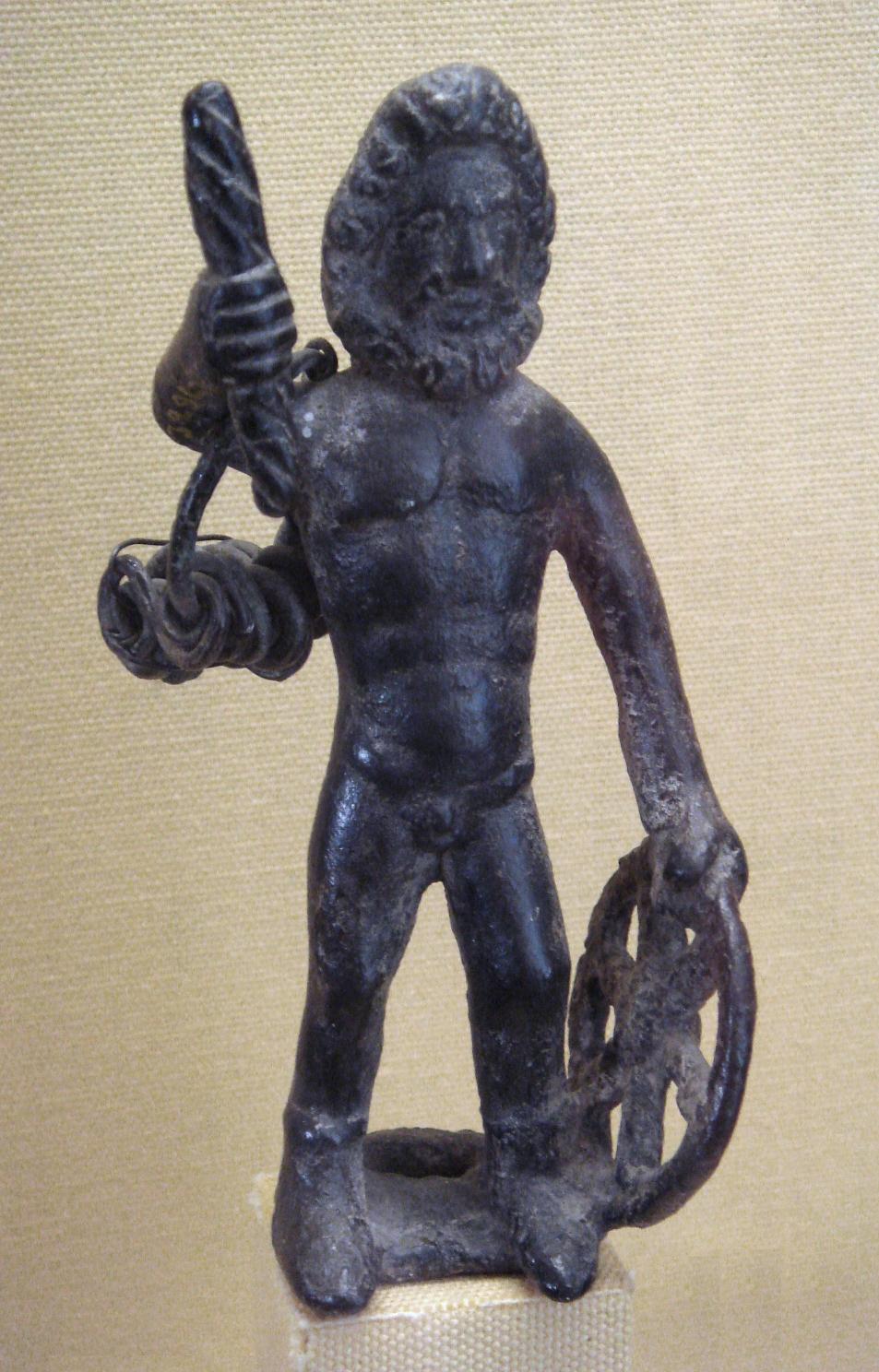
Taranis Jupiter, holding a Gallic chariot wheel in one hand
and a lighting bolt in the other - syncretastic!

After Rome conquered, the Gauls submitted and ceased their human sacrifices. Druids, the mysterious oracles of the Gallic religion, fled to Germania and Northern Britannia to continue their strange and unrecorded practices. The conquest of the Gauls and the destruction of their religion marked the end of the old days of Western European nomads and the beginning of a more urban, administrative era. At least, until the Eastern tribes migrated toward the Atlantic, bringing with them a similar form of Pagan animism and mysterious ceremonies.
Pax vobiscum