Showing posts with label Culture. Show all posts

Wednesday, January 9, 2013

Soldiers and Ghosts: A Review

When you have a hobby, you tend to get cocky about it.  You think about how smart or skilled you are to be pursuing something because you enjoy it and not because you're in school or because it's your job.  If you're not careful, you eventually begin to think that you can't possibly learn anything new about your subject.

I purchased Soldiers and Ghosts with an Amazon Gift Card last year, and I finally got around to reading it, thinking that it would be fun to read a fresh account of Cannae or read Hannibal's life story.  Again.  What I wasn't expecting was a psycho-cultural analysis of the motives behind the tactics of ancient warfare, starting with the early Greeks.  And I certainly wasn't expecting the first battle I read about to have taken place during the Vietnam War.

Spoiler Alert: the Ancient Romans weren't even involved in the Vietnam War for some reason.
It is a common assumption that warfare has always been about practicality and pragmatism.  The Greeks used the phalanx with great success, and we assume that they chose it primarily for its effectiveness.  However, we often forget that the Ancient people lived in a very different world than ours; a world of augury and divination, of mysticism and heavenly conflicts, of invisible forces that haunted their every step.  They did not look at the Olympic Pantheon as a rustic mythological belief system; it was what they believed.  It stands to reason that their motivations went way beyond simple pragmatic strategy.

My first clue to the Romans' lack of pragmatism is that they all seem to be wearing their baseball caps backward.
But J. E. Lendon puts it best when he explains it this way: "These [people of Papua New Guinea] are peoples who fight wars in ways we call ritualized, meaning they allow their beliefs to dictate a mode of fighting less ruthlessly efficient than we could devise for them.  There are other ways, too, in which beliefs draw modern armies away from purely efficient methods of killing: the reluctance, since World War I, of many armies to employ poison gas and the practice of preserving the lives of prisoners.  Such restraints are powerfully reinforced by the scorpion sting of the Golden Rule: soldiers do not want to be gassed themselves, and they want their own surrenders to be accepted.  But such restraints are grounded also in shared belief: the belief that war has rules, however fragile, and that there are appropriate ways of killing and methods of killing too horrible to be used." (pp.3-4, emphasis mine)

Other highlights and insights include:

  • "Sometimes the glory of the victor depends not only upon his observed performance, but also on the excellence of the defeated; this is a second, quite separate, mechanism for gaining glory in battle." (p. 26)
  • "But the ethos that lay underneath this cooperation [of the phalanx] was only superficially cooperative, for those who fought in the seemingly unheroic phalanx conceived of what they were doing in Homeric terms . . . if grave reliefs were our only evidence we would never imagine that the Greeks fought massed in the phalanx rather than as heroic individuals." (pp.44-45)
  • "Amidst the showers of spears and arrows and stones, amidst the running to and fro and confusion and stabbing by surprise, men of high standing would go down, killed anonymously by stray missiles and the spears of low wretches, trampled by horses, or crushed ingloriously by stray chariots.  In the confusion the high deeds of the brave would go unnoticed, along with the cringing of the cowardly." (p. 46)
  • "Yet it is not in spear fighting in which the hoplite competes but holding his place in the line, and the courage of holding one's place is perhaps the form of martial behavior whose success in the real world is most in the hands of the warrior and subject to the least external influence." (p. 53)
  • "The irony of Thermopylae is that, although the Spartans went to their deaths according to the hoplite code, they did not in their last hours fight entirely as hoplites, bravely holding their ground." (p. 66)
  • "Xenophon urges the hiring of foreign mercenary cavalry chiefly to inspire a sense of rivalry in the Athenian cavalry." (p. 103)
  • "Macedonian leaders had to fight with their own hands because that is how they commanded the obedience of their soldiers." (P. 137)
  • "Soldiers fight well not because they are compelled from above but because they do not want to let down their comrades." (p. 171)
  • "For disciplina [Roman Discipline] was not primarily a system of imposed or felt rules to make an unwarlike people place themselves in danger or to do something unnatural to them . . . it is conceived primarily as a brake to overly aggressive behavior." (p. 177)
  • "The Roman soldier did not primarily think of himself as part of a team, and he was not treated as such by his officers.  Rather, he regarded his comrades as his competitors in aggressive bravery." (p. 185)
  • "The manipular legion was the fruit of compromise resulting from the meeting of an imported method of fighting, the phalanx, with a people whose martial values, whether inherited or new-acquired, made fighting in the phalanx a heroic challenge for them." (p. 190)
  • "After a loss a Roman general might be prosecuted for personal cowardice, but not for tactical stupidity." (p. 207)
So, yeah.  I highly recommend reading this book if you're ready to go beyond the surface-level of Ancient-world tactics and strategies to learn about the cultural forces that drove them.  I'm pretty busy with other plans at the moment, but I'll probably have a few blog posts related to the claims in this book coming up in the near future, so look forward to that.

Thursday, June 10, 2010

Culture Wednesday: The Early Republicans

For those of you rooting around teh Interweb for American political posts, welcome! This blog is about the ancient world, but hey, stick around and you might learn something new.

During the early Republic, Rome had certain ideals which its citizens, for the most part, tried to uphold. This young, upstart city-state was based, like most ancient economies, on agriculture first and foremost. The ideal Roman, therefore, was a farmer, regardless of social status, personal wealth, or fame. Land ownership was key to obtaining respect, political office, and financial independence, and the ironically egalitarian rhetoric of the Patricians often praised the Roman farmer-soldiers for their simplicity of lifestyle, expertise with weaponry, and willingness to fight for the city and put her needs above their own.

Not unlike Sparta before it, or even America much later, the early Roman military system was militia-style conscripting with annual training during the slow winter season. If you owned enough property to qualify for the fifth census class, you were not only eligible for service, you were required to report for duty. Those in the lower classes were expected to obtain work as farm-hands, house servants, or really any menial work.

Scipio Africanus, who I so recently covered, served as a great bad example by the conservative Senators of his day for his tendency to wear his hair long, spend huge amounts of money on lavish parties, and generally live a life of excess matched today only by rock stars, royalty and professional athletes. Despite his unique lifestyle, he still restored Rome's honor by defeating Carthage, though the Senate was largely displeased at his decision to parlay with the residents rather than simply burning their city to ash and putting its citizens to the sword.

The Senate's desire to see Carthage destroyed seems an unspeakable war crime to us today, and became a famous warning when it did happen after the Third Punic War. Their other imperial-style cruelties would certainly horrify us today, as well as their military discipline, which included killing soldiers who drew a short straw. However, what set the Romans apart from the Greeks and other peoples was their practicality. This may have come about because of their farming ethic, but regardless of its source, it was their most powerful weapon.

While other 'great' civilizations were concerned with the true meaning of love or which day is proper for worshiping Athena, the Romans concerned themselves with supply lines, siege engineering, battle tactics, and in general, how to ensure victory. They learned well the lesson of the Second Samnite War: either destroy your enemy or forgive them, but never humiliate if you intend to let them live. Their world and culture, heinous though some of its elements may seem to our modern sensibilities, was born out of necessity and practical reality.

The Republic had its triumphs along with its faults, and lauded the heroes of old who were granted temporary Dictatorship and did what was necessary to resolve whatever crisis led to their election only to relinquish power when their term was up. Cincinnatus was a one such hero, who went right back to farming after he had served Rome and defeated its enemies.

What happened to the noble Roman, the farmer-soldier who was as skillful with a sword as he was with a plowshare? He was out-sourced. In short, the Patricians and wealthy Plebs utilized slavery so extensively that it became impossible for the working class to find work. The excesses promoted by Scipio Africanus became commonplace, and politics became overly corrupt. The Senate, having grown powerful since the Punic Wars, desperately tried to restore the old ethics of a hard day's work and a simple lifestyle, but even they had grown used to living in great estates with their every need attended to by slaves from every corner of their colonies. Their conservatism was short-sighted at best; treating symptoms instead of stepping back to understand the problem. They sacrificed their hard-nosed practicality for selfish, soft living, and many of them paid the price in their own blood.

The biggest danger to representative government, historically, is itself. The poor Plebs became frustrated at their lack of power and representation and turned to liberators like Lucius Cornelius Sulla, Gaius Marius, and Julius Caesar. The cult of personality toppled the old rhetoric of freedom and shared power, replacing it with hero worship, mob rule, and might-makes-right style politics. The old Romans eventually faded into the annals of history along with Romulus and the kings of old, their lifestyles gradually viewed as quaint instead of inspiring.

Pax vobiscum

Wednesday, June 2, 2010

Phoenician Artifacts

We owe more to Phoenician culture than we'll probably ever know. They colonized the Mediterranean, developed the first widely-used phonetic alphabet, and developed one of the earliest urban civilizations west of the Fertile Crescent. It is thanks to them that the Romans began developing their massive Empire – most of which they took from the Carthaginians in war. Let's take a quick look at some of their more interesting artifacts.

This ceremonial mask of Ba'al Hammon was likely used in various rites and rituals designed to curry the favor of the Carthaginian chief deity. It is made from Terra Cotta. Date unknown

This coin dates somewhere between 310-290 BCE, and features the moon goddess Tanit, the highest of the goddesses worshiped in Carthage. She was the patron of life, fertility, and war, and is closely linked to Artemis of the Greeks, Diana of the Romans. Her symbol is very similar to the Egyptian Ankh.

This statue is meant to represent a man praying. It comes to us courtesy of the Phoenician colonists in the Balaeric Islands (near Spain) and is made of Terra Cotta and gold.

This is either a pendant or a brooch, and was discovered on the site of Carthage itself. It dates to the 3rd or 4th century BCE, and looks pretty cool. Whether it is meant to represent an average Carthaginian or is some kind of divine image remains unknown.

Pax vobiscum

Wednesday, May 26, 2010

The Other Italians

Before the rise of Rome and its Empire, Italy was filled with a multitude of people groups, mostly tribal and nomadic, but united in themselves by common language and culture. One such people was the Samnites, whose culture was a combination of urban and tribal elements. They maintained their political independence until the Third Samnite War circa 290 BCE, when their land was taken by the Romans for good.

The Samnites worshiped the typical Greco-Roman Pantheon, especially Mars, Athena, and Hercules, and had the same tendency toward divination by birds and animal entrails. Their cities were surrounded by well-tended farms, while their shepherds would lead their flocks along a pre-determined grazing trail throughout the year.

Warfare was of utmost importance to these Latin tribesmen, and they had a reputation as ferocious fighters. Many believe that the Manipular system adopted by the Roman legions originally belonged to the Samnites, and they certainly understood the importance of army flexibility on the rough terrain of their homeland. They knew their lands well, and often used them to their advantage over the Romans and other peoples with whom they came into conflict.

Bravery served a dual purpose for these rugged shepherds as it directly affected their choice in marriage. Men who had performed great acts of bravery on the battlefield got first choice among the eligible women for a bride. Emotion in the ceremony itself was strictly forbidden, and men were expected to simply choose the woman they wanted with the approval of the tribal elders and priest.

Samnites fought with many weapons similar to Roman arms, including the javelin, spear, and rectangular shield (though theirs were tapered toward the bottom). However, they also excelled at using slings as well as the bow-and-arrow, crafts they no doubt perfected while protecting their herds from wild beasts or neighboring tribes. In one encounter with the Roman army, the Samnites had trapped several legions in a narrow pass called the Caudine Forks and positioned their archers high upon a nearby mountain to keep their enemy hemmed in.

The story goes that Gaius Pontius, the Samnite commander, was at an impasse when that Roman army surrendered to him. He dispatched a letter to his father, Herennius Pontius, a statesman and politician, to pick the old man's brain. Herennius responded in a letter that the Roman army should be freed, for which Rome would be grateful and possibly become an ally. Not liking this idea, Gaius sent another letter to his father, and this time the reply came back that the entire army should be executed, and Rome would then cease to be a threat for at least a generation. Gaius Pontius foolishly decided to try and have his cake and eat it, too, disarming the Romans and forcing them to pass under the “yoke”- a sort of doorway made of their own spears. The army returned unarmed and ashamed, but eager to have revenge and win back their lost honor. After honoring a five-year peace that they agreed to in their terms of surrender, they struck back hard at the Samnites and won the war, executing Gaius Pontius in the process.

Though they showed great promise as an up-and-coming civilization, the Samnites fell prey to their divided, tribal nature, and the Romans were able to play one family against another, successfully subduing their southern neighbors and incorporating them into Roman society as slaves, soldiers, and farmers.

Pax vobiscum

Wednesday, May 19, 2010

The Iberians

The Gallic Celts who settled in Spain and mingled among the natives to create the Iberian culture changed very little about their culture in comparison to the Gauls who settled in modern-day France. So, rather than pick through the minutiae of differences between them and their north-eastern neighbors, I will give a short summary of their history and importance before showing several interesting pictures to display some of the more brilliant and unique aspects of the Iberian peoples.

The city of Gadiz was founded in 1104 BCE, according to tradition, and is therefore the oldest continually inhabited city in Western Europe. Its people were Phoenician colonists originally, but over time its population grew to include some local tribes who decided to give up nomadic herding for urban life. This seems to be a trend among the Gauls worldwide, that they eventually decide to build settlements instead of continuing to roam. The Phoenician-Iberian-Celts did very well for themselves, and Gadiz as well as other Spanish settlements became some of Carthage's most prosperous colonies. That's not to say that it was all fuzzy hugs with the Carthaginians; securing their cities from raiding tribes who were competing for resources meant conquering much of Spain, ensuring a healthy supply line for continued prosperity.

The Carthaginians were notorious for farming their wars out to mercenaries. Carthaginian soldiers would form the main line of their army, but they lacked the martial culture of Rome or even their more ancient colonists in Palestine (which you may know as the Philistines). They were much more interested in trade than war, so when war came about, they hired the mercenaries they needed to pursue their military agenda. The Iberian tribes which continued to live outside of Phoenician hegemony were offered a deal during the Second Punic War: fight for us and gain spoils and honest pay. However, try as he might, Hannibal did not have the logistical support necessary to successfully subdue Rome and the Second Punic War ended Carthaginian control over Iberia as part of the terms of peace. The Romans set up shop and used the massive, underpopulated region as their bread basket and plentiful source of metal.

This sword is called a falcata, and its weight is distributed in such a way that swinging it creates the same force and impact as swinging a larger battle axe. It dates to the 4th Century BCE.

The most useful of their weapons was adopted by the Romans around the 300's BCE and utilized more heavily in their army after the Second Punic War. The Iberian version of this sword was around 5 feet long, which the Romans shortened to 2-3 feet for the practical purpose of stabbing someone by going around their shield

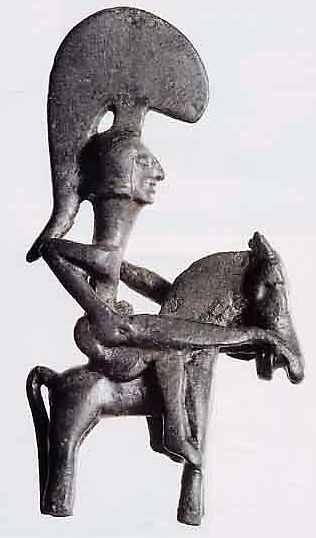
And lastly, this little bronze statue shows an Iberian knight on his horse, gladius in hand and plumed helmet looking very Greek. Clearly the Iberians had an equestrian class capable of purchasing and maintaining horses, indicating some level of class structure.

The Iberian peoples were Romanized at the first available opportunity, and lost most of their connections to the culture of the Gauls, who would not be conquered until Julius Caesar put an end to them once and for all in 50 BCE.

Pax vobiscum

Wednesday, May 12, 2010

Women in Rome

One of the more famous Roman myths is the story of the Sabine women. Romulus, Rome's founder, gathered outcasts from neighboring cities to Rome to populate it. Unfortunately, they were mostly men and had been exiled from the other cities for fraud, theft, and other bad behavior. If Rome was to have a future, they would need to find women and reproduce. The nearby tribe of the Sabines had plenty of women, but they were unwilling to allow their daughters to marry the scoundrels that lived in Rome. So Romulus hatched a nefarious plot.

He invited the Sabines to a massive feast just outside the city gates. Since it was an all-you-can-eat affair, they brought their children, daughters, wives, and sisters along for the party, and it carried on for some time. When the Sabine men had become drunk, the Romans seized every unwed woman they could find and carried them into the city, locking the massive gates behind them. There was war with the Sabines, and the story goes that it was the abducted women who prevented all out slaughter on both sides, agreeing to live in Rome. Since they had been raped, they were considered ruined for other men, and they knew that their best bet at survival lay in submission to their newfound Roman companions.

This story seems so repugnant to modern sensibilities that it's hard for us to imagine how any culture would place it in their oral history and public record. However, it certainly helps to shed light on the position of women in the Roman world. For the most part, women weren't permitted to hold office, own property, or choose a husband. Their family structure was such that the father or Paterfamilias held legal power over life and death for all his children. At least for the young boys there was an age of independence, but a girl might live in her father's house all the days of her life.

It was assumed that marriage would eventually lead two people into a deep romantic friendship, but first and foremost, marriage was duty. They needed to continue their family line, and they were very often betrothed from birth. As a result, marriage became a burdensome chore and many soldiers and aristocrats started putting off, visiting prostitutes and keeping female slaves and concubines instead. Augustus Caesar, desiring to preserve Roman culture despite helping to destroy its Democracy, passed a series of laws and regulations governing betrothal, marriage, and success.

He promoted soldiers who fathered many children, fearing that Rome was becoming dangerously underpopulated. He gave the best seats in the Coliseum to married men, and granted some say in property disputes to married women who bore three or more children. He penalized wealthy bachelors and single women by heavily taxing their inheritance, and made it illegal for husbands to murder adulterous wives, preferring that they divorce them instead.

Despite all these reforms, women were a far cry from men in terms of power in almost every measurable criteria. Though they could sue for divorce themselves, the courts often ruled with the father, giving him custody of their children. And if their husband was involved in a war, there was always the chance that he would return with a German or Phoenician slave girl whom he would take as a concubine. However, since the earliest Roman wives were brought to Rome in a similar fashion, it was hard to argue that things should be any different. After all, only barbarians allowed their women to have the same rights and privileges as men.


Wednesday, May 5, 2010

It's All Greek To Me!


How do you know what you know? Seriously, think of something you are sure is true right now. How did you come to know that truth? Do you believe that humans are basically good or evil? Do we have souls, or are we purely material, and what is the meaning of life? Is there a God, and is she in a good mood? With the economy the way it is, it's unlikely that most of us have had a lot of time to ponder the deeper meanings in life. Socrates would be greatly disappointed in us for this. And so would Archimedes.
The Socratic Method is the practical application of Socrates' belief in self-examination. It began circa 430 BCE, so the story goes, with a bunch of young Athenians who were trying to find the answers to life's biggest questions. They sought out Socrates, a bricklayer and veteran, who had a most curious way of discussing matters of truth. Rather than making quotable statements or using flowery words to push his point across, he asked questions. For example, if one of them stated that “Love always gives and never seeks to receive,” Socrates might answer, “If love never receives, what will it have left to give?” His entire point in life was to make people say, “Hmmmmm . . . .”
While he was mostly concerned with ethical and spiritual matters, he did use his questioning method as a way of trying to understand the world around him. Archimedes was born hundreds of years after Socrates' death, but it seems obvious from his discoveries that he used the same principles of critical thinking. One of the most famous stories (though it's believed to be Apocryphal) is that of the riddle that King Heiro II posed. A local goldsmith had forged a golden crown, and the King was suspicious that it was a fake. He asked Archimedes to find a way to prove it, so the mathematician went to work. He thought deeply about the subject, but couldn't come to a good conclusion, so he took a bath to relax before going at the problem again. While in the bath, he observed the water rising and falling, and realized that he could use the principle of buoyancy (which he basically created) to determine whether the crown was real or a cheap knock-off.
Greek thinking started with how to think, and it was only when the ancients strayed from the art of questioning that they plunged the known world into an intellectual dark age, with only a few bright lights like Archimedes to lead the way. Aristotle, a student of Plato (who was a student of Socrates) went about using inquisition to determine the natural world. After Alexander the Great, his student, took that knowledge with him to every place he conquered, it became concrete fact for the next thousand years. History loves irony, and so it stands that the scholastic line of Socrates ends with someone claiming absolute truth over the natural world.

Pax vobixcum

Thursday, April 29, 2010

Theology Thursday: The Cult of Artemis

Looking at the statue of the Ephesian Artemis reminds me of when I lived in Japan, as the slender statue looks more like a Shinto deity than a Greek goddess. In fact, if you were to compare the idols of the Greek gods with the statue of Artemis which came from Ephesus, you'd probably think you were looking at completely different religious icons. And, in a way, you'd be right.


Artemis is unique among the Greek deities because she never married or had 'relations' with the other gods. She preferred the hunt to a dinner party, and the human lovers who were lucky enough to win her affection always met with tragic death, sometimes at her hand. She was the goddess of the moon, but the forest and childbirth were also within her realm of protection. Hunters would often lay the skins and horns of their prey upon a tree branch before leaving the woods as an offering so that Artemis wouldn't hunt them down for killing the animals before she had the chance. Women would cry out to her during childbirth in hope of relief from their pain either by the child emerging or receiving a quick death. The Greeks of Peloponnessus, that's the European side of ancient Greece, far preferred Zeus or Ares as their important deities, but for the Ephesians, none other than Artemis would do.

The Artemis image from Ephesus sticks out like a sore thumb in the Pantheon of Greek gods, and that is because that image predates Greek settlement in Asia Minor. It seems that before the Greek colonists came, the Ionian natives had built a matriarchal culture around a fertility goddess whose name has been erased by the fog of time. When the Greeks came and conquered the place, they adopted the image and claimed that it was Artemis, since the Greeks were fond of syncretism (that means incorporating local deities into your religion – word of the day!).

The Greek culture was extremely patriarchal, especially in Athens. Though it is true that Spartan women could own land and personal property (something Athenian women had no right to), this was done mostly out of necessity since the Spartans practiced open marriage. Thus it became necessary for the Greek priests to first break down the matriarchal local religion before they could alter the culture as well. Since the ancient worldview was typically that reality reflected the divine realm, those Ionians who were conquered must have figured that their religion was backwards, and so gave in to the priests and renamed their statue.

Her unique appearance, combined with the need for ancient people to have a lot of children to hedge their bet, made her a popular deity, and her temple in Ephesus was three times larger than the Parthenon temple that the Athenians built for their patron god Athena. In fact, the Ephesian Temple of Artemis was one of the seven wonders of the Ancient world, making Ephesus a huge tourist attraction for people from every corner of the Mediterranean and Black Sea. Ephesus being a coastal town, its economy was dependent on trade and tourism, so much so that there was once a riot against Christian missionaries organized by idol craftsmen who feared the sag in their income that a more popular god would bring! You can read more about this uprising in Acts chapter 19, which is a very informative account of the fame of the Ephesian Artemis.


The cult surrounding Artemis, ironically, centered around her virginity. Priests who served this moon goddess would willingly castrate themselves while men who went off to war would swear vows of chastity before the idols and likely keep a pocket-sized version with them as a reminder. While encamped in rugged hills on campaign, I imagine many a veteran Hoplite telling a tale around a cookfire all about a foolish young soldier who broke his vow to Artemis and brought his entire army to ruin. There were many such tales, since the Greeks were so fond of Fables.

Though Artemis was widely beloved, she eventually fell to the cross, as did all her Olympian brethren. Over time, the Roman Empire became more and more Christian through either proselytizing or by political manipulation, and the old gods were cast aside like yesterday's newspaper. Artemis would hunt no more.

Pax vobiscum


Monday, April 26, 2010

Military Monday: The Early Maniples


The Phalanx had served Rome well. The Etruscans used it to dominate the early Romans in the 700's BCE, and the Romans were nothing if not very efficient copy-cats. So they worked toward overcoming Etruscan hegemony and in 509 BCE (or sometime thereabout), they succeeded in overthrowing their king and reforming their constitution to include separation of powers, election of Senators, and citizens' assemblies. Their Hoplite armies proceeded to subdue the cities in northern Italy, and established Roman hegemony in their region. However, the Phalanx proved problematic in several embarrassing battles.
The Roman Phalanx was arrayed with the wealthiest citizens in the front, center rank, which made sense because they had the best quality armor and weapons. A strong core meant a strong army, or so the wisdom of the time dictated. However, an army with weak flanks is just asking for trouble, which the Romans learned at a great cost at The Battle of the Allia around 390 BCE, where the Senone Gauls crushed their flanks and surrounded their core, killing them to the man. Later, in the Second Samnite War (326-304 BCE), the Romans learned from their enemies the value of small, flexible groups in a battle. And by learned from, I mean that they got beaten like little girls several times by these 'barbarians,' before numbers and brute force established their dominance over the hill country of central Italy.
So, whether through sweeping reforms as the later historians claimed, or through the more likely course of gradual tactical evolution, the Romans decided to do away with the single-line Phalanx and make way for a more effective army. This army would consist of three different types of heavy foot soldiers who were arrayed in three lines on the field in a checkerboard formation. Of particular concern, especially to the Roman upper-class, was the economic order of soldiers. Putting the most well-armed and protected soldiers in the front line made sense if you wanted the initial shock to truly penetrate the enemy line, but it meant that those soldiers may be unable to help if the battle was long and contentious. So the change in battle-lines began with placing the poorest of the soldiers (who were still members of that upper rung, just 'lower-upper' classmen) at the front of the army. These front-line soldiers were called Hastati, named for the spears they carried, the Hasta. Early on, all of the soldiers carried these spears, but the Hastati were likely named for it because they were at least wealthy enough to afford their own spear.
All of this would vary because all the equipment was self-provided, but a typical Hastati would be outfitted in leather armor and a bronze helmet, but no leg armor. Along with their Hasta, they would carry a scutum, one of those famous convex rectangular shields. After the Hastati was the Principe, who carried the same weapons, but had leg armor and chain-mail covering their torso, which was highly prized in the ancient world for giving protection without hindering mobility. The third line was composed of Triarii, who had the heaviest armor and highest quality weapons, and fought in a tight phalanx. The flanking units, who were above the Triarii, were the Equites, early cavalrymen rich enough to afford the best armor and weapons, and a horse. Incidentally, this is the reason that horse-related activities are referred to as “equestrian.”
Attached to each of the line soldiers was a compliment of Leves, or javelin-throwers who used light javelins to harass the enemy line before a charge. This proved especially effective against a Phalanx because it is hard to maintain a strong frontal formation while dodging javelins. Gaps could be exploited, and the enemy line could be divided and crushed. Discipline was essential for this kind of fighting, and lieutenants had to pay close attention to the banners and whistles coming from the main army to make sure their unit wasn't surrounded if there was a call to retreat. Training the individual soldiers took a few months out of the year, and it was considered the duty of the wealthy in Rome to protect the city and advance the Roman agenda throughout the world.
A typical Roman battle using the Camillian Maniples would go like this: Hastati charge, while Leves soften the line. If the Hastati couldn't break the enemy battle line, they would retreat in an organized fashion behind the Triarii in the back while the Principes charged forward, making their own attempt to crush the enemy. However, if they could not succeed, then they, too would retreat and the Triarii would charge.

Usually the Triarii could luxuriate behind the battle line and watch the show, but if a battle was going poorly enough for them to get involved, it was not a good sign. A Latin idiom meaning 'to be in a desperate situation' is ' rem ad Triarios redisse,' which literally means, 'it has come to the Triarii.' For example, "How close are you to getting out of debt?” “It has come to the Triarii.” Try it next time someone asks you about a hopeless situation, and the look on their face should lift your spirits nicely!
As well as this primitive strategy worked, it couldn't last forever. And as you may have guessed, it was  humiliating defeat that forced the Romans once again to renew their tactical and strategic methods and ensure their dominance of the Mediterranean. Hannibal, in particular, played a part in bringing the spearmen-based Maniples to an end, especially after a huge Roman army was crushed at the Battle of Cannae.
However, despite the resounding defeats they suffered, what kept Roman culture and influence alive for more than a thousand years was their ability to adapt. It's true that their pride was gravely wounded by massive defeats (especially from the 'barbarians'), but eventually they got over themselves, went back to the drawing board, and found something that worked. And the coming reform of the Legions meant that the class preference in the Roman army would be destroyed for a merit-based seniority system.
Pax vobiscum


Wednesday, April 21, 2010

Culture Wednesday: More Than a Theorem

Anyone who's learned even the most rudimentary geometry has heard his name. Yes, in his own way, Pythagoras achieved the Greek ideal of fame that causes him to live forever, even if he is relegated to the pages of High School textbooks. But there is more to this mathematician than a simple ratio. Among other things, he believed himself to be the reincarnation of a Trojan hero, and refused to eat beans. His mathematekoi brotherhood was thought to be the most well-learned in the ancient world, but they did not hesitate to murder one man who would expose their most embarrassing secret: irrational numbers.

Though he seems harmless in his textbook depictions, Pythagoras was considered by many in the ancient world to be a dangerous cult leader, and a malcontent. He lived during that necessary twilight between oral tradition and written history, and thus his life and work is shrouded in an unfortunate cloud of mystery and myth. It is said that he traveled all throughout the world to gain knowledge of mathematics, science, medicine, astronomy, astrology, and mysticism from whomever would teach him. I think it likely that he traveled to Egypt, home of the famous ancient mathematician Thales, who accurately calculated the height of a pyramid by measuring its shadow. The Greek philosophy of math and science was that it was attainable, that they could actually observe and learn from what they saw to predict or manipulate future behavior. However, it was also steeped in Pagan mysticism, something which taints their learning somewhat and caused many, especially Pythagoras, to go off the rails.

Eccentric though he was, even by ancient weirdo standards, he built a school around this central tenet: All is number. He believed that numbers could be used not only to define all things, but could even give them greater meaning. His disciples took this motto to heart, and immediately began measuring angles and lengths to find the hidden constant ratios between them. In fact, most of the really boring parts of Geometry today (constructions, proofs) were what the Pythagoreans discovered when they were just playing around. They would challenge each other with number riddles like, “can you form a right triangle if given two points?”

One story claims that Pythagoras discovered the mathematical value of music. He was passing by a smithy one day, and the ringing of the anvils was sticking in his head. He noticed the relationship between their individual pitches, and examined three of them to discover that the middle one was one-third bigger than the smallest, and that the largest was one third bigger than the middle. Through experiments that the school performed on strings, bells, and other instruments, they created the octave as a means of dividing the musical notes, something we still do in Western music today.

As clever as these stories make him out to be, my belief is that Pythagoras was just the charismatic leader of some very bright young Greeks. I believe his school as a group made much of the discoveries that he is given credit for, just like professors will occasionally take credit for their students' findings today. In either case, he should at least be honored for cultivating an environment in which learning and discovery could take place.

However, this was long before the days of public education, and knowledge of every sort was a tightly guarded secret, particularly mathematics. As we will see in coming weeks, mathematics can kill people, and it often does so in great quantities with a minimal effort. For the Pythagoreans, the biggest secrets that they kept were the ones that they hated and couldn't explain.

Pythagoras and his followers were so convinced that everything could be expressed as a ratio of whole numbers that when they discovered ratios that didn't work out to nice, neat, clean whole numbers they were thrown into a crisis of faith. You see, this wasn't “just math” to them; this was their religion. Everything they held to be true, yes, the very order of the universe was at stake, and if it was just all random, irrational events, then knowledge itself was a fools game, a mirage in the desert of unpredictability.

Try this to see what I mean: draw yourself a square. Go ahead, draw one. Now, assign each side the number 1. Doesn't matter how big you've made it, just pretend you've created your own unit of measurement, name it after yourself if you like. Now that you have your square, draw a diagonal line from one corner to the other. Great. Now, using the Pythagorean Theorem, a^2 + b^2 = c^2, calculate the length of that diagonal. You should get 1^2 + 1^2 = c^2, and c^2 is equal to 2. So how long is that diagonal? The number √2, if you bother to plug it in, should make your calculator go crazy with an endless stream of numbers. However, it's a decimal answer, and therefore not a whole number. The Pythagoreans probably convinced themselves that there must be some sort of mistake in all of this, but their equations would continue to come out irrational, that is, being unable to express in a ratio of whole numbers. And since the square was one of their 'sacred shapes,' there's no doubt that they wanted to keep this a secret until they could find a way to make it work.

Well, enter Hippasus, a Pythagorean disciple who couldn't keep this cat inside its loosely constructed bag. He blew the whistle to the general public and alerted everyone in the Mediterranean that Pythagoras and his school were just a bunch of frauds. Little is truly known about this character as well, though some believe he created a rival school of mathematics. In either case, it is believed that he was murdered by Pythagorean zealots while trying to leave town. Yes, that's right, he was murdered for mathematics.

Pythagoras himself was killed during a political uprising in Croton in which he found himself on the wrong side. Supposedly, he ran from his assassins and was gaining ground until he came to a field of beans. He stopped and declared that he would not cross a field of beans, at which point I like to imagine his attackers stopping for a second to tilt their heads in unison before promptly dispatching this mathematical primadonna.

Pax vobiscum


Monday, April 19, 2010

Military Monday: The Early Army of Mithridates VI

The army of Pontus reflected the Kingdom itself, and even its king: it was a mixture of different fighting men with different styles, cultures, and ideas. In the best of circumstances, this mix led to sweeping victory, but in the end, it led to ultimate defeat. Fancying himself the heir of Alexander the Great, Mithridates VI followed Alex's tendency to augment his army with whatever kind of troops he conquered along the way. While this worked well for Alexander, it should be noted that Mithridates lived considerably longer and this region had been changing for almost three hundred years since the young Macedonian conqueror.

Asia Minor was and remains a land of many peoples. Considered prime colonial ground by the Greeks, it had an unmistakable flavor of Hellenist-style learning, fighting, and worship. However, there were also Persian colonists there, left-over from Darius' invasion years before Alexander. And this is all in combination with the native peoples, who were primarily tribal, though growing more and more agrarian and urban, forsaking their nomadic ways. In order to unite these people, Mithridates would often resort to xenophobia, at least the anti-Roman variety, thus giving them a common enemy. Here, truly, was a wise student in the art of war.

After he had conquered some of the Balkan region to the North, Mithridates looked to securing his borders in the south. So he made plans, along with Nicomedes III, the king of western neighbor Bithynia, to divy up the area called Cappadocia, just south of Pontus, between the two of them. Mithridates' sister was ruling as regent because her husband had just died. Nicomedes, being a cunning king himself, decided to marry the sister instead, leaving one of his sons in charge of the region.

The two men sent representatives to Rome to resolve the dispute, leaving Nicomedes in a position of comfort, thinking that there would be no battle until their dignitaries returned. Mithridates waited for a time, then invaded Cappadacia outright, and its puppet king was killed in the ensuing fight. This enraged the Romans in the area, who helped Nicomedes raid and burn several towns and settlements in southern Pontus as punishment for his invasion.

Mithridates was more than capable of stopping this looting, but instead he allowed it to happen. Nicomedes ravaged the countryside while the Pontic king merely took reports and made preparations. He knew that the Romans would likely move against him on the pretense of aiding Bithynia, and so he spread word far and wide that those villages had been pillaged under Roman advice, thus uniting the varied people of Pontus against Rome, and Bithynia, her handmaiden. Raising an army was easy for him at this point; those who had their crops and livestock stolen by the Bithynian raiders were only too happy to take up a spear and get some of it back, with interest.

Sure enough, the three Roman generals whose armies were in various parts of Asia Minor all moved against Pontus with the hope of quelling Mithridates VI. The three armies were probably about forty thousand each, along with Nicomedes' army which was reportedly fifty thousand foot, six thousand horse. If they had all joined together to take on this rogue Pontic despot, they may have had a chance. But in their anger, and without waiting for orders from the Roman Senate, they took him on individually, along with his army of two hundred and fifty thousand foot and forty thousand horse. He crushed them one by one, capturing their generals and subjecting them to horrible, humiliating treatment.

His footmen were likely Phalanx pikemen at the core, along with lighter armed auxiliaries and javilineers. The javelin-throwers of Pontus were legendary for their accuracy, and the deadliness of their weapons. The horsemen he employed were mostly, probably all, javelin-armed and heavily armored, capable of forming a kind of highly-mobile Phalanx which disrupted enemy formations with missiles before charging home at their flanks. His tactics were most likely pin-and-fork, using the heavy spearmen to hold the enemy in place while his horses harassed their flanks and caused a rout. He may have also had some Scythian horse archers in his ranks, recruited when he defeated them in the Bosporus up north, and if that were the case, their contribution would have been immeasurable. They were a Steppe people; born in the saddle and taught to ride and shoot from a very young age. Their accuracy was high, and their tactics were notorious: they would pretend to retreat in a panic, only to outrun their pursuers while shooting them with their poisoned arrows. No matter Mithridates' tactics, the comparatively small armies of Rome and Bithynia didn't stand a chance.

Because of this conquest, all of Asia Minor was under his control. He moved swiftly to secure the loyalties of Greek colonies in the western regions, and sent representatives to gain alliances with the Greek cities, who had been living almost a hundred years under Roman hegemony. They eagerly agreed, giving Mithridates a buffer region with which to hold back immediate Roman retaliation.

Unfortunately for him, when Rome did retaliate, they took all of Greece back, but signed a treaty with him that left him in control of Asia Minor. Though he accomplished much and did a lot to unify such a diverse group, it seems that their divisions were stronger than a mutual hatred of Rome. Mithridates the Great himself spoke at least twenty-two languages, which apparently was necessary just to communicate with all the captains in his army!

In the ensuing Mithridatic Wars, the Romans repeatedly punished Pontus with their manipular legions and flexible tactics. Eventually, trouble within his own household was Mithridates' undoing as he was betrayed by Pharnaces, his illegitimate son.

Opinion of this warlord varies, depending on the source. Some look upon him as just another petty king trying to build an empire and advance his own name. Others see him as a kind of freedom fighter against Roman imperial oppression. Personally, the jury's out for me. I think he was much smarter than the average despot, yet his cruelty toward Romans, both military and civilian, cannot be overlooked. It should be noted, however, that he never referred to himself with the surtitle “the Great.” That was something the Romans did shortly after he died. It seems that though they were enemies, there was something about this man that they deeply respected.

Pax vobiscum


Friday, April 16, 2010

Famous Friday: Mithridates VI, Alexander's Last Heir

I don't blame Rome for conquering the world. Sure, they did some terrible things along the way and their very name became synonymous for oppression, but I don't really think it was all their fault. Rome, not unlike Sparta, had the practice of ensuring its security by serious, disciplined military training, and using slaves to handle the menial work of growing food and tending to the livestock (although Rome's slavery was nowhere near the scale of Sparta's!). This meant that, in the same way that the Peloponnese city-states all wanted to be Sparta's ally when it was strong, the emerging powers of the Mediterranean wanted to be counted among Rome's friends. When a conflict would break out involving one of Rome's allies, they would often call for help and Rome would send and army. Eventually, to save on time and travel expenses, the Romans just built an outpost nearby and eventually saw to all that nagging day-to-day governance stuff.

Ergo (+100 Latin bonus points!), if there was a destabilized area in the Mediterranean from about 200 BCE onward, you could bet that it wouldn't be long before the Romans would lend a hand. Asia Minor circa 90 BCE was one such area where local conflict and civil strife were both common. It was a land of many cultures, having been conquered by both the Persians and Greeks respectively over the previous 500 years, and there was still a significant local population who had their own customs and philosophies. To the Romans, who admittedly had begun to look toward the expansion of their already impressive empire, it looked like a good land for up-and-coming politicians to get noticed through conquest.

So it was that Lucius Cornelius Sulla found himself far from home on the Asian frontier facing off against a mighty Pontic king who had somehow unified these diverse people and formed an army. Mithridates VI, also called Eupator, stood before him proud and defiant, refusing to repent for his slaughter of Roman civilian colonists in the terrible massacre that Appian refers to as the “Asiatic Vespers.” It is important to note that though this act certainly qualifies Mithridates VI as a cruel, petty despot, it was not without pretense from the Romans themselves

Though they admired Greek thought and borrowed their mythology, the Romans were notoriously merciless in their dealings with Greek settlements. In 167 BCE, the Greek colony of Epirus was sacked and all its inhabitants enslaved. In 146 BCE, they destroyed Corinth. Not to mention the slaughter of Archimedes at Syracuse. Though I don't believe the Romans always sought the wars that entangled them, they certainly didn't go to war without real commitment.

Before continuing our tale of the small kingdom of Pontus versus the mighty empire of Rome, let's explore Mithridates as a person, that we might better understand this man and why he did such terrible things. First of all, let's explore the area where he was born.


The light purple is his empire at its most expansive. The dark purple represents where he started. Clearly, this was a man who knew how to exert his influence without the aid of Roman interlopers. His heritage probably has a lot to do with his disdain for all things Roman.

Mithridates was a descendant of Alexander the Great on his father's side, and this was a fact he took great pride in. It helped him to recruit the Greeks living in Asia Minor, as they grew up hearing stories from their parents about mighty Alexander and how he conquered the world. On his mother's side, he was a descendant of Darius I, a mighty Persian conqueror. This helped him to win support from Persians, and also from the Asians. Thus, Mithridates set himself up as the heir of both the Macedonian empire and the Persian empire, which was a powerful political and rhetorical weapon.

His father died when he was only 14, and it is believed that he left his home soon afterward for a time. His mother ruled in his stead as a regent, and meanwhile sold large portions of the Pontic territory to Rome, who was eager to stake their claim on the East. The city of Laodicea is named after her.

Six years after his father's death, Mithridates VI either came of age or returned to his throne (since it's unclear whether he ever really left) and threw his mother in prison. He did not approve of the partitioning of the kingdom, and he especially didn't want to involve the Romans. He desired to defeat them, to overturn a hundred years of virtually unchallenged Mediterranean hegemony and establish a new Helleno-Persian Empire that would rule in its place. But first, he would have to unite Asia, carefully maintaining a balance between diplomacy and outright conquest.

First, he turned his eye to the north, knowing that it would be impossible to reunite Asia without a base of power in the form of money. So, in exchange for protection, he raised and sent an army to drive the Scythians out of Crimea and the Eastern Baltic region. The Bosporans, who lived in that area for many years, eagerly accepted this help because the Scythians had long been their bitter rivals; mostly horse archers who fought with poison arrows and had a raiding-based economy. They were kind of like ancient land-based vikings. Mithridates' army succeeded, thanks to the leadership of Diophantes, one of his greatest generals. Thanks to him, the Rhoxolanoi, a Scythian ally, also accepted Pontic rule. Now that he had cut his teeth on northern politics and warfare, he was ready to mix it up with the locals.

Nicomedes III ruled Bithynia at the time, and Mithridates initially meant to ally with him. Nicomedes proved himself a friend of Rome, however, and so a war broke out between them. Mithridates met Nicomedes on the battlefield, and the Pontic army consistently defeated the poorly-trained Bithynians, who were scattered like chaff in the wind. So it was that Nicomedes chose to enlist Rome's help directly, corresponding with them and begging for relief from the Pontic tyrant. Rome, having received a request for help, gladly obliged and thus began Mithridates' direct struggle with the Empire.

Next week, we will take a detailed look at the tactics and customs of the Pontic peoples, with their Greek Phalanxes, Peltasts, and Scythe Chariots. As this week turned out to be a “Greek Week,” next week will be mostly a “Mithridates VI Week.” Stay tuned, and stay safe.

Pax vobiscum

Technorati Tags: , , , , ,

Thursday, April 15, 2010

Theology Thursday: The Paradigm of Pettiness

In my younger days (and, let's face it, even now), I couldn't get enough of Myth. I consumed volumes of the stuff, usually the ancient Greek and the Norse, because the idea of many gods was totally different from what I believed, and therefore, intriguing. What especially struck me was their behavior and character, and how different they were in that regard from the God I read about in the Bible.

The Greek gods developed from an oral tradition that quite possibly predates urban Greek civilization. Their stories are almost always told as an answer to a question. For example, the tale of Arachne most likely began when a small child asked their parent where spiders came from. There is a common thread running through most fables of the gods, a universal philosophy: do not cross the gods.

Unlike the Hebrews, whose one God commanded strict obedience to a moral code and religious practice, the Greek gods simply commanded humanity not to get too full of itself. They saw us as a nuisance at best, and rivals at worst. Prometheus, a demi-god who served those uppity Olympians, had the audacity to bring us fire. Zeus was pretty upset by this, since he didn't want humanity becoming powerful enough to overthrow him the way that he, along with his siblings and allies, had overthrown the titans before them. For his trouble, Prometheus was chained to a cliffside where every day birds would come and eat his insides. Every night they would grow back and the circle of pain would continue. It was Heracles who finally saved him on one of his many quests.

Yes, jealousy is an ugly emotion, and the gods were filled with it. The idea of an immortal deity being envious of mankind seems silly to us today, even those of us who still believe that there is a God. Yet the Greeks believed in gods that displayed all the worst human emotions and had super-powers to boot. Hera, Zeus' wife, would frequently vent her frustrations by tormenting some of her philandering husband's illegitimate children (and there were many!). Why, we might ask, didn't she punish her husband directly? Well, Hera's one attempt to go against the king of the gods ended very badly.

Believing that Zeus was wielding too much power for one god, Hera, Poseidon, and Apollo decided to stage a coup, waiting until their king was asleep on his couch and then binding him with one hundred leather ties so that he could not move at all. When Zeus awoke, he was furious and threatened to destroy the betrayers, who openly mocked him, laughing at his feeble attempts to reach the lightning bolts which they had made sure were well out of range. However, the problem with coups is that eventually you have to decide who's in charge. So the three ring-leaders got all the other gods involved and each one began lobbying for leadership in a debate that gradually threatened to erupt into an Olympian civil war.

While they wasted time with talk of succession, Thetis, a long-time friend of Zeus since the days of his rebellion against Chronos, dispatched her giant, named Aegaeon, who possessed one hundred hands. He untied Zeus while the others were distracted, and Zeus quickly grabbed his lightning bolts and brought the situation under control.

For their part in the conspiracy, Apollo and Poseidon were ordered to serve the King of Troy for a time. Taking advantage of this new immortal work force, King Laomedon had them build walls for his city, which were said to be impregnable. If The Illiad is right, it worked, and the Achaeans had to take the city by the trick of the Trojan horse rather than scale those massive walls. Hera received a far worse punishment for her role in the scheme. She was shackled to the sky by her wrists and anvils were hung from her ankles. She continually screamed in anguish night and day until Zeus freed her after securing oaths of permanent fealty from his fellow gods, who cringed at the horrific sound of Hera's pain.

It is interesting that what gave Zeus success in his original ascension is also what prevented this challenge to his power and authority. Unlike the titans before him, who were looked upon by the Greeks as being primitive, Zeus was able to forge alliances and coalitions. He could never have taken the titans down by himself, but with the help of many powerful demi-gods he was able to free his siblings from Chronos' belly, and bring them all to victory. No doubt the Greeks associated the titans with their Mycenaean ancestors, but Zeus and his band were modern gods for a more civilized era, whereby men would be killed in much more civilized ways, no doubt.

It is because of their gods' pettiness that most Greeks simply looked upon them as potential hazards rather than helpers in their time of need. In fact, if a god did help you in your time of need, they probably needed a favor. This is why the Pagan Greeks never wrangled, as modern Christian Theologians do, with the question of suffering. While Christians revere Jehovah as a God who is good and has good intentions, the Greeks held no such opinion of their deities. This meant that while they would sacrifice to them and try to get their attention with great displays of worship, it was either quid pro quo or mollification. That is, if you'd already fought and won your battle, or finished building your house, you would give a dedication to the gods so that they would see your humility and refrain from screwing up your life to remind you that you were still mortal, and therefore not as cool as they are.

The criteria for a successful Greek life was the attainment of fame, whereby you would live forever because people would tell stories about you. The only figures lucky enough to have that honor were, at first, the gods. However, tales of Ulysses, Achilles, Ajax, and the other Greek heroes were passed down through oral tradition and used as models for young Greek boys to follow. And in a world where the gods don't care about you, some claim to fame is your only real hope of eternal life.

Pax vobiscum


Wednesday, April 14, 2010

Culture Wednesday: Sparta - The Phobiopolis


Few of my friends still make the mistake of mentioning any recent 'historical' movie in my presence. I don't get invited if that's what they're going to see, and if anyone brings it up in conversation, someone else in the group is quick to silence them if I'm around. This is because I hate (HATE) pretty much all modern movies based on historical events. And that includes the most recent Greek tale of heroics and glory, 300.
But wait, before you go back to the lolcats and delete my feed, hear this: I solemnly swear not to make this entire post about how inaccurate and terrible this movie was. However, you should be aware that it will come up. This is not a movie review, just a second look at the Spartans, through the lens of reality rather than romance. Let's start with Sparta's economy.
Every Spartan male was part of the army. From age 7 or so, they would live in the barracks and learn to be ruthless, survivalist warriors. However, if everyone is a Hoplite, who grows the food? Who trades? Well, the Spartan warriors that so many have come to revere and admire were slavers, plain and simple. Sometime very near the founding of Sparta, the surrounding indigenous people, later known as Helots, were enslaved and forced to work on the farms that dotted the Spartan countryside. They wore dog-skin hats and out-numbered the Spartans about 10 to 1 by most estimates. And periodically, just to keep things interesting, the leaders of Sparta would call for a mass execution. Or some soldiers would just kill a few Helots for amusement.
Some historians have claimed that the Helots, though no doubt resistant to their captivity at first, gradually grew to believe the Spartan propaganda that they were less than human and lived only to obey. The number of Helot rebellions seems to squish this theory like a fat, slow bug, however, and I can't bring myself to imagine anyone enjoying slavery. On top of the rebellions, the Spartans themselves would always bear their spear and shield when walking around the city at night, only unbuckling their shields when they were safely within the walls of their own home. That's how seriously they took the threat of being murdered secretly by a group of Helots.
Of course, slavery was common in ancient times, and the Greeks had several different words for slave, ranging from a slave captured in battle to an indentured servant. No one was as cruel to their slaves as the Spartans, though, which has raised a number of questions dealing with their unabashed oppression.
First, why the wanton violence toward the unarmed slaves? Why did they give them annual beatings regardless of their behavior? I believe the answer is fear. The Spartans, under all their armor, chutzpah, and rigorous training were nothing more than a bunch of frightened people trying desperately to obtain some sense of control.
The day-to-day Spartan lifestyle is pretty famous, and is the one thing I will give credit to 300 for portraying correctly. When they were not campaigning, they lived very simple lives as if they always lived in camp. They wore burlap-like clothes, and even their kings lacked the jewels and pomp of their Eastern neighbors. This is why the Spartans were never bribed with money; they didn't use it. Gold was just a shiny metal to them, and they scorned the opulence of Athens and Corinth. Even today, Spartan has become an adjective for someone who lives on the barest necessities.
They craved military power, to the point of conscripting the entire free population permanently. Their army was their most valuable commodity, and it set them apart from their neighbors. To have the Spartans in your alliance was a good reason for your enemies to negotiate. Their Phalanxes were near unbreakable, and their armor was heavy and durable. However, while we interpret military strength as a reason for security, that same thought reveals the insecurity of building up a military in the first place. Why build such a massive, professional force if you have nothing to fear? It was in fear that they trained, and a pure cynical ploy to motivate the troops by the council of Elders to leave the city with no walls (claiming Sparta's fighting men are its walls).
They practiced infanticide for those babies who had deformities or were crippled from birth. This practice horrifies us today, and no one will defend a mother who has left her baby in a dumpster by saying that she is just being “spartan.” Surely they could find work for a child that was disabled, the same way that the Japanese, for example, would train their blind people in the art of massage and acupuncture? But common work is not for Spartans; it is for Helots. The Spartans are born to fight or they are killed after birth. This, too, was fear at work. Fear of weakness, fear of social change, and fear of subjugation.
So the next time you watch a movie or read a book portraying those gallant, rugged, and noble Spartans defending their homeland or joining their allies to defend Greece, don't be taken in by the romantic view that started, I believe, with the Renaissance. Remember the Helot, who lived in daily fear of his life. Remember the baby whose life was taken because he was deemed unfit to live. Remember, most of all, the founders and leaders who would take the freedom of ten times their number just to ensure their own.
Pax vobiscum
Technorati Tags: , , ,

Tuesday, April 13, 2010

Spears of the Ancient World - More than Just Pointy Sticks

Thousands of years ago, a hunter was looking for a better way to kill things. So, he found a long stick and tied a sharp rock to one end of it, and used it to kill some food. From such humble origins, the spear has been humanity's weapon of choice for millennia, and that tradition is carried on today (sort of) with bayonets. For the sake of clarity and brevity, today I will focus on three kinds of spears common to the ancient world – 2 Greek and 1 Roman.

Dory – This five- to ten-foot weapon with a iron leaf-head point is the spear of the original Hoplite. It only weighed between 2 and 4 lbs., making it a very versatile and nimble tool. It was the choice weapon of the Greeks, and it served them well for generations. A big bonus to the shorter Dory is that you don't need a lot of training to use it. Sure, you may want to know where to stab people to cause the most damage, but its small size makes it easy to wield and self-preservation does the rest.

While the levies could get away with using instinct in battle, the line soldiers had to be disciplined in both its use and the execution of a solid Phalanx. The Dory had a small bronze spike on the butt which could be pinned into the ground during an enemy charge. Also, if your Dory broke, you could just flip the short spiked end around and use it as a short-range spear.

The longer Dory was used by professional soldiery in the Greco-Persian and Peloponnesian wars. Being heavier and more unwieldy, it took some training to use properly, and you also needed Phalanx training. These spears allowed the Greeks to drive off Xerxes' invasion since they were longer than their Persian counterparts. Once again, longer spears = greater killing range = victory (usually). The Dory served the Greeks well for hundreds of years, but it was outmatched by evolution, which brought about a longer spear that made a 32-year-old Macedonian into the ruler of the Eastern world.

Sarissa – The mighty spears of Phillip II and Alexander the Great could measure between 13 and 21 feet and weigh between 10 and 15 lbs. Because of its size and weight, soldiers needed a lot of training to both use the spear effectively, and march in Phalanx with them. Without a disciplined army, you may as well use your Sarissas to build a wall instead.

Being a very long and heavy spear, Hoplites needed to use both hands to wield it, leaving them more vulnerable to arrows and javelins. The solution was an uncomfortable one: the soldiers would wear a shield that was slung around their necks. Like their predecessor, the Dory, the Sarissa also had a bronze “lizard killer” spike on the hilt to prevent charges and to provide a secondary weapon if (more like when) the spear would break.

The Sarissa evolved into the pike and lance in later times, but never really made it into widespread use the way that the Dory did. The most obvious reason for this is the training commitment. If you have a village full of hunters and farmers, you can hand them Dories and teach them the Phalanx and you won't have too rough of a time. If you give them a two-handed spear and a heavy shield to wear around their neck, however, you have a lot more work to do. The Phalanx peaked with the introduction of the Sarissa, and gradually became outmoded by other types of warfare.

Hasta – The Roman spear evolved from the Dory without a doubt, but they went in a different direction. The average length for a spear like this was 6 ½ feet long, while they opted for larger, oval-shaped shields to defend themselves. The Roman Phalanxes, which comprised early Rome's army, never went toe-to-toe with the Greeks (as far as we know), which is why they could keep their spears short.

The Hasta varied depending on the wealth of its owner. The wealthier Romans used spears with Iron cores, making them near-impossible to break. The less-wealthy opted for simple wood-and-bronze spears, with the butt-spike necessary to stop charging enemies. Every man in early Rome's army possessed a spear, however, since they also used the Phalanx tactic of the Greeks. But the Romans, unlike the Greeks, didn't allow military tradition to dictate the composition of their army.

The Roman weapons and tactics were based on who they were fighting and where. The mountainous terrain of Italy doesn't lend itself to the shoulder-to-shoulder formation of the Phalanx, so they needed flexibility or they would have no hope of defeating local tribes like the Samnites (more on them next week!). So they looked into different weapon technology while continuing to use the spear as a staple.

That is not to say they just moved on! The possession of a spear, and the knowledge to use it effectively, was paramount to early Roman armies. Though little is known about their origins, their mythology indicates that they were a martial people, and they clearly took spear training as a serious matter. Though they modified their Hastas later into javelins and cavalry lances, the spear remained their symbol of war and pride.

Pax vobiscum


Friday, April 9, 2010

A Weekly Format

In the interest of organization, I have decided on a weekly schedule so that I can better plan these posts and keep updates regular. After some thinking, here's what I've decided on:

Military Mondays - For all things martial. Monday's posts will cover tactics, weaponry, armor (or lack thereof), and all manner of warfare. Expect some series' out of this day, like The Punic Wars and The Marian Reforms.

Technology Tuesdays - Ancient technology will be the center of Tuesday's discussions. From triremes to pulleys, we will examine every aspect of ancient technology in all its amazing forms. Here is where I'll also discuss the war technology in greater detail (though I'll probably 'synergize' this with Monday's post e.g. posting about the invasion of Britannia on Monday and writing about the design and brutal effectiveness of the scorpion siege weapon on Tuesday).

Culture Wednesdays - C-C-C-Combo Breaker! Yeah, I couldn't think of anything that started with 'W' that would both relate to the ancient world and be important enough to warrant its own day, so Wednesdays got stuck with culture. But hey, we'll talk about Togas, superstitions, mathematics and education. And don't forget: you can't spell culture without spelling cult!

Theology Thursdays - Belief in the divine other was central to life in the ancient world, and the Roman Empire saw plenty of change on that front. And no, I'm not just referring to the advent of Christianity. Get ready to learn about Emperor worship, proper sacrifice techniques, and how the Philosophers tried to tie it all together.

Famous Fridays - The one day of the week when I will sell out and write about some well-known figure of antiquity in all their glory, hypocrisy, and glorious hypocrisy. Seriously, though, I will be investigating sources to formulate theories on how common people thought of, say, Julius Caesar during his time and long after his death. The Romans especially had a serious jones for hero worship, but they were not alone in that regard. I'll probably also touch on the paradigms for ancient heroes because they are very different from modern standards.

Feel free to leave a comment on any post you feel like. I want this blog to be a conversation - not a lecture. If you think I'm wrong, or being unfair, please let me know and I'll adjust my position (or tell you how you're wrong and being unfair. Doesn't feel good does it?). If you think I'm right, send me some kudos. Like all writers, my poor little ego is fragile and needs constant praise to prop it up.

Pax Vobiscum