Showing posts with label siege weapons. Show all posts

Thursday, June 10, 2010

Culture Wednesday: The Early Republicans

For those of you rooting around teh Interweb for American political posts, welcome! This blog is about the ancient world, but hey, stick around and you might learn something new.

During the early Republic, Rome had certain ideals which its citizens, for the most part, tried to uphold. This young, upstart city-state was based, like most ancient economies, on agriculture first and foremost. The ideal Roman, therefore, was a farmer, regardless of social status, personal wealth, or fame. Land ownership was key to obtaining respect, political office, and financial independence, and the ironically egalitarian rhetoric of the Patricians often praised the Roman farmer-soldiers for their simplicity of lifestyle, expertise with weaponry, and willingness to fight for the city and put her needs above their own.

Not unlike Sparta before it, or even America much later, the early Roman military system was militia-style conscripting with annual training during the slow winter season. If you owned enough property to qualify for the fifth census class, you were not only eligible for service, you were required to report for duty. Those in the lower classes were expected to obtain work as farm-hands, house servants, or really any menial work.

Scipio Africanus, who I so recently covered, served as a great bad example by the conservative Senators of his day for his tendency to wear his hair long, spend huge amounts of money on lavish parties, and generally live a life of excess matched today only by rock stars, royalty and professional athletes. Despite his unique lifestyle, he still restored Rome's honor by defeating Carthage, though the Senate was largely displeased at his decision to parlay with the residents rather than simply burning their city to ash and putting its citizens to the sword.

The Senate's desire to see Carthage destroyed seems an unspeakable war crime to us today, and became a famous warning when it did happen after the Third Punic War. Their other imperial-style cruelties would certainly horrify us today, as well as their military discipline, which included killing soldiers who drew a short straw. However, what set the Romans apart from the Greeks and other peoples was their practicality. This may have come about because of their farming ethic, but regardless of its source, it was their most powerful weapon.

While other 'great' civilizations were concerned with the true meaning of love or which day is proper for worshiping Athena, the Romans concerned themselves with supply lines, siege engineering, battle tactics, and in general, how to ensure victory. They learned well the lesson of the Second Samnite War: either destroy your enemy or forgive them, but never humiliate if you intend to let them live. Their world and culture, heinous though some of its elements may seem to our modern sensibilities, was born out of necessity and practical reality.

The Republic had its triumphs along with its faults, and lauded the heroes of old who were granted temporary Dictatorship and did what was necessary to resolve whatever crisis led to their election only to relinquish power when their term was up. Cincinnatus was a one such hero, who went right back to farming after he had served Rome and defeated its enemies.

What happened to the noble Roman, the farmer-soldier who was as skillful with a sword as he was with a plowshare? He was out-sourced. In short, the Patricians and wealthy Plebs utilized slavery so extensively that it became impossible for the working class to find work. The excesses promoted by Scipio Africanus became commonplace, and politics became overly corrupt. The Senate, having grown powerful since the Punic Wars, desperately tried to restore the old ethics of a hard day's work and a simple lifestyle, but even they had grown used to living in great estates with their every need attended to by slaves from every corner of their colonies. Their conservatism was short-sighted at best; treating symptoms instead of stepping back to understand the problem. They sacrificed their hard-nosed practicality for selfish, soft living, and many of them paid the price in their own blood.

The biggest danger to representative government, historically, is itself. The poor Plebs became frustrated at their lack of power and representation and turned to liberators like Lucius Cornelius Sulla, Gaius Marius, and Julius Caesar. The cult of personality toppled the old rhetoric of freedom and shared power, replacing it with hero worship, mob rule, and might-makes-right style politics. The old Romans eventually faded into the annals of history along with Romulus and the kings of old, their lifestyles gradually viewed as quaint instead of inspiring.

Pax vobiscum

Catching up: The Battle of Mylae and the Corvus

At the beginning of the First Punic War, Rome and Carthage both faced significant disadvantages to one another, and a kind of Cold War stalemate ensued for the first four years of the war. By 264 BCE, the Roman army had been honed into a victory machine in most land battles, particularly where rough, hilly terrain was the proving ground. This gave them many tactical victories in Sicily early on, the primary theater of the war, but the Carthaginians had been holding that land for many years, and developed a solid defensive strategy that left them well-fortified even if the local garrison had been routed. Carthaginian ships would arrive with fresh mercenary troops and supplies, making it difficult for the Romans to really gain any ground, since they didn't have a navy of their own to counter the enemy.

The story goes that some Carthaginian ships washed up on the Italian shore and were discovered by the Romans, who copied the design and made themselves ready for a sea invasion of North Africa or Iberia. However, siege weapons aboard boats were pretty useless in those days, so crews had to rely on ramming to tear their enemy's hulls and sink them in the Mediterranean, an art in which the Carthaginians were well-versed. Time and again, they sunk every Roman ship that dared cross into their space, breaking blockades with ease and resupplying their dwindling, demoralized armies in Sicily. So how does a land-based power defeat a naval power? By turning sea battles into land battles.

Roman engineers developed the Corvus, a swiveling draw-bridge device whose spiked tip could be smashed onto an enemy deck, attaching the two ships and allowing for legionnaires to take the ship. The Carthaginian fleet didn't know what hit them at Mylae: they lost almost half of their fleet to the Romans, who appropriated the vessels and bolstered their navy. Carthage's biggest advantage was lost, and the surprise of the Roman tactics cost them heavily. The war would drag on for nineteen more years, however, and end with Carthage being driven out of Sicily for good, causing them to intensify their colonization efforts in Spain and once again come into conflict with Rome.

While the Corvus remains one of the most brilliant innovations in ancient naval warfare, Carthage adjusted its sea tactics after several other disastrous encounters with Roman fleets. Roman innovation won the day, and the tired old Phoenician stronghold teetered one step closer to eventual annihilation.
Pax vobiscum

Tuesday, June 1, 2010

To Siege, or Not to Siege?

The basic siege tactic is to wait around until your enemy gets desperate enough to surrender, rather than starve to death. Sure, it's effective if the city has no allies and no hope of relief, but if they're well supplied, you could be waiting for years while your homestead's crops wither and you contract dysentery. Therefore, since they excelled at every other form of combat, it makes perfect sense that the Romans would use their engineering skills and upgrade a few local weapons to make them capable of destroying walls, piercing armor, and making life for the besieged as uncomfortable as possible.

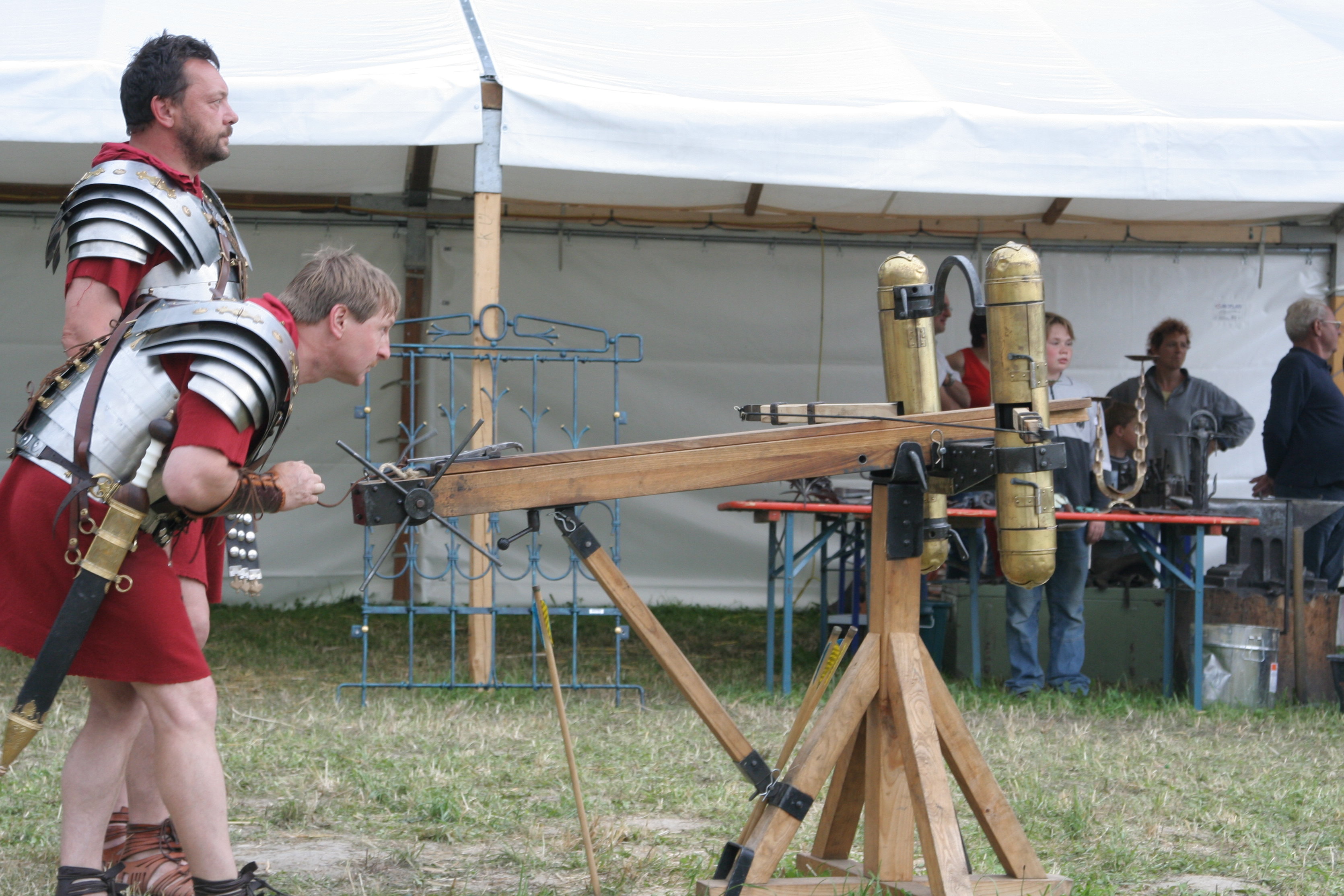
The Scorpio was the smallest of the artillery weapons, and was mostly used for sniping any one target within one hundred meters. It was basically a big crossbow whose bow apparatus consisted of two wooden arms connected to a torsion-mechanism. Its bolts could pierce the strongest armor, and the machine itself could be operated by one person. Every legion was supported by at least 60 Scorpios, giving the infantry a cover of deadly bolts to retreat under, should the battle prove contentious enough to warrant a second or third line engagement. It was mostly used to support Roman infantry in the field and in a siege, they were angled and fired in a parabolic fashion, quadrupling their range, but eliminating their precision. Still, the chance of getting instantly killed by one of 60 iron-tipped bolts that could rain from the sky any second was enough to cause the right kind of disruption within the besieged city.

The Ballistae was the Scorpio's steroid-popping big brother. Being much larger and more powerful, there were probably only a few Ballistae per legion, though reinforcements might bring more if there was a siege. In its early days, it hurled massive bolts over 460 meters, often impaling several men at once. Its purpose was mostly to cause fear in the beginning, though later it met with greater advancements which made it a very useful piece of field artillery. It was attached to wagons which would pull the terrible giant crossbow to wherever they could be deployed effectively, and let them rip into the enemy ranks.

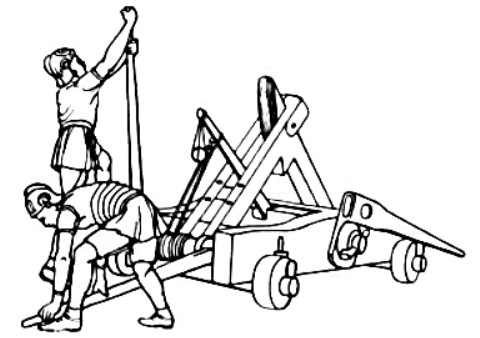
Let's face it: the real ultimate weapon of the ancient world was fire. Still a largely misunderstood and uncontrollable force in those days, the sight of fire alone could devastate an army's morale, much less the thought of having balls of the stuff thrown at them. The Onager existed for just this purpose. You may notice in the picture that the payload is contained in a sling, which increases its range, but pretty much destroys any sense of precision. It worked well enough to hurl pots of pitch over enemy walls to set alight whatever they happened to land on, wrecking food supplies, killing soldiers or civilians, and giving yet another calamity for besieged cities to fear.

In the Medieval period, many of these weapons would evolve in different ways; the Scorpio being replaced by the crossbow, the Ballistae by . . . well, better Ballistae, and the Onager by the catapult, which had a fixed bowl instead of a sling and was used to hurl hot coals or large boulders at whatever you want to die. As Hannibal learned the hard way, you can't take a city without laying a siege, and the Romans show us time and time again that it is always best to be prepared.

Pax vobiscum

Friday, May 7, 2010

Archimedes

Unfortunately, Archimedes is one of those semi-mythical guys who wasn't written about heavily until hundreds of years after his death. What we do know about him is a combination of contemporary and later sources, all of which agree on at least one thing: he was crazy smart.

He approximated pi to an unprecedented degree, which by itself is one heck of an accomplishment. He built world-changing inventions, created new mathematical formulas which incorporated infinity and zero (two concepts which scared the daylights out of Aristotle), applied buoyancy, and created complicated pulley systems which allowed for the earliest cranes to be built. I have focused mostly on how his inventions applied to warfare and farming, but those were the two chief interests of the ancient Mediterranean, when you get right down to it.

Though he died an untimely death at the hands of a foolish Roman Legionnaire, his concepts and inventions continued to change history long after his death. That is, the inventions that they could duplicate continued to change the world. There were several items the plunderers found in his workshop which could not be re-created and were taken as trophies by Marcellus and his Captains. One of them was a sphere with gears and levers which could calculate the exact position of the known planets.


Pax vobiscum


Monday, May 3, 2010

The Siege of Syracuse

Located in south-eastern Sicily, Syracuse was an old Corinthian-Greek Colony with old-time values. Ruled over by kings and tyrants since its founding in 733 BCE, Syracuse enjoyed the many benefits of its central Mediterranean locale and became very wealthy through trade with Egypt, Rome, Carthage, Asia Minor, Palestine, and Spain. After the Pyrrhic war in 275 BCE, however, it was the sole remaining Greek settlement west of the Peninsula itself, and in a very tenuous position sandwiched between Rome and Carthage.

Syracuse survived for quite a while after Pyrrhus' final defeat because its leaders made smart alliances and used skilled diplomacy to ensure the protection of either Rome or Carthage. When the first Punic War broke out, Syracuse was at the center of the action and made an alliance with Carthage from fear of Rome. Luckily, Rome and Carthage fought each other so bitterly that by the time Rome got around to dealing with the unlucky Sicilian Greeks, they had already lost so many in battle that they were willing to settle for an apology and a cut of their trade. However, when the second Punic War broke out, Syracuse made the mistake of allying with Carthage again, and the Romans were determined to make them pay. However, Roman vengeance would come at a high cost to the Republic because of one resident of Syracuse whose mind possessed knowledge that could bring both great prosperity and very great destruction. This man's name was Archimedes.

I like to think of Archimedes as a sort of ancient world Da Vinci, except without the moral qualms about creating weapons. Where Da Vinci was purposefully putting gears in the wrong place so that his designs would ultimately fail, Archimedes was not only sketching these out, but utilizing them to a terrible degree of success. For this week's Famous Friday, we'll delve into Archimedes' discoveries in greater detail, but since it's Military Monday, let's focus on his original and horrific siege weapons.

The most famous of his weapons was The Claw, which utilized pulleys and complicated weight balancing to capsize Roman Triremes. Seriously, this crane-like weapon would hook onto the bow or stern of the boat, lift it out of the water, and send it crashing against the nearby rocks. Each boat carried about two hundred soldiers, so you can imagine the carnage that ensued when this happened over and over:


Another of his creations was an improved catapult. Again, using pulleys and counterweights, he was able to create an engine capable of throwing a 500 pound rock with much better accuracy than the inferior Roman scorpions and ballistae. He also contributed to the building of other weapons which could fire missiles and keep the Romans at bay.

The most controversial of his creations was his 'death ray.' Several authorities have tested it using various techniques, and some have been successful, while most have ended in a wash. Supposedly, Archimedes built a large array of bronze mirrors which could be turned, focusing their reflected light into a concentrated beam onto an approaching ship. The Roman ships, which were sealed with tar, caught on fire and sunk. While this does seem a bit far-fetched, I wouldn't put it past old Archie to give it a try. After all, it was Hiero II, the king of Syracuse and relative of Archimedes, who frequently challenged the genius and gave him the funding he needed to build better weapons since the first Punic War, so why wouldn't this mathematician try literally everything he could think of? Were there easier ways to light ships on fire? Yeah, lots. But if I were an invading Roman, I might think twice about mixing it up with an enemy who can light my ships on fire without shooting anything.

Syracuse eventually fell to sheer Roman determination, and Archimedes was killed, possibly while drawing circles in the sand. If not for him, the last Greek colony on Italian soil would surely have fallen in the first year, and Carthage wouldn't have stood a chance of surviving the Second Punic War. By the time the Roman army came to the gates of Carthage, they had suffered so many casualties from Syracuse and from fighting Hannibal for ten years that they allowed Carthage to live, albeit under severe economic sanctions. And when Carthage was finally leveled in the Third Punic War, there were no more brilliant mathematicians around to set Romans on fire from a distance.

Pax vobiscum