Tuesday, June 22, 2010
Adequate Aqueducts
Thursday, June 10, 2010
Catching up: The Battle of Mylae and the Corvus
Tuesday, May 25, 2010
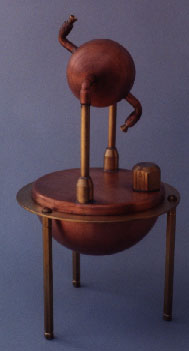
The Ancient Greek Steam Engine
Tuesday, May 18, 2010
Ancient Metallurgy
Tuesday, May 11, 2010
Why do All Roads Lead to Rome?
The simple answer is that the Romans built them. There. Satisfied? I didn't think so. We see in the Romans a penchant to absorb and syncretize the things that they admired from other cultures, and in one respect, roads were no different. Government building of roads has been with humanity since at least the Ancient Persian Empire, and it is likely that the Etruscans brought a road-building ethic with them from Asia Minor, and that the Romans appropriated this idea. And if there was one thing that the politicians could all agree on, it was roads.
The Romans didn't just level dirt paths; they had a method of paving these roads which made them durable and easy to drive on. Merchants from all over mainland Europe used carts to transport goods, and sturdy, flat roads ensured that their more expensive breakable items would remain intact on the way to market. Travelers and pilgrims eager to visit the famous Temple of Saturn in the heart of Rome could now make the trip without fear of getting lost, since Augustus made the Temple the starting point for the marker stones. If the numbers on the stones got smaller, you were heading for Rome, hence the famous saying.
The politics of roads was always contentious, with many Patrician Senators using their vast treasuries to pave large, wide roads and name them after themselves. Like the Gladiatorial games, this was a good way to endear themselves to an underrepresented populace of mostly Plebeians. However, anyone who built a road in the early Republic was required to pay for its upkeep, which could be a problem if a wealthy Senator got involved in shady financial dealings that went south.
Eventually, the Roman Empire was connected by a large system of roads, which were eventually all made public property. Armies could march over the roads very easily compared to marching through dangerous forests and hunting paths. While this also helped the enemy armies of 'barbarians' to invade, the Romans made a habit of building a system of outposts and forts near choke points, and had a swift communication system to help ward off the smelly hordes. The roads lasted for centuries, some of them being preserved up to this present day.
Tuesday, May 4, 2010
Things That Archimedes Made
Following in the footsteps of other great eccentric Greek mathematicians, Archimedes seems to have gone about his life by trying to learn something new every day. To make an exhaustive list of everything he discovered, invented, or improved would take far more space than what should be contained in these virtual pages, so today we'll take a look at just a few of his mind-boggling creations.
The pulley itself is so ancient that its creator's name has been lost in the mist of time. Archimedes experimented heavily with pulleys and created the world's first block and tackle system (basically a mechanism in which two or more pulleys are utilized). He discovered that each pulley he added made the load seem lighter, since the force was being transferred equally among all the pulleys in the array. This allowed merchants to construct great cranes capable of lifting heavier cargo, which meant more money on arrival.
But his genius did not end at maritime physics. While trying to find an easier way to irrigate highland farms, he invented Archimedes' screw, a device capable of carrying water upward. Now, ground water could be raised to the surface and reused on the crops. It could even be carried up mountains, if the pipes and screws were long enough. This revolutionary invention was so useful that the Romans later built it into all their farmland and even used it to carry drinking water into high fortified camps. Here's a great image of how this works:
During the First Punic War, he invented a primitive odometer. It was an array of gears and levers which would drop a ball into a small box for each mile it traveled. To have done this during a time when people believed that disease was caused by the moon is not only surprising; it's mind-bogglingly astonishing. In addition to this, he created several astronomical implements, some of which were carried away as loot by the Roman commander who sacked Syracuse.
In between revolutionary and brilliant inventions, he did Calculus. But wait! Didn't Sir Isaac Newton invent Calculus? No more than Henry Ford invented the automobile. Newton greatly expanded the science, which laid dormant for more than a thousand years, but it was Archimedes himself who made the first foray into the measurement of the infinite. Unfortunately, there was no one around capable of understanding Archimedes' work, let alone carry it on. Though he served as a bright light for a time, the world went dark again at his passing, and the Greeks and Romans went back to their day-to-day business, being afraid of things they didn't understand. His work lives on, and he remains one of the most important mathematicians and inventors in all of history.
Tuesday, April 27, 2010
Technology Tuesday: Triremes
A few years ago I worked as a substitute teacher, and wanting to make Geometry interesting to high school students, I told them all about Thales, the Greek Mathematician who calculated the exact height of the Egyptian pyramids by measuring their shadows circa 500 BCE, and of Eratosthenes, who calculated almost perfectly the circumference of the Earth sometime around 220 BCE. They were astounded to learn that Geometry was, in fact, one of the oldest forms of Mathematics on the planet. However, the one theory they wouldn't believe was that of a Phoenician voyage to the Americas – which supposedly took place in the 400's BCE. One student remarked, “How did they get across the Atlantic? In rafts?”
And there it is. The all-too-common misunderstanding about history that constantly pervades Western culture. We think of the ancients as being nothing but primitive, superstitious fear-mongers who jumped at their own shadows and had no technological achievements of interest. This is one of the reasons I am writing this blog; to show that mankind has been ingeniously solving problems since long before the industrial revolution, and to remind us that some of the problems we face today may have a solution in the past. After all, those who forget the past are doomed to . . . um . . . something something.
Well, anyway, let's press on. The ancient people didn't get across the Mediterranean in rafts or skiffs, or any other short-range vessel. They used one of the oldest ships around: the Trireme. The Trireme is so old that no one is really sure who invented it, or even which people group started using them first. Yet they could travel fifty to sixty miles a day if the crew worked at a moderate pace. If they worked harder, they could travel more than a hundred and fifty miles (theoretically). What was the secret of their power?
Well, the Trireme gets the tri- from the number three, as in three rows of hardworking oarsmen. The ship's interior was designed with the two sides slanting inward toward a fairly pointed bottom. Holes were cut in the side for oars, and the ship was big enough to accommodate 170 rowers who were guided by a few midshipmen who gave the rhythm. Add 20 or so Marines on the deck to prevent boarding, and you've got yourself an authentic fully-manned Trireme, a fearsome weapon when wielded by those who used them the best: the Athenians.
Athens is a coastal city, just like most powerful Greek cities. However, Athens had a rich countryside in which they cultivated olives, wheat, and other foodstuffs, and its mountains were full of precious metals, of which the rich speculators in Athens took full advantage. Yes, this future capital of Greece had a lot going for it, and constant naval trade meant that this city was always ready to drive off invaders by sea.
The Romans would later spend several months out of every year training their soldiers, but Athens had no need to train its navy because they were constantly keeping in shape by serving the merchants and ensuring commerce to places like Palestine, Egypt, Carthage, and even Rome itself. Because of this, anyone hoping to attack Athens would have to do so by land, which is what inevitably led to its downfall.
The Athenian Trireme was built hull-first from soft, light woods, with the ribs and girders being added after the woodwork was finished. It was light enough that the crew could carry it to shore without much difficulty, but this also meant that it could fall prey to heavier ships. However, heavier ships were typically slower, and the main tactic used by Trireme crews in this time was to ram the other ships diagonally from the side to tear a huge breach in their hull. This was easy to do in a light, nimble Trireme, and heavier ships made from stronger woods often fell prey to these jackrabbits of the sea.
So could these ships, which were very expensive, time-consuming to produce (6000 man hours per ship!), and exhausting to operate have really traveled from the Western Mediterranean all the way to Brazil? Personally, I think it's possible, but I don't think it was accomplished. If they did, there's little evidence to suggest that any pan-Atlantic commerce was taking place, as some who promote this theory claim, and I can't imagine that such commerce would even cover the expedition cost, much less turn a profit. However, there is a Carthaginian coin that dates to 350 BCE which has what looks like a tiny world map near its edge that seems to depict some land beyond Spain. Perhaps they had at least discovered that there was land beyond the seemingly endless ocean, but short of a sudden windfall of evidence, this theory remains on the fringe.
While the odds are stacked against them, I think that this subject should be discussed in the classroom. What keeps most subjects alive and interesting are the questions which arise from them, and I think that the world of history education needs to stop being afraid of these kinds of questions, especially when the events that are in question happened so long ago. Again, after weighing the evidence myself, I find that it's only wishful thinking that makes me want to believe it, therefore I cast it out since it cannot be supported. But the act of weighing that evidence was fun, and I think that if school were more fun, more kids would give it an honest chance.
Pax vobiscum
Tuesday, April 20, 2010
Technology Tuesday: The Scythed Chariot
If you ever read accounts of early white American colonists and their scuffles with the native peoples, you may be surprised to find out just how often the colonists won battles despite being outnumbered by huge margins. Sometimes, this was because the colonists would target women and children instead of warriors, but when they did face native warriors, they won because of weaponry. Now, if you've ever watched a demonstration of a musket from the 1600's, you know that hitting anything with that unwieldy, smooth-bored weapon would be pretty impressive, even from ten feet away. But the shot itself is only half of the musket's usefulness; the other half is the bang. The Native Americans had a natural fear of smoke during battle because fire is an uncontrollable force of nature. The muskets give a loud report followed by clouds of white smoke and even if it didn't cause mass casualties, it usually caused enough fear to lead to a rout within a few volleys, often less. So it was with the ancient world that there were some weapons useful for their practical effectiveness in battle and others which, though they did not inflict great physical damage, caused fear and panic.
One such weapon of fear is the Scythed Chariot, brought to Asia Minor from Persia during the Greco-Persian wars. Civilian chariots were a status symbol in Rome, and in most of ancient Europe. Owning a horse was an expensive venture by itself, much less owning enough to pull you comfortably along in your little convertible boxcar. They were also used in races in the hippodrome, as seen on Ben Hur. The design of the chariot varied considerably depending upon its use, and the Scythed Chariot's use was to plow through tightly packed enemy formations to break them apart and to slaughter men in large numbers.
A typical Scythed Chariot was built very heavy, since it was made for combat. Four horses (usually heavily armored) would pull a large, sturdy boxcar with two or three soldiers inside, one to drive and the others to protect the driver. The wheels of the chariot were large and spoked, and attached to both sides of the axles were one or more three-to-five foot blades. You can imagine the carnage that would ensue if even one of these monstrosities successfully charged a tightly-packed Phalanx.
Spears, and especially the long Macedonian spears, could be effective in slowing the charge, but only by a coordinated defense could these frightening inventions be countered. Each had the charging power of four heavy horses, and even if the first two were injured, the momentum they created would still cause the bladed wheels to tear through men like fire to dried underbrush. Alexander the Great faced them when he pushed into Persia during his conquest, and he formulated an effective containment solution. His Phalanxes would move into an E-shaped formation, focusing the small center column against the vicious chariots. When the densely-packed group would slow the chariot's initial charge, The outside columns would flank it and kill the drivers and horses. This was effective, but costly, and not every center column was able to stand their ground as they needed to.
The Romans had a better counter: move out of the way. Their army was structured like their society; efficient. Their forces were disciplined, and they had a clearly-defined command structure. Their flexible formations gave them a great advantage over these heavy weapons, which were not easily maneuverable.
During the Mithridatic Wars, Mithridates VI made the mistake of using his Scythed Chariots in an initial charge, thinking to thin the Roman lines for his foot troops. Instead, the Romans moved out of the chariots' way at the last second, allowing them to pass through their ranks and into rough ground behind them that they had lined with stakes. Many of the chariots stopped in time, but were pretty easily dispatched by a few Triarii who were waiting for them. The Roman army taunted their Pontic enemy, cheering for the chariots as if they were watching a race. This fearful weapon had failed to bring victory, and Mithridates ended up losing that battle, his troops being demoralized to see their fellow soldiers slaughtered and mocked.
The Scythe Chariot was not finished with history at this point, however, and Mithridates' son Pharnaces II actually utilized them effectively against a Roman army himself much later. However, they were costly to maintain and the fear they created wasn't sufficient to infect Roman troops, so as Rome conquered the East, they fell out of style and practice as a suitable weapon. Eventually, the Romans thought of better things they could place on the chariots instead of blades; siege weapons. Yes, they later strapped ballistae (kind of a big crossbow) to the backs of their wagons and used them as the world's first known mobile artillery.
Pax vobiscum
Tuesday, April 13, 2010
Spears of the Ancient World - More than Just Pointy Sticks
Thousands of years ago, a hunter was looking for a better way to kill things. So, he found a long stick and tied a sharp rock to one end of it, and used it to kill some food. From such humble origins, the spear has been humanity's weapon of choice for millennia, and that tradition is carried on today (sort of) with bayonets. For the sake of clarity and brevity, today I will focus on three kinds of spears common to the ancient world – 2 Greek and 1 Roman.
Dory – This five- to ten-foot weapon with a iron leaf-head point is the spear of the original Hoplite. It only weighed between 2 and 4 lbs., making it a very versatile and nimble tool. It was the choice weapon of the Greeks, and it served them well for generations. A big bonus to the shorter Dory is that you don't need a lot of training to use it. Sure, you may want to know where to stab people to cause the most damage, but its small size makes it easy to wield and self-preservation does the rest.
While the levies could get away with using instinct in battle, the line soldiers had to be disciplined in both its use and the execution of a solid Phalanx. The Dory had a small bronze spike on the butt which could be pinned into the ground during an enemy charge. Also, if your Dory broke, you could just flip the short spiked end around and use it as a short-range spear.
The longer Dory was used by professional soldiery in the Greco-Persian and Peloponnesian wars. Being heavier and more unwieldy, it took some training to use properly, and you also needed Phalanx training. These spears allowed the Greeks to drive off Xerxes' invasion since they were longer than their Persian counterparts. Once again, longer spears = greater killing range = victory (usually). The Dory served the Greeks well for hundreds of years, but it was outmatched by evolution, which brought about a longer spear that made a 32-year-old Macedonian into the ruler of the Eastern world.
Sarissa – The mighty spears of Phillip II and Alexander the Great could measure between 13 and 21 feet and weigh between 10 and 15 lbs. Because of its size and weight, soldiers needed a lot of training to both use the spear effectively, and march in Phalanx with them. Without a disciplined army, you may as well use your Sarissas to build a wall instead.
Being a very long and heavy spear, Hoplites needed to use both hands to wield it, leaving them more vulnerable to arrows and javelins. The solution was an uncomfortable one: the soldiers would wear a shield that was slung around their necks. Like their predecessor, the Dory, the Sarissa also had a bronze “lizard killer” spike on the hilt to prevent charges and to provide a secondary weapon if (more like when) the spear would break.
The Sarissa evolved into the pike and lance in later times, but never really made it into widespread use the way that the Dory did. The most obvious reason for this is the training commitment. If you have a village full of hunters and farmers, you can hand them Dories and teach them the Phalanx and you won't have too rough of a time. If you give them a two-handed spear and a heavy shield to wear around their neck, however, you have a lot more work to do. The Phalanx peaked with the introduction of the Sarissa, and gradually became outmoded by other types of warfare.
Hasta – The Roman spear evolved from the Dory without a doubt, but they went in a different direction. The average length for a spear like this was 6 ½ feet long, while they opted for larger, oval-shaped shields to defend themselves. The Roman Phalanxes, which comprised early Rome's army, never went toe-to-toe with the Greeks (as far as we know), which is why they could keep their spears short.
The Hasta varied depending on the wealth of its owner. The wealthier Romans used spears with Iron cores, making them near-impossible to break. The less-wealthy opted for simple wood-and-bronze spears, with the butt-spike necessary to stop charging enemies. Every man in early Rome's army possessed a spear, however, since they also used the Phalanx tactic of the Greeks. But the Romans, unlike the Greeks, didn't allow military tradition to dictate the composition of their army.
The Roman weapons and tactics were based on who they were fighting and where. The mountainous terrain of Italy doesn't lend itself to the shoulder-to-shoulder formation of the Phalanx, so they needed flexibility or they would have no hope of defeating local tribes like the Samnites (more on them next week!). So they looked into different weapon technology while continuing to use the spear as a staple.
That is not to say they just moved on! The possession of a spear, and the knowledge to use it effectively, was paramount to early Roman armies. Though little is known about their origins, their mythology indicates that they were a martial people, and they clearly took spear training as a serious matter. Though they modified their Hastas later into javelins and cavalry lances, the spear remained their symbol of war and pride.
Pax vobiscum
Friday, April 9, 2010
A Weekly Format
Military Mondays - For all things martial. Monday's posts will cover tactics, weaponry, armor (or lack thereof), and all manner of warfare. Expect some series' out of this day, like The Punic Wars and The Marian Reforms.
Technology Tuesdays - Ancient technology will be the center of Tuesday's discussions. From triremes to pulleys, we will examine every aspect of ancient technology in all its amazing forms. Here is where I'll also discuss the war technology in greater detail (though I'll probably 'synergize' this with Monday's post e.g. posting about the invasion of Britannia on Monday and writing about the design and brutal effectiveness of the scorpion siege weapon on Tuesday).
Culture Wednesdays - C-C-C-Combo Breaker! Yeah, I couldn't think of anything that started with 'W' that would both relate to the ancient world and be important enough to warrant its own day, so Wednesdays got stuck with culture. But hey, we'll talk about Togas, superstitions, mathematics and education. And don't forget: you can't spell culture without spelling cult!
Theology Thursdays - Belief in the divine other was central to life in the ancient world, and the Roman Empire saw plenty of change on that front. And no, I'm not just referring to the advent of Christianity. Get ready to learn about Emperor worship, proper sacrifice techniques, and how the Philosophers tried to tie it all together.
Famous Fridays - The one day of the week when I will sell out and write about some well-known figure of antiquity in all their glory, hypocrisy, and glorious hypocrisy. Seriously, though, I will be investigating sources to formulate theories on how common people thought of, say, Julius Caesar during his time and long after his death. The Romans especially had a serious jones for hero worship, but they were not alone in that regard. I'll probably also touch on the paradigms for ancient heroes because they are very different from modern standards.
Feel free to leave a comment on any post you feel like. I want this blog to be a conversation - not a lecture. If you think I'm wrong, or being unfair, please let me know and I'll adjust my position (or tell you how you're wrong and being unfair. Doesn't feel good does it?). If you think I'm right, send me some kudos. Like all writers, my poor little ego is fragile and needs constant praise to prop it up.
Pax Vobiscum