Showing posts with label Greece. Show all posts

Wednesday, January 9, 2013

Soldiers and Ghosts: A Review

When you have a hobby, you tend to get cocky about it.  You think about how smart or skilled you are to be pursuing something because you enjoy it and not because you're in school or because it's your job.  If you're not careful, you eventually begin to think that you can't possibly learn anything new about your subject.

I purchased Soldiers and Ghosts with an Amazon Gift Card last year, and I finally got around to reading it, thinking that it would be fun to read a fresh account of Cannae or read Hannibal's life story.  Again.  What I wasn't expecting was a psycho-cultural analysis of the motives behind the tactics of ancient warfare, starting with the early Greeks.  And I certainly wasn't expecting the first battle I read about to have taken place during the Vietnam War.

Spoiler Alert: the Ancient Romans weren't even involved in the Vietnam War for some reason.
It is a common assumption that warfare has always been about practicality and pragmatism.  The Greeks used the phalanx with great success, and we assume that they chose it primarily for its effectiveness.  However, we often forget that the Ancient people lived in a very different world than ours; a world of augury and divination, of mysticism and heavenly conflicts, of invisible forces that haunted their every step.  They did not look at the Olympic Pantheon as a rustic mythological belief system; it was what they believed.  It stands to reason that their motivations went way beyond simple pragmatic strategy.

My first clue to the Romans' lack of pragmatism is that they all seem to be wearing their baseball caps backward.
But J. E. Lendon puts it best when he explains it this way: "These [people of Papua New Guinea] are peoples who fight wars in ways we call ritualized, meaning they allow their beliefs to dictate a mode of fighting less ruthlessly efficient than we could devise for them.  There are other ways, too, in which beliefs draw modern armies away from purely efficient methods of killing: the reluctance, since World War I, of many armies to employ poison gas and the practice of preserving the lives of prisoners.  Such restraints are powerfully reinforced by the scorpion sting of the Golden Rule: soldiers do not want to be gassed themselves, and they want their own surrenders to be accepted.  But such restraints are grounded also in shared belief: the belief that war has rules, however fragile, and that there are appropriate ways of killing and methods of killing too horrible to be used." (pp.3-4, emphasis mine)

Other highlights and insights include:

  • "Sometimes the glory of the victor depends not only upon his observed performance, but also on the excellence of the defeated; this is a second, quite separate, mechanism for gaining glory in battle." (p. 26)
  • "But the ethos that lay underneath this cooperation [of the phalanx] was only superficially cooperative, for those who fought in the seemingly unheroic phalanx conceived of what they were doing in Homeric terms . . . if grave reliefs were our only evidence we would never imagine that the Greeks fought massed in the phalanx rather than as heroic individuals." (pp.44-45)
  • "Amidst the showers of spears and arrows and stones, amidst the running to and fro and confusion and stabbing by surprise, men of high standing would go down, killed anonymously by stray missiles and the spears of low wretches, trampled by horses, or crushed ingloriously by stray chariots.  In the confusion the high deeds of the brave would go unnoticed, along with the cringing of the cowardly." (p. 46)
  • "Yet it is not in spear fighting in which the hoplite competes but holding his place in the line, and the courage of holding one's place is perhaps the form of martial behavior whose success in the real world is most in the hands of the warrior and subject to the least external influence." (p. 53)
  • "The irony of Thermopylae is that, although the Spartans went to their deaths according to the hoplite code, they did not in their last hours fight entirely as hoplites, bravely holding their ground." (p. 66)
  • "Xenophon urges the hiring of foreign mercenary cavalry chiefly to inspire a sense of rivalry in the Athenian cavalry." (p. 103)
  • "Macedonian leaders had to fight with their own hands because that is how they commanded the obedience of their soldiers." (P. 137)
  • "Soldiers fight well not because they are compelled from above but because they do not want to let down their comrades." (p. 171)
  • "For disciplina [Roman Discipline] was not primarily a system of imposed or felt rules to make an unwarlike people place themselves in danger or to do something unnatural to them . . . it is conceived primarily as a brake to overly aggressive behavior." (p. 177)
  • "The Roman soldier did not primarily think of himself as part of a team, and he was not treated as such by his officers.  Rather, he regarded his comrades as his competitors in aggressive bravery." (p. 185)
  • "The manipular legion was the fruit of compromise resulting from the meeting of an imported method of fighting, the phalanx, with a people whose martial values, whether inherited or new-acquired, made fighting in the phalanx a heroic challenge for them." (p. 190)
  • "After a loss a Roman general might be prosecuted for personal cowardice, but not for tactical stupidity." (p. 207)
So, yeah.  I highly recommend reading this book if you're ready to go beyond the surface-level of Ancient-world tactics and strategies to learn about the cultural forces that drove them.  I'm pretty busy with other plans at the moment, but I'll probably have a few blog posts related to the claims in this book coming up in the near future, so look forward to that.

Friday, June 4, 2010

Scipio Africanus: A New Kind of Roman

Known to readers of this blog as 'that guy who finally beat Hannibal,' Scipio Africanus was much more than just another Roman military genius. He grew his hair long, wore his toga in an unorthodox style, preferred Greek culture and language to Latin, and became a model of later charismatic commanders like Gaius Marius, Lucius Cornelius Sulla, and Julius Caesar. Scipio introduced the cult of personality into Roman politics, and it was a cult that would outlive and ultimately destroy the Republic itself.

Scipio got his start at age 17, joining his father on campaign against the Carthaginian invaders. He was present at the battles of Ticinus, Trebia, and Cannae, all of which ended with decisive victories for Hannibal. In 211 BCE a mere five years after that crushing defeat at Cannae, Scipio went to the Senate and requested command over the new Roman army which was being sent to Spain (the previous army had been utterly destroyed by Hannibal's brother Hasdrubal). The other candidates kept their mouths shut, believing Spain to be a death sentence, now that it was once again so firmly under Carthaginian control. Scipio promptly captured New Carthage and proceeded to win goodwill for Roman occupation. He set captives free, and returned a young Celtiberian princess to her fiancé and family, thus earning that tribe's allegiance against the Carthaginians.

Wisely plotting his strategic course, he sought to defeat the three Carthaginian armies in the area one by one, knowing that they would too far outnumber his own legions if he faced them all at once. He faced off against Hasdrubal Barca in the battle of Baecula and gained a victory by using a similar technique that gave Hannibal the victory at Cannae. Hasdrubal withdrew and marched on Italy, and in a controversial move both now and then, Scipio Africanus refused to pursue. There have been many theories of why he did this, but I tend to believe that it was his strategic good sense that prevented him from risking being caught between the remnants of Hasdrubal's forces and those of Mago or Gisgo, the other two Carthaginian commanders in Spain.

After gaining more Celtiberian allies, he defeated the two other Carthaginian commanders at Ilipa (modern Seville) in 206 BCE, and consequently drove their commanders out of Spain entirely. In addition to recruiting the local tribes, Scipio also made overtures to Syphax and Massinissa, two Numidian princes who agreed to cease their support of Carthage and supply the Roman army with cavalry. This was a huge win for the Romans because Numidian cavalry of the time outmatched nearly all other types, and was one of the chief causes of Hannibal's many successes. Syphax later switched back to the Carthaginian side, marrying one of their noble-ladies to seal the deal, but Massinissa proved extremely helpful in the later invasion of Carthage itself.

Scipio was the ultimate success story for the new culture of Rome: a culture which was fast-growing among the military and plebs. The old Roman model of farmer/soldier was quickly eroding under the increasing power of the Senate and their abusive practices toward the soldiers and the poor. The conservatives in the Senate distrusted his charismatic Greek mannerisms and disliked his fame. When Scipio won at Zama and ended the Second Punic War, he was greeted as a national hero in Rome and given his famous moniker Africanus. Several dissident groups offered to nominate him as Dictator or Consul for Life, but to his credit, he refused. It seems that this radical, innovative commander and politician had some old-fashioned Roman virtue in him after all.

Pax vobiscum

Tuesday, May 25, 2010

The Ancient Greek Steam Engine

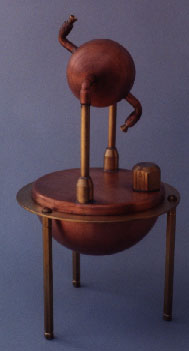
I can already hear you groaning. Here we go again, you're probably thinking. Another revisionist theory that Justin likes, big surprise. You may be surprised to learn, then, that this is no theory: sometime between 10 and 70 CE, Hero of Alexandria created what is believed to be the world's first steam engine. No joke, no hair-brained theory, just cold, hard, unforgiving historical facts. Still don't believe me? Just take a look at this illustration from his book:

Not sure what you're looking at? Well, it worked like this: you poured water into that bowl on the bottom, then build a flame underneath it and waited for awhile. Eventually, that water transforms into steam, which shoots up through the two pipes and into the circular object in the center, which was more like a pinwheel than a globe. The steam would travel out of the two spouts out of the pinwheel, causing it to spin. Presto, ancient Mediterranean steam engine!

In addition to this, Hero is also credited with the invention of the force pump, the syringe, a wind-powered organ, and the vending machine. So, the next time you buy yourself a soda or sodium-coated snack, think of Hero and wonder to yourself what else he may have jotted down on some note paper which was lost along with most of his work when the Serapeum was destroyed in 391 CE by a Christian mob.

Friday, May 21, 2010

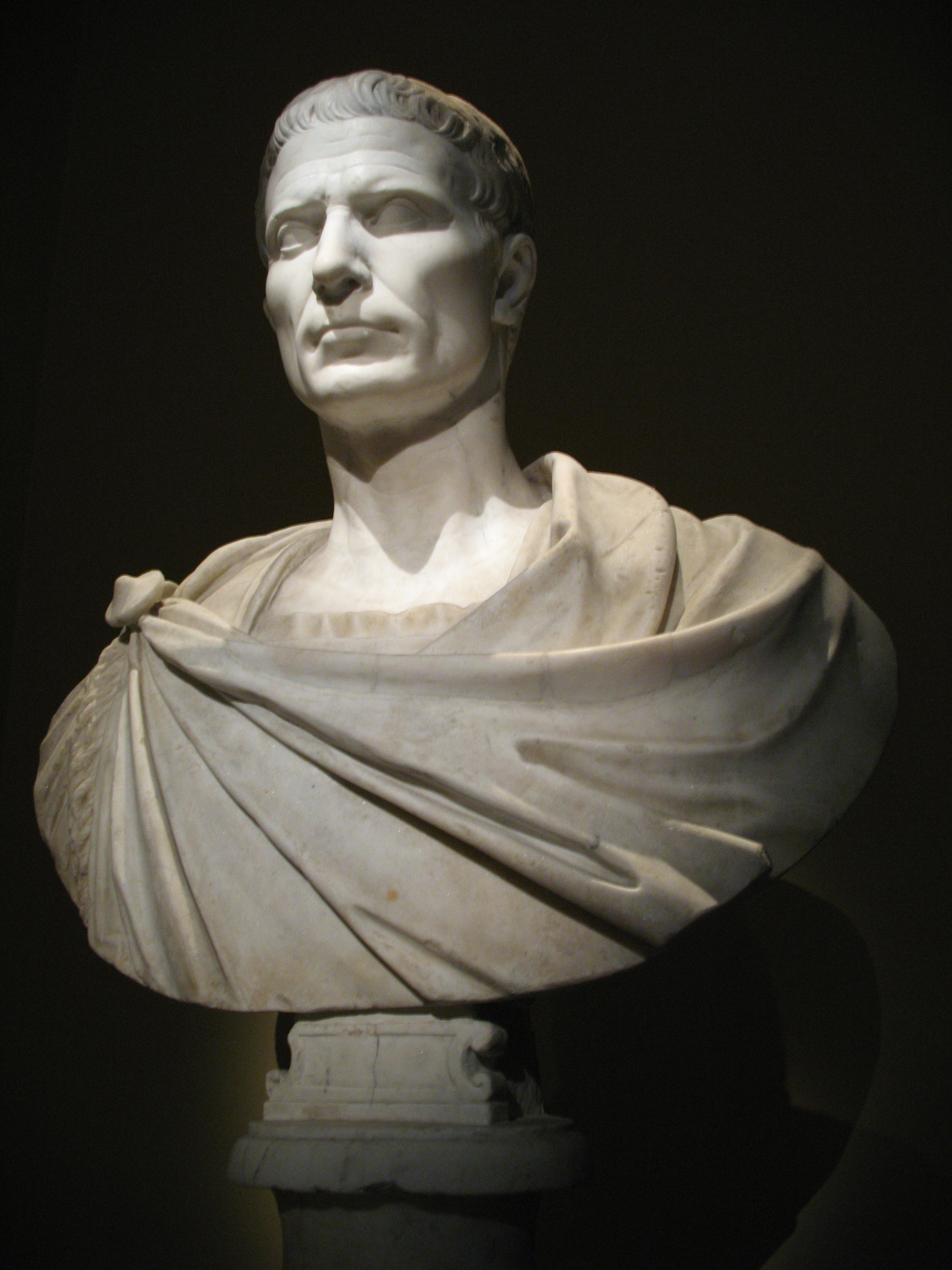
Julius Caesar Part II: The Later Years

When we last left old Gaius Julius Caesar, he had just won Consulship for the year in 59 BCE by a nasty, corrupt election that left no Senator clean, including Caesar's most tireless opponent, the notoriously incorruptible Cato. Marcus Calpurnius Bibulus was elected to serve as the second Consul, but would prove to be an ineffective check against his fellow executive. Supporting Caesar were Crassus, to whom Julius owed his freedom, and Pompey, whom Caesar recruited by promising to support land redistribution, a wedge issue amongst the Senators, and one that Caesar would use to cast the elite into the role of petty oligarchs and himself as the egalitarian savior of Rome.

When Caesar proposed a series of reforms designed to redistribute tracts of land to the poor, Crassus supported it on the Senate floor, while Pompey garrisoned his soldiers inside the city, frightening the moderate Senators into passing the decree. Seeking divine intervention, Bibulus tried to declare foul omens and therefore end the assembly prematurely, but he was chased off by armed supporters of Caesar and a bucket of sewage was thrown onto him as he rushed to his home to remain until the end of his term. The law passed without further delay, and thus was the First Triumvirate born: an alliance of three ambitious and savvy populists who would ultimately turn on each other. Caesar and Bibulus' Consulship was so one-sided that the Romans jokingly referred to the year 59 BCE as the Consulship of Julius and Caesar.

Caesar's father-in-law was elected as Consul during the next term, and it was lucky for Caesar because the Optimate Senators were thirsty for his blood. Instead of being confined to stewardship of a nearby uninhabited forest, Caesar's friends saw to it that he was appointed the governor of Cisalpine Gaul and Illyricum, in northern Italy and just east of the Adriatic Sea. He was given command over four legions and was now prepared to fight his way out of his ever-increasing debt. He made war on some local tribes which had been arming themselves, and made some money from their spoils. His term as governor was made to be five years instead of the usual one, which was lucky because otherwise his debts would have made him a slave, and he would have faced prosecutions for his quasi-legal activities while serving as Consul.

His campaigns in Gaul led him all the way to Britain, which he invaded under the pretense that they had aided a local Gallic tribe against him, a shaky accusation against anyone other than the Britons, who were mostly Gauls themselves and very similar in culture. His first invasion didn't go well and he had to return to the mainland, but he succeeded following season, securing Roman-allied control over the southern portion of the island.

Meanwhile, back in Rome, Caesar's daughter Julia, whom he had married to Pompey to secure his alliance, died during childbirth in 54 BCE. He offered him his niece Octavia, but Pompey eventually refused. Crassus died the next year while trying to invade Parthia in the east. Pompey weighed his options carefully and chose to marry Cornelia, the daughter of Caesar's enemy Quintus Metellus Scipio. In 52 BCE, political violence in the city got so bad that Pompey was declared the sole Consul, an office very different from Dictator because a Consul is answerable for their actions in office while a Dictator is not. While in office, Pompey blocked an attempt by Caesar to serve as Consul in absentia, though this had been allowed in previous years. The Triumvirate was broken and the two men left would now fight over the real prize: Rome itself.

That same year, there was a massive rebellion in Gaul led by Vercingetorix, a charismatic and capable military leader who defeated the Roman legions on more than one occasion during the war. Eventually, the Gallic forces were defeated by superior technology through the extensive siegeworks in place at the Battle of Alesia and Vercingetorix was forced to surrender. I'd like to go into more detail here, but rest assured, there will be coverage of these battles in upcoming Military Mondays.

In 50 BCE, Pompey and the Senate ordered Caesar to lay down arms, disband his troops and return to Rome. Caesar believed that it was a trap; that Pompey, who had now joined his enemies, would lead the way in prosecuting Caesar for crimes real and fabricated. He was probably not far off, for at one point that year Pompey accused Caesar publicly of insubordination and treason. January 10, 49 BCE, Gaius Julius Caesar crossed the Rubicon River with one legion and set off the Civil War. When many of the cities in northern Italy surrendered willingly to the invading legion, Pompey and his Senator allies abandoned Rome and sailed for Greece, taking with them every ship in the harbors of southern Italy. And so Caesar, being unable to chase his quarry, set off to challenge Pompey's lieutenants in Iberia, declaring, “I go to fight an army without a leader, so as later I may fight a leader without an army.”

He swept up the remains of forces loyal to Pompey and the Optimates in Iberia and made passage to Greece, where he would square off against his old ally and former son-in-law. At the Battle of Dyrrachium the next year, Pompey's army, which outnumbered Caesar's own legions at least 3 to 1, easily broke through Caesar's battle lines and his army routed. Caesar himself withdrew, and Pompey probably could have ended the entire war then and there, but his years of alliance with Caesar had taught him to be wary of this crafty populist. He feared a trap, and so did not pursue the enemy legions. Even Caesar remarked later that victory had belonged to his enemies, if only one of them would have claimed it.

His forces resupplied and fought the Battle of Pharsalus, in which they won an impressive and decisive victory for Caesar. The Optimates' power now broken, they fled in all directions, while Pompey sailed to Egypt where he believed he might find refuge. Instead he was assassinated, and his head presented to Caesar by Pharaoh Ptolemy XIII, who believed the gift would win him Caesar's favor. It worked in the opposite, however, and Caesar soon cast his support for Ptolemy's sister, Cleopatra VII, helping her to secure the throne of Egypt before he left. Caesar maintained a close relationship with Cleopatra, and there are historical rumors that they had a secret love child. He could have never married the Egyptian queen, however, as she was not a Roman citizen.

There was still work to be done, so Caesar granted immunity to many of his former enemy Senators, while mopping up the remnants of Pompey's forces, defeating all military opposition by 45 BCE. He had been elected Dictator in 48 and again in 47 BCE. In 46 he was appointed as Dictator for an unprecedented 10-year term, which undoubtedly led to his downfall two years later.

On the 15th of March, 44 BCE, Caesar was attending a session of the Senate. A group of Senators had organized a conspiracy against this perpetual Dictator, calling themselves the Liberatores, or liberators. They lured Caesar into a false state of security by gathering around him to support a bill, and then proceeded to stab him repeatedly until he was dead. As many as 60 Senators participated in the assassination, and declared that Rome was now a free Republic once again.

Ultimately, Caesar's death did nothing to stem the tide of anti-Republican sentiment. In the old days of Rome, citizens were expected to be loyal to the State first, and many of the cautionary fables from the early years involve fathers ordering the executions of their own children if they betrayed the Republic. The shift from Republic to Empire was a gradual one, and as I said last week, Caesar is by no means the first ambitious Senator to have delusions of kingship. However, because the people had come to believe, generation after generation, that the Oligarchical Senators did not have their best interests at heart, they turned to Dictators and Emperors to right the wrongs that their own corrupt and bogged down bureaucracies had either created or failed to counteract. The fall of the Republic, and indeed Caesar's life as a whole, should send shivers down the spine of any government official, elected or otherwise, who fails to care for their citizens.


Pax vobiscum

Thursday, May 20, 2010

The Ultimate Sacrifice

This story from the Greek oral tradition stands out as one of the most heinous crimes of the Trojan War. King Agamemnon made a foolish boast against Artemis after shooting a stag through the heart with a single arrow. She cursed his upcoming expedition against Troy unless he made a sacrifice: his eldest daughter Iphegenia. He obliged, and the war was ultimately successful, but the cruel king himself was murdered when he returned home by avenging family members. There is a similar story in the Bible's Old Testament centering around Jephtha, a Charismatic Judge who swore to sacrifice the first creature that approached him when he returned home if God would grant him a victory over the Philistines. The first creature was his daughter, whom he sacrificed to Yahweh, an event that stands completely alone in Judeo-Christian scriptures. The Greeks, Hebrews, and Romans had come to feel that human sacrifice was wrong by the 500's BCE or before, and kept it out of their worship, exiling it to their oral traditions as cautionary tales rather than promotional stories.

All this is to say that the Phoenicians were not alone in sacrificing people to their gods, but they were getting lonelier when they extended that practice into the early 100's CE. Carthage was the most powerful of the old Phoenician colonies, and by the 300's BCE its power was slowly being crushed under the weight of political corruption and a vacuum in leadership. Having almost no native military power because of their tendency to hire foreign mercenaries to do their fighting, they could only appeal to their gods when Scipio Africanus was at their gates.

The Phoenician deities were of a much older variety than the Greco-Roman gods, being much more like the savage Titans than the diplomatic Olympians. Ba'al was their chief deity, and his very name is derived from the Semitic word El, which means god, and is used in Hebrew words like El Shaddai or Elohim, referring to Yahweh and his angels. His partner goddess was Tanit, whose symbol included a crescent moon and star not unlike the modern Islamic symbol. The Romans identified Ba'al as Saturn, the father of Jupiter who had been usurped by the Olympians years ago, and it seems likely that they factored this into their ideas of superiority to the Carthaginians.

To me, the evidence of child sacrifice in Carthage is very clear. There are mass graves filled with children whose bones have been charred by sacrificial fire. Those who try and make the case that the children had already died of some disease or natural cause before being cremated are ignoring the fact that no evidence of any disease has been found among the remaining bones. I know very well the desire to demonize the Romans and try to rewrite history based on how we would have liked it, but the facts are the facts, and I see no benefit to these attempts at making the Carthaginians into something they are not.

In the cult of Ba'al, children were sacrificed to gain special favor from the gods. The idea was that only blood could show your true devotion to the gods' fame, and what better way to show your true devotion than giving your own child? The Romans and Greeks certainly were no strangers to the idea of blood sacrifice, often killing bulls, birds, and other animals in acts of worship and for divination, but human sacrifice of any kind had long since been outlawed by the Punic Wars.

That is not to say that the Carthaginians always sacrificed their own children. There are accounts (from 800 BCE) of aristocrats buying slave children to sacrifice in place of their own, but in times of famine, war, and hardship the priests would encourage parents to give their youngest child to the fires of Ba'al. Ba'al was associated with the sun, and by extension, fire, which is why the children were killed with a ceremonial knife before being thrown into the blaze.

One bit of evidence that often escapes Carthaginian apologists is the account of young Hannibal joining his father for a campaign in Iberia. It is written that he begged his father repeatedly to join him, and that his father, bitter from the recent defeats in the First Punic War, agreed to take Hannibal only if he would swear an oath against friendship with Rome. Hannibal responded by placing his arm over a nearby open firepit and swearing that he would use fire and steel to arrest the destiny of Rome. While this story is probably mostly fiction, it displays a practice that seems logical for a people who worship a god of fire. What better way to swear an oath by such a god than by allowing the fire to singe you just a little bit to prove your devotion?

No matter how antiquated or barbaric it seems to us, sacrificing animals to appease gods can certainly be said to contribute to the later spread of Christianity, which presented Christ, the sinless man who served as a blood sacrifice for all who believe.

Pax vobiscum

Thursday, May 6, 2010

When Bad Things Happen: an Ancient Pagan View


When disaster strikes, I always seem to feel an overwhelming urge to understand it. Whether it's the attacks on 9/11 or the recent flooding of Tennessee, these questions always come up: Where was God? Why did He allow this to happen? This is not unique to Western culture, or even Christianity, as it seems that humans the world over just want to feel safe and secure, and disasters strike a blow to our sense of spiritual safety just as surely as they throw our sense of physical safety right out the window.
The Greek and Roman Pagans did not believe in benevolent, all-loving protector deities, as you will quickly find by reading literally any story about their gods. Most animals were given stories that involved puny mortals pissing off the gods and being cursed with their present forms. Even answering the question of why we have winter for half the year involves deception, kidnapping, and rape.
Persephone was a lovely young girl, and an illegitimate child of Zeus and Demeter, the goddess of nature. Like her mother, Persephone enjoyed taking walks in the woods and playing with woodland creatures like a princess in a Disney cartoon. Many of the male gods wanted her for a wife, pursuing her with gifts, but Demeter refused them all, hiding her daughter in some remote woods. This dissuaded the Olympian gods, but you can't hide from Hades. Being the god of the underworld, he heard Persephone singing while picking flowers one day, and burst out from the rocks and kidnapped her. He took her for his wife (which is to say he raped her) and Demeter was heartbroken when she discovered that her daughter was gone. She looked far and wide, neglecting her duty as the goddess of nature, and so the earth became cold and barren. Zeus finally got involved and solved the dispute by agreeing to joint custody of Persephone between Hades and Demeter. Because she had eaten Pomegranate seeds while in the underworld, she could only leave it for a time to be with her mother, which is why we have six months of decay and six months of plenty.
It's very common to read in Ancient Greek literature about some disaster that occurred because Poseidon was upset (he was blamed for earthquakes and storms at sea) or because Hephaestus fell asleep while his forge was burning (volcanic eruptions). Given the violence and pettiness that these gods were prone to, I have to say that these disasters probably didn't bother the Pagans as much as later disasters would bother Christians. They probably just shrugged and said, along with Kurt Vonnegut, “So it goes.”
Pax vobiscum


Wednesday, May 5, 2010

It's All Greek To Me!


How do you know what you know? Seriously, think of something you are sure is true right now. How did you come to know that truth? Do you believe that humans are basically good or evil? Do we have souls, or are we purely material, and what is the meaning of life? Is there a God, and is she in a good mood? With the economy the way it is, it's unlikely that most of us have had a lot of time to ponder the deeper meanings in life. Socrates would be greatly disappointed in us for this. And so would Archimedes.
The Socratic Method is the practical application of Socrates' belief in self-examination. It began circa 430 BCE, so the story goes, with a bunch of young Athenians who were trying to find the answers to life's biggest questions. They sought out Socrates, a bricklayer and veteran, who had a most curious way of discussing matters of truth. Rather than making quotable statements or using flowery words to push his point across, he asked questions. For example, if one of them stated that “Love always gives and never seeks to receive,” Socrates might answer, “If love never receives, what will it have left to give?” His entire point in life was to make people say, “Hmmmmm . . . .”
While he was mostly concerned with ethical and spiritual matters, he did use his questioning method as a way of trying to understand the world around him. Archimedes was born hundreds of years after Socrates' death, but it seems obvious from his discoveries that he used the same principles of critical thinking. One of the most famous stories (though it's believed to be Apocryphal) is that of the riddle that King Heiro II posed. A local goldsmith had forged a golden crown, and the King was suspicious that it was a fake. He asked Archimedes to find a way to prove it, so the mathematician went to work. He thought deeply about the subject, but couldn't come to a good conclusion, so he took a bath to relax before going at the problem again. While in the bath, he observed the water rising and falling, and realized that he could use the principle of buoyancy (which he basically created) to determine whether the crown was real or a cheap knock-off.
Greek thinking started with how to think, and it was only when the ancients strayed from the art of questioning that they plunged the known world into an intellectual dark age, with only a few bright lights like Archimedes to lead the way. Aristotle, a student of Plato (who was a student of Socrates) went about using inquisition to determine the natural world. After Alexander the Great, his student, took that knowledge with him to every place he conquered, it became concrete fact for the next thousand years. History loves irony, and so it stands that the scholastic line of Socrates ends with someone claiming absolute truth over the natural world.

Pax vobixcum

Monday, May 3, 2010

The Siege of Syracuse

Located in south-eastern Sicily, Syracuse was an old Corinthian-Greek Colony with old-time values. Ruled over by kings and tyrants since its founding in 733 BCE, Syracuse enjoyed the many benefits of its central Mediterranean locale and became very wealthy through trade with Egypt, Rome, Carthage, Asia Minor, Palestine, and Spain. After the Pyrrhic war in 275 BCE, however, it was the sole remaining Greek settlement west of the Peninsula itself, and in a very tenuous position sandwiched between Rome and Carthage.

Syracuse survived for quite a while after Pyrrhus' final defeat because its leaders made smart alliances and used skilled diplomacy to ensure the protection of either Rome or Carthage. When the first Punic War broke out, Syracuse was at the center of the action and made an alliance with Carthage from fear of Rome. Luckily, Rome and Carthage fought each other so bitterly that by the time Rome got around to dealing with the unlucky Sicilian Greeks, they had already lost so many in battle that they were willing to settle for an apology and a cut of their trade. However, when the second Punic War broke out, Syracuse made the mistake of allying with Carthage again, and the Romans were determined to make them pay. However, Roman vengeance would come at a high cost to the Republic because of one resident of Syracuse whose mind possessed knowledge that could bring both great prosperity and very great destruction. This man's name was Archimedes.

I like to think of Archimedes as a sort of ancient world Da Vinci, except without the moral qualms about creating weapons. Where Da Vinci was purposefully putting gears in the wrong place so that his designs would ultimately fail, Archimedes was not only sketching these out, but utilizing them to a terrible degree of success. For this week's Famous Friday, we'll delve into Archimedes' discoveries in greater detail, but since it's Military Monday, let's focus on his original and horrific siege weapons.

The most famous of his weapons was The Claw, which utilized pulleys and complicated weight balancing to capsize Roman Triremes. Seriously, this crane-like weapon would hook onto the bow or stern of the boat, lift it out of the water, and send it crashing against the nearby rocks. Each boat carried about two hundred soldiers, so you can imagine the carnage that ensued when this happened over and over:


Another of his creations was an improved catapult. Again, using pulleys and counterweights, he was able to create an engine capable of throwing a 500 pound rock with much better accuracy than the inferior Roman scorpions and ballistae. He also contributed to the building of other weapons which could fire missiles and keep the Romans at bay.

The most controversial of his creations was his 'death ray.' Several authorities have tested it using various techniques, and some have been successful, while most have ended in a wash. Supposedly, Archimedes built a large array of bronze mirrors which could be turned, focusing their reflected light into a concentrated beam onto an approaching ship. The Roman ships, which were sealed with tar, caught on fire and sunk. While this does seem a bit far-fetched, I wouldn't put it past old Archie to give it a try. After all, it was Hiero II, the king of Syracuse and relative of Archimedes, who frequently challenged the genius and gave him the funding he needed to build better weapons since the first Punic War, so why wouldn't this mathematician try literally everything he could think of? Were there easier ways to light ships on fire? Yeah, lots. But if I were an invading Roman, I might think twice about mixing it up with an enemy who can light my ships on fire without shooting anything.

Syracuse eventually fell to sheer Roman determination, and Archimedes was killed, possibly while drawing circles in the sand. If not for him, the last Greek colony on Italian soil would surely have fallen in the first year, and Carthage wouldn't have stood a chance of surviving the Second Punic War. By the time the Roman army came to the gates of Carthage, they had suffered so many casualties from Syracuse and from fighting Hannibal for ten years that they allowed Carthage to live, albeit under severe economic sanctions. And when Carthage was finally leveled in the Third Punic War, there were no more brilliant mathematicians around to set Romans on fire from a distance.

Pax vobiscum


Thursday, April 29, 2010

Theology Thursday: The Cult of Artemis

Looking at the statue of the Ephesian Artemis reminds me of when I lived in Japan, as the slender statue looks more like a Shinto deity than a Greek goddess. In fact, if you were to compare the idols of the Greek gods with the statue of Artemis which came from Ephesus, you'd probably think you were looking at completely different religious icons. And, in a way, you'd be right.


Artemis is unique among the Greek deities because she never married or had 'relations' with the other gods. She preferred the hunt to a dinner party, and the human lovers who were lucky enough to win her affection always met with tragic death, sometimes at her hand. She was the goddess of the moon, but the forest and childbirth were also within her realm of protection. Hunters would often lay the skins and horns of their prey upon a tree branch before leaving the woods as an offering so that Artemis wouldn't hunt them down for killing the animals before she had the chance. Women would cry out to her during childbirth in hope of relief from their pain either by the child emerging or receiving a quick death. The Greeks of Peloponnessus, that's the European side of ancient Greece, far preferred Zeus or Ares as their important deities, but for the Ephesians, none other than Artemis would do.

The Artemis image from Ephesus sticks out like a sore thumb in the Pantheon of Greek gods, and that is because that image predates Greek settlement in Asia Minor. It seems that before the Greek colonists came, the Ionian natives had built a matriarchal culture around a fertility goddess whose name has been erased by the fog of time. When the Greeks came and conquered the place, they adopted the image and claimed that it was Artemis, since the Greeks were fond of syncretism (that means incorporating local deities into your religion – word of the day!).

The Greek culture was extremely patriarchal, especially in Athens. Though it is true that Spartan women could own land and personal property (something Athenian women had no right to), this was done mostly out of necessity since the Spartans practiced open marriage. Thus it became necessary for the Greek priests to first break down the matriarchal local religion before they could alter the culture as well. Since the ancient worldview was typically that reality reflected the divine realm, those Ionians who were conquered must have figured that their religion was backwards, and so gave in to the priests and renamed their statue.

Her unique appearance, combined with the need for ancient people to have a lot of children to hedge their bet, made her a popular deity, and her temple in Ephesus was three times larger than the Parthenon temple that the Athenians built for their patron god Athena. In fact, the Ephesian Temple of Artemis was one of the seven wonders of the Ancient world, making Ephesus a huge tourist attraction for people from every corner of the Mediterranean and Black Sea. Ephesus being a coastal town, its economy was dependent on trade and tourism, so much so that there was once a riot against Christian missionaries organized by idol craftsmen who feared the sag in their income that a more popular god would bring! You can read more about this uprising in Acts chapter 19, which is a very informative account of the fame of the Ephesian Artemis.


The cult surrounding Artemis, ironically, centered around her virginity. Priests who served this moon goddess would willingly castrate themselves while men who went off to war would swear vows of chastity before the idols and likely keep a pocket-sized version with them as a reminder. While encamped in rugged hills on campaign, I imagine many a veteran Hoplite telling a tale around a cookfire all about a foolish young soldier who broke his vow to Artemis and brought his entire army to ruin. There were many such tales, since the Greeks were so fond of Fables.

Though Artemis was widely beloved, she eventually fell to the cross, as did all her Olympian brethren. Over time, the Roman Empire became more and more Christian through either proselytizing or by political manipulation, and the old gods were cast aside like yesterday's newspaper. Artemis would hunt no more.

Pax vobiscum


Tuesday, April 27, 2010

Technology Tuesday: Triremes

A few years ago I worked as a substitute teacher, and wanting to make Geometry interesting to high school students, I told them all about Thales, the Greek Mathematician who calculated the exact height of the Egyptian pyramids by measuring their shadows circa 500 BCE, and of Eratosthenes, who calculated almost perfectly the circumference of the Earth sometime around 220 BCE. They were astounded to learn that Geometry was, in fact, one of the oldest forms of Mathematics on the planet. However, the one theory they wouldn't believe was that of a Phoenician voyage to the Americas – which supposedly took place in the 400's BCE. One student remarked, “How did they get across the Atlantic? In rafts?”

And there it is. The all-too-common misunderstanding about history that constantly pervades Western culture. We think of the ancients as being nothing but primitive, superstitious fear-mongers who jumped at their own shadows and had no technological achievements of interest. This is one of the reasons I am writing this blog; to show that mankind has been ingeniously solving problems since long before the industrial revolution, and to remind us that some of the problems we face today may have a solution in the past. After all, those who forget the past are doomed to . . . um . . . something something.

Well, anyway, let's press on. The ancient people didn't get across the Mediterranean in rafts or skiffs, or any other short-range vessel. They used one of the oldest ships around: the Trireme. The Trireme is so old that no one is really sure who invented it, or even which people group started using them first. Yet they could travel fifty to sixty miles a day if the crew worked at a moderate pace. If they worked harder, they could travel more than a hundred and fifty miles (theoretically). What was the secret of their power?

Well, the Trireme gets the tri- from the number three, as in three rows of hardworking oarsmen. The ship's interior was designed with the two sides slanting inward toward a fairly pointed bottom. Holes were cut in the side for oars, and the ship was big enough to accommodate 170 rowers who were guided by a few midshipmen who gave the rhythm. Add 20 or so Marines on the deck to prevent boarding, and you've got yourself an authentic fully-manned Trireme, a fearsome weapon when wielded by those who used them the best: the Athenians.

Athens is a coastal city, just like most powerful Greek cities. However, Athens had a rich countryside in which they cultivated olives, wheat, and other foodstuffs, and its mountains were full of precious metals, of which the rich speculators in Athens took full advantage. Yes, this future capital of Greece had a lot going for it, and constant naval trade meant that this city was always ready to drive off invaders by sea.

The Romans would later spend several months out of every year training their soldiers, but Athens had no need to train its navy because they were constantly keeping in shape by serving the merchants and ensuring commerce to places like Palestine, Egypt, Carthage, and even Rome itself. Because of this, anyone hoping to attack Athens would have to do so by land, which is what inevitably led to its downfall.

The Athenian Trireme was built hull-first from soft, light woods, with the ribs and girders being added after the woodwork was finished. It was light enough that the crew could carry it to shore without much difficulty, but this also meant that it could fall prey to heavier ships. However, heavier ships were typically slower, and the main tactic used by Trireme crews in this time was to ram the other ships diagonally from the side to tear a huge breach in their hull. This was easy to do in a light, nimble Trireme, and heavier ships made from stronger woods often fell prey to these jackrabbits of the sea.

So could these ships, which were very expensive, time-consuming to produce (6000 man hours per ship!), and exhausting to operate have really traveled from the Western Mediterranean all the way to Brazil? Personally, I think it's possible, but I don't think it was accomplished. If they did, there's little evidence to suggest that any pan-Atlantic commerce was taking place, as some who promote this theory claim, and I can't imagine that such commerce would even cover the expedition cost, much less turn a profit. However, there is a Carthaginian coin that dates to 350 BCE which has what looks like a tiny world map near its edge that seems to depict some land beyond Spain. Perhaps they had at least discovered that there was land beyond the seemingly endless ocean, but short of a sudden windfall of evidence, this theory remains on the fringe.

While the odds are stacked against them, I think that this subject should be discussed in the classroom. What keeps most subjects alive and interesting are the questions which arise from them, and I think that the world of history education needs to stop being afraid of these kinds of questions, especially when the events that are in question happened so long ago. Again, after weighing the evidence myself, I find that it's only wishful thinking that makes me want to believe it, therefore I cast it out since it cannot be supported. But the act of weighing that evidence was fun, and I think that if school were more fun, more kids would give it an honest chance.

Pax vobiscum


Thursday, April 15, 2010

Theology Thursday: The Paradigm of Pettiness

In my younger days (and, let's face it, even now), I couldn't get enough of Myth. I consumed volumes of the stuff, usually the ancient Greek and the Norse, because the idea of many gods was totally different from what I believed, and therefore, intriguing. What especially struck me was their behavior and character, and how different they were in that regard from the God I read about in the Bible.

The Greek gods developed from an oral tradition that quite possibly predates urban Greek civilization. Their stories are almost always told as an answer to a question. For example, the tale of Arachne most likely began when a small child asked their parent where spiders came from. There is a common thread running through most fables of the gods, a universal philosophy: do not cross the gods.

Unlike the Hebrews, whose one God commanded strict obedience to a moral code and religious practice, the Greek gods simply commanded humanity not to get too full of itself. They saw us as a nuisance at best, and rivals at worst. Prometheus, a demi-god who served those uppity Olympians, had the audacity to bring us fire. Zeus was pretty upset by this, since he didn't want humanity becoming powerful enough to overthrow him the way that he, along with his siblings and allies, had overthrown the titans before them. For his trouble, Prometheus was chained to a cliffside where every day birds would come and eat his insides. Every night they would grow back and the circle of pain would continue. It was Heracles who finally saved him on one of his many quests.

Yes, jealousy is an ugly emotion, and the gods were filled with it. The idea of an immortal deity being envious of mankind seems silly to us today, even those of us who still believe that there is a God. Yet the Greeks believed in gods that displayed all the worst human emotions and had super-powers to boot. Hera, Zeus' wife, would frequently vent her frustrations by tormenting some of her philandering husband's illegitimate children (and there were many!). Why, we might ask, didn't she punish her husband directly? Well, Hera's one attempt to go against the king of the gods ended very badly.

Believing that Zeus was wielding too much power for one god, Hera, Poseidon, and Apollo decided to stage a coup, waiting until their king was asleep on his couch and then binding him with one hundred leather ties so that he could not move at all. When Zeus awoke, he was furious and threatened to destroy the betrayers, who openly mocked him, laughing at his feeble attempts to reach the lightning bolts which they had made sure were well out of range. However, the problem with coups is that eventually you have to decide who's in charge. So the three ring-leaders got all the other gods involved and each one began lobbying for leadership in a debate that gradually threatened to erupt into an Olympian civil war.

While they wasted time with talk of succession, Thetis, a long-time friend of Zeus since the days of his rebellion against Chronos, dispatched her giant, named Aegaeon, who possessed one hundred hands. He untied Zeus while the others were distracted, and Zeus quickly grabbed his lightning bolts and brought the situation under control.

For their part in the conspiracy, Apollo and Poseidon were ordered to serve the King of Troy for a time. Taking advantage of this new immortal work force, King Laomedon had them build walls for his city, which were said to be impregnable. If The Illiad is right, it worked, and the Achaeans had to take the city by the trick of the Trojan horse rather than scale those massive walls. Hera received a far worse punishment for her role in the scheme. She was shackled to the sky by her wrists and anvils were hung from her ankles. She continually screamed in anguish night and day until Zeus freed her after securing oaths of permanent fealty from his fellow gods, who cringed at the horrific sound of Hera's pain.

It is interesting that what gave Zeus success in his original ascension is also what prevented this challenge to his power and authority. Unlike the titans before him, who were looked upon by the Greeks as being primitive, Zeus was able to forge alliances and coalitions. He could never have taken the titans down by himself, but with the help of many powerful demi-gods he was able to free his siblings from Chronos' belly, and bring them all to victory. No doubt the Greeks associated the titans with their Mycenaean ancestors, but Zeus and his band were modern gods for a more civilized era, whereby men would be killed in much more civilized ways, no doubt.

It is because of their gods' pettiness that most Greeks simply looked upon them as potential hazards rather than helpers in their time of need. In fact, if a god did help you in your time of need, they probably needed a favor. This is why the Pagan Greeks never wrangled, as modern Christian Theologians do, with the question of suffering. While Christians revere Jehovah as a God who is good and has good intentions, the Greeks held no such opinion of their deities. This meant that while they would sacrifice to them and try to get their attention with great displays of worship, it was either quid pro quo or mollification. That is, if you'd already fought and won your battle, or finished building your house, you would give a dedication to the gods so that they would see your humility and refrain from screwing up your life to remind you that you were still mortal, and therefore not as cool as they are.

The criteria for a successful Greek life was the attainment of fame, whereby you would live forever because people would tell stories about you. The only figures lucky enough to have that honor were, at first, the gods. However, tales of Ulysses, Achilles, Ajax, and the other Greek heroes were passed down through oral tradition and used as models for young Greek boys to follow. And in a world where the gods don't care about you, some claim to fame is your only real hope of eternal life.

Pax vobiscum


Wednesday, April 14, 2010

Culture Wednesday: Sparta - The Phobiopolis


Few of my friends still make the mistake of mentioning any recent 'historical' movie in my presence. I don't get invited if that's what they're going to see, and if anyone brings it up in conversation, someone else in the group is quick to silence them if I'm around. This is because I hate (HATE) pretty much all modern movies based on historical events. And that includes the most recent Greek tale of heroics and glory, 300.
But wait, before you go back to the lolcats and delete my feed, hear this: I solemnly swear not to make this entire post about how inaccurate and terrible this movie was. However, you should be aware that it will come up. This is not a movie review, just a second look at the Spartans, through the lens of reality rather than romance. Let's start with Sparta's economy.
Every Spartan male was part of the army. From age 7 or so, they would live in the barracks and learn to be ruthless, survivalist warriors. However, if everyone is a Hoplite, who grows the food? Who trades? Well, the Spartan warriors that so many have come to revere and admire were slavers, plain and simple. Sometime very near the founding of Sparta, the surrounding indigenous people, later known as Helots, were enslaved and forced to work on the farms that dotted the Spartan countryside. They wore dog-skin hats and out-numbered the Spartans about 10 to 1 by most estimates. And periodically, just to keep things interesting, the leaders of Sparta would call for a mass execution. Or some soldiers would just kill a few Helots for amusement.
Some historians have claimed that the Helots, though no doubt resistant to their captivity at first, gradually grew to believe the Spartan propaganda that they were less than human and lived only to obey. The number of Helot rebellions seems to squish this theory like a fat, slow bug, however, and I can't bring myself to imagine anyone enjoying slavery. On top of the rebellions, the Spartans themselves would always bear their spear and shield when walking around the city at night, only unbuckling their shields when they were safely within the walls of their own home. That's how seriously they took the threat of being murdered secretly by a group of Helots.
Of course, slavery was common in ancient times, and the Greeks had several different words for slave, ranging from a slave captured in battle to an indentured servant. No one was as cruel to their slaves as the Spartans, though, which has raised a number of questions dealing with their unabashed oppression.
First, why the wanton violence toward the unarmed slaves? Why did they give them annual beatings regardless of their behavior? I believe the answer is fear. The Spartans, under all their armor, chutzpah, and rigorous training were nothing more than a bunch of frightened people trying desperately to obtain some sense of control.
The day-to-day Spartan lifestyle is pretty famous, and is the one thing I will give credit to 300 for portraying correctly. When they were not campaigning, they lived very simple lives as if they always lived in camp. They wore burlap-like clothes, and even their kings lacked the jewels and pomp of their Eastern neighbors. This is why the Spartans were never bribed with money; they didn't use it. Gold was just a shiny metal to them, and they scorned the opulence of Athens and Corinth. Even today, Spartan has become an adjective for someone who lives on the barest necessities.
They craved military power, to the point of conscripting the entire free population permanently. Their army was their most valuable commodity, and it set them apart from their neighbors. To have the Spartans in your alliance was a good reason for your enemies to negotiate. Their Phalanxes were near unbreakable, and their armor was heavy and durable. However, while we interpret military strength as a reason for security, that same thought reveals the insecurity of building up a military in the first place. Why build such a massive, professional force if you have nothing to fear? It was in fear that they trained, and a pure cynical ploy to motivate the troops by the council of Elders to leave the city with no walls (claiming Sparta's fighting men are its walls).
They practiced infanticide for those babies who had deformities or were crippled from birth. This practice horrifies us today, and no one will defend a mother who has left her baby in a dumpster by saying that she is just being “spartan.” Surely they could find work for a child that was disabled, the same way that the Japanese, for example, would train their blind people in the art of massage and acupuncture? But common work is not for Spartans; it is for Helots. The Spartans are born to fight or they are killed after birth. This, too, was fear at work. Fear of weakness, fear of social change, and fear of subjugation.
So the next time you watch a movie or read a book portraying those gallant, rugged, and noble Spartans defending their homeland or joining their allies to defend Greece, don't be taken in by the romantic view that started, I believe, with the Renaissance. Remember the Helot, who lived in daily fear of his life. Remember the baby whose life was taken because he was deemed unfit to live. Remember, most of all, the founders and leaders who would take the freedom of ten times their number just to ensure their own.
Pax vobiscum
Technorati Tags: , , ,

Tuesday, April 13, 2010

Spears of the Ancient World - More than Just Pointy Sticks

Thousands of years ago, a hunter was looking for a better way to kill things. So, he found a long stick and tied a sharp rock to one end of it, and used it to kill some food. From such humble origins, the spear has been humanity's weapon of choice for millennia, and that tradition is carried on today (sort of) with bayonets. For the sake of clarity and brevity, today I will focus on three kinds of spears common to the ancient world – 2 Greek and 1 Roman.

Dory – This five- to ten-foot weapon with a iron leaf-head point is the spear of the original Hoplite. It only weighed between 2 and 4 lbs., making it a very versatile and nimble tool. It was the choice weapon of the Greeks, and it served them well for generations. A big bonus to the shorter Dory is that you don't need a lot of training to use it. Sure, you may want to know where to stab people to cause the most damage, but its small size makes it easy to wield and self-preservation does the rest.

While the levies could get away with using instinct in battle, the line soldiers had to be disciplined in both its use and the execution of a solid Phalanx. The Dory had a small bronze spike on the butt which could be pinned into the ground during an enemy charge. Also, if your Dory broke, you could just flip the short spiked end around and use it as a short-range spear.

The longer Dory was used by professional soldiery in the Greco-Persian and Peloponnesian wars. Being heavier and more unwieldy, it took some training to use properly, and you also needed Phalanx training. These spears allowed the Greeks to drive off Xerxes' invasion since they were longer than their Persian counterparts. Once again, longer spears = greater killing range = victory (usually). The Dory served the Greeks well for hundreds of years, but it was outmatched by evolution, which brought about a longer spear that made a 32-year-old Macedonian into the ruler of the Eastern world.

Sarissa – The mighty spears of Phillip II and Alexander the Great could measure between 13 and 21 feet and weigh between 10 and 15 lbs. Because of its size and weight, soldiers needed a lot of training to both use the spear effectively, and march in Phalanx with them. Without a disciplined army, you may as well use your Sarissas to build a wall instead.

Being a very long and heavy spear, Hoplites needed to use both hands to wield it, leaving them more vulnerable to arrows and javelins. The solution was an uncomfortable one: the soldiers would wear a shield that was slung around their necks. Like their predecessor, the Dory, the Sarissa also had a bronze “lizard killer” spike on the hilt to prevent charges and to provide a secondary weapon if (more like when) the spear would break.

The Sarissa evolved into the pike and lance in later times, but never really made it into widespread use the way that the Dory did. The most obvious reason for this is the training commitment. If you have a village full of hunters and farmers, you can hand them Dories and teach them the Phalanx and you won't have too rough of a time. If you give them a two-handed spear and a heavy shield to wear around their neck, however, you have a lot more work to do. The Phalanx peaked with the introduction of the Sarissa, and gradually became outmoded by other types of warfare.

Hasta – The Roman spear evolved from the Dory without a doubt, but they went in a different direction. The average length for a spear like this was 6 ½ feet long, while they opted for larger, oval-shaped shields to defend themselves. The Roman Phalanxes, which comprised early Rome's army, never went toe-to-toe with the Greeks (as far as we know), which is why they could keep their spears short.

The Hasta varied depending on the wealth of its owner. The wealthier Romans used spears with Iron cores, making them near-impossible to break. The less-wealthy opted for simple wood-and-bronze spears, with the butt-spike necessary to stop charging enemies. Every man in early Rome's army possessed a spear, however, since they also used the Phalanx tactic of the Greeks. But the Romans, unlike the Greeks, didn't allow military tradition to dictate the composition of their army.

The Roman weapons and tactics were based on who they were fighting and where. The mountainous terrain of Italy doesn't lend itself to the shoulder-to-shoulder formation of the Phalanx, so they needed flexibility or they would have no hope of defeating local tribes like the Samnites (more on them next week!). So they looked into different weapon technology while continuing to use the spear as a staple.

That is not to say they just moved on! The possession of a spear, and the knowledge to use it effectively, was paramount to early Roman armies. Though little is known about their origins, their mythology indicates that they were a martial people, and they clearly took spear training as a serious matter. Though they modified their Hastas later into javelins and cavalry lances, the spear remained their symbol of war and pride.

Pax vobiscum


Monday, April 12, 2010

Military Monday: Phillip II's Phavorite Phormation

Say you're an ancient Mediterranean warlord getting ready for a campaign and you've mustered a few thousand spear-men through levies and conscription. Now what? You could just march them straight into combat, that is, if you enjoy playing dice with peoples' lives. Or, if you are serious about gaining a victory with minimal losses, you'll use a disciplined formation; you will teach them the Phalanx.

Several ancient cultures, especially the Greeks and Romans, utilized this formation as the core of their strategy. A Phalanx is a group of spear-men who stand in rank shoulder to shoulder and shield to shield, their spears pointed in a unified direction, creating a wall of spear-points. If something happened to the front rank, the second rank would step up to take their place. It started as a simple idea, but simple ideas have a way of evolving when they come into contact with the right people.

The Phalanx came into its own with Phillip II of Macedon, a charismatic, smart Greek warlord and Alexander the Great's absentee father. Under his leadership, the Kingdom of Macedon expanded and conquered much of the Greek peninsula, and he showed no signs of slowing down. Macedon had been a relatively obscure power until he came along, after being educated in warfare while he was a hostage in Thebes. He had learned how a simple switch in traditional strategy had given the Thebans victory over the mighty Spartans and therefore, hegemony over the entire Greek world.

The Spartans always placed their most experienced and elite forces on their right-most flank, but this was a tradition with no strategic purpose. The Thebans took advantage and placed their most elite directly against them, bolstering those ranks with common soldiers as well. The Spartans' right flank crumbled and the rest is, well, history.

The Phalanx was more than just a bunch of guys with spears playing follow the leader though: there were several strategies that they could employ to adjust to their situation. Marching against archers? Bunch up closer to give a smaller target. What if the enemy infantry charges? Macedonian Spears, or sarissas had a short spike on their hilt (called a “lizard killer”) which you could stick in the ground, allowing the enemy to impale themselves on your spears without giving ground. Good order in a Phalanx generally led to victory, and likewise bad order led to certain defeat.

One-sided formations work well as long as the enemy is only attacking from that one direction. However, the sides and rear of the Phalanx were wide open, and unless the lieutenant saw a flank coming and had time to turn the men, they would most likely be scattered and routed by a charge of cavalry or even lightly-armed reinforcements.

Heavy armor was essential for the Hoplites of Phillip's (and later Alexander's) army. Their early conquests were against fellow Greeks who also employed Phalanxes, albeit with inferior equipment (more on this tomorrow). In Phalanx vs. Phalanx, the most important things are quality of weapons, durability of armor, and the discipline of the troops. They would march to each other and then repeatedly strike using brisk stabbing motions, hammering away at their opposition. If a front-rank soldier became afraid, there was nowhere to run, and panic nearly always leads to crushing defeat.

When Phillip II returned from Thebes, he secured his realm and immediately began a rigorous training program for his soldiers. They became experts at the Phalanx, which their leader used to a devastating effect on the battlefield. Their discipline gave them a sense of security on the field, while their leader's charisma gave them confidence.

Alexander the Great owed much to his father. But, although Phillip II built the machine, young Alex would drive it to great fame, which the ancient Greeks desired above all else. This wasn't just a case of a spoiled teenager winning a race with daddy's Bentley, however. Alexander improved on his father's tactics and made them work so well that he regularly won against superior forces. The main way he accomplished this was by a tactic similar to what the Medieval strategists called the Pin and Fork. One of Alexander's Phalanxes would engage an enemy Phalanx, while another unit would flank them . . . or Phlank them [/pun]. However, he did not allow the power of the Phalanx to seduce him into relying on it alone. As he passed through Asia minor, (and by passed through, I mean conquered) he would add local units to his army, taking advantage of their strengths and leading even his vanquished to victory. Using the Phalanx as a core, this young man was able to conquer all of Asia Minor, Palestine, the entire Fertile Crescent, and get all the way to the border of India. Then he drank himself to death, or was poisoned, at the age of 32 while returning home to take a break between victories.

Of course, all things must come to an end, and progress is no respecter of tradition. The Romans, who had also grown very powerful by utilizing the Phalanx, set their eyes on expanding further. They began using larger shields, javelins, and a 3-line infantry tactic that could crush an army of Phalanxes by flanking, dividing, and conquering. Using these and other techniques (stay tuned, kids!), they drove many of the Greek colonists out of Italy and ruled over those that remained. And just as the Phalanx began in Greece and spread to India, Rome's tactics met with success the world over.

Pax vobiscum