Showing posts with label warfare. Show all posts

Wednesday, January 9, 2013

Soldiers and Ghosts: A Review

When you have a hobby, you tend to get cocky about it.  You think about how smart or skilled you are to be pursuing something because you enjoy it and not because you're in school or because it's your job.  If you're not careful, you eventually begin to think that you can't possibly learn anything new about your subject.

I purchased Soldiers and Ghosts with an Amazon Gift Card last year, and I finally got around to reading it, thinking that it would be fun to read a fresh account of Cannae or read Hannibal's life story.  Again.  What I wasn't expecting was a psycho-cultural analysis of the motives behind the tactics of ancient warfare, starting with the early Greeks.  And I certainly wasn't expecting the first battle I read about to have taken place during the Vietnam War.

Spoiler Alert: the Ancient Romans weren't even involved in the Vietnam War for some reason.
It is a common assumption that warfare has always been about practicality and pragmatism.  The Greeks used the phalanx with great success, and we assume that they chose it primarily for its effectiveness.  However, we often forget that the Ancient people lived in a very different world than ours; a world of augury and divination, of mysticism and heavenly conflicts, of invisible forces that haunted their every step.  They did not look at the Olympic Pantheon as a rustic mythological belief system; it was what they believed.  It stands to reason that their motivations went way beyond simple pragmatic strategy.

My first clue to the Romans' lack of pragmatism is that they all seem to be wearing their baseball caps backward.
But J. E. Lendon puts it best when he explains it this way: "These [people of Papua New Guinea] are peoples who fight wars in ways we call ritualized, meaning they allow their beliefs to dictate a mode of fighting less ruthlessly efficient than we could devise for them.  There are other ways, too, in which beliefs draw modern armies away from purely efficient methods of killing: the reluctance, since World War I, of many armies to employ poison gas and the practice of preserving the lives of prisoners.  Such restraints are powerfully reinforced by the scorpion sting of the Golden Rule: soldiers do not want to be gassed themselves, and they want their own surrenders to be accepted.  But such restraints are grounded also in shared belief: the belief that war has rules, however fragile, and that there are appropriate ways of killing and methods of killing too horrible to be used." (pp.3-4, emphasis mine)

Other highlights and insights include:

  • "Sometimes the glory of the victor depends not only upon his observed performance, but also on the excellence of the defeated; this is a second, quite separate, mechanism for gaining glory in battle." (p. 26)
  • "But the ethos that lay underneath this cooperation [of the phalanx] was only superficially cooperative, for those who fought in the seemingly unheroic phalanx conceived of what they were doing in Homeric terms . . . if grave reliefs were our only evidence we would never imagine that the Greeks fought massed in the phalanx rather than as heroic individuals." (pp.44-45)
  • "Amidst the showers of spears and arrows and stones, amidst the running to and fro and confusion and stabbing by surprise, men of high standing would go down, killed anonymously by stray missiles and the spears of low wretches, trampled by horses, or crushed ingloriously by stray chariots.  In the confusion the high deeds of the brave would go unnoticed, along with the cringing of the cowardly." (p. 46)
  • "Yet it is not in spear fighting in which the hoplite competes but holding his place in the line, and the courage of holding one's place is perhaps the form of martial behavior whose success in the real world is most in the hands of the warrior and subject to the least external influence." (p. 53)
  • "The irony of Thermopylae is that, although the Spartans went to their deaths according to the hoplite code, they did not in their last hours fight entirely as hoplites, bravely holding their ground." (p. 66)
  • "Xenophon urges the hiring of foreign mercenary cavalry chiefly to inspire a sense of rivalry in the Athenian cavalry." (p. 103)
  • "Macedonian leaders had to fight with their own hands because that is how they commanded the obedience of their soldiers." (P. 137)
  • "Soldiers fight well not because they are compelled from above but because they do not want to let down their comrades." (p. 171)
  • "For disciplina [Roman Discipline] was not primarily a system of imposed or felt rules to make an unwarlike people place themselves in danger or to do something unnatural to them . . . it is conceived primarily as a brake to overly aggressive behavior." (p. 177)
  • "The Roman soldier did not primarily think of himself as part of a team, and he was not treated as such by his officers.  Rather, he regarded his comrades as his competitors in aggressive bravery." (p. 185)
  • "The manipular legion was the fruit of compromise resulting from the meeting of an imported method of fighting, the phalanx, with a people whose martial values, whether inherited or new-acquired, made fighting in the phalanx a heroic challenge for them." (p. 190)
  • "After a loss a Roman general might be prosecuted for personal cowardice, but not for tactical stupidity." (p. 207)
So, yeah.  I highly recommend reading this book if you're ready to go beyond the surface-level of Ancient-world tactics and strategies to learn about the cultural forces that drove them.  I'm pretty busy with other plans at the moment, but I'll probably have a few blog posts related to the claims in this book coming up in the near future, so look forward to that.

Thursday, June 10, 2010

Culture Wednesday: The Early Republicans

For those of you rooting around teh Interweb for American political posts, welcome! This blog is about the ancient world, but hey, stick around and you might learn something new.

During the early Republic, Rome had certain ideals which its citizens, for the most part, tried to uphold. This young, upstart city-state was based, like most ancient economies, on agriculture first and foremost. The ideal Roman, therefore, was a farmer, regardless of social status, personal wealth, or fame. Land ownership was key to obtaining respect, political office, and financial independence, and the ironically egalitarian rhetoric of the Patricians often praised the Roman farmer-soldiers for their simplicity of lifestyle, expertise with weaponry, and willingness to fight for the city and put her needs above their own.

Not unlike Sparta before it, or even America much later, the early Roman military system was militia-style conscripting with annual training during the slow winter season. If you owned enough property to qualify for the fifth census class, you were not only eligible for service, you were required to report for duty. Those in the lower classes were expected to obtain work as farm-hands, house servants, or really any menial work.

Scipio Africanus, who I so recently covered, served as a great bad example by the conservative Senators of his day for his tendency to wear his hair long, spend huge amounts of money on lavish parties, and generally live a life of excess matched today only by rock stars, royalty and professional athletes. Despite his unique lifestyle, he still restored Rome's honor by defeating Carthage, though the Senate was largely displeased at his decision to parlay with the residents rather than simply burning their city to ash and putting its citizens to the sword.

The Senate's desire to see Carthage destroyed seems an unspeakable war crime to us today, and became a famous warning when it did happen after the Third Punic War. Their other imperial-style cruelties would certainly horrify us today, as well as their military discipline, which included killing soldiers who drew a short straw. However, what set the Romans apart from the Greeks and other peoples was their practicality. This may have come about because of their farming ethic, but regardless of its source, it was their most powerful weapon.

While other 'great' civilizations were concerned with the true meaning of love or which day is proper for worshiping Athena, the Romans concerned themselves with supply lines, siege engineering, battle tactics, and in general, how to ensure victory. They learned well the lesson of the Second Samnite War: either destroy your enemy or forgive them, but never humiliate if you intend to let them live. Their world and culture, heinous though some of its elements may seem to our modern sensibilities, was born out of necessity and practical reality.

The Republic had its triumphs along with its faults, and lauded the heroes of old who were granted temporary Dictatorship and did what was necessary to resolve whatever crisis led to their election only to relinquish power when their term was up. Cincinnatus was a one such hero, who went right back to farming after he had served Rome and defeated its enemies.

What happened to the noble Roman, the farmer-soldier who was as skillful with a sword as he was with a plowshare? He was out-sourced. In short, the Patricians and wealthy Plebs utilized slavery so extensively that it became impossible for the working class to find work. The excesses promoted by Scipio Africanus became commonplace, and politics became overly corrupt. The Senate, having grown powerful since the Punic Wars, desperately tried to restore the old ethics of a hard day's work and a simple lifestyle, but even they had grown used to living in great estates with their every need attended to by slaves from every corner of their colonies. Their conservatism was short-sighted at best; treating symptoms instead of stepping back to understand the problem. They sacrificed their hard-nosed practicality for selfish, soft living, and many of them paid the price in their own blood.

The biggest danger to representative government, historically, is itself. The poor Plebs became frustrated at their lack of power and representation and turned to liberators like Lucius Cornelius Sulla, Gaius Marius, and Julius Caesar. The cult of personality toppled the old rhetoric of freedom and shared power, replacing it with hero worship, mob rule, and might-makes-right style politics. The old Romans eventually faded into the annals of history along with Romulus and the kings of old, their lifestyles gradually viewed as quaint instead of inspiring.

Pax vobiscum

Catching up: The Battle of Mylae and the Corvus

At the beginning of the First Punic War, Rome and Carthage both faced significant disadvantages to one another, and a kind of Cold War stalemate ensued for the first four years of the war. By 264 BCE, the Roman army had been honed into a victory machine in most land battles, particularly where rough, hilly terrain was the proving ground. This gave them many tactical victories in Sicily early on, the primary theater of the war, but the Carthaginians had been holding that land for many years, and developed a solid defensive strategy that left them well-fortified even if the local garrison had been routed. Carthaginian ships would arrive with fresh mercenary troops and supplies, making it difficult for the Romans to really gain any ground, since they didn't have a navy of their own to counter the enemy.

The story goes that some Carthaginian ships washed up on the Italian shore and were discovered by the Romans, who copied the design and made themselves ready for a sea invasion of North Africa or Iberia. However, siege weapons aboard boats were pretty useless in those days, so crews had to rely on ramming to tear their enemy's hulls and sink them in the Mediterranean, an art in which the Carthaginians were well-versed. Time and again, they sunk every Roman ship that dared cross into their space, breaking blockades with ease and resupplying their dwindling, demoralized armies in Sicily. So how does a land-based power defeat a naval power? By turning sea battles into land battles.

Roman engineers developed the Corvus, a swiveling draw-bridge device whose spiked tip could be smashed onto an enemy deck, attaching the two ships and allowing for legionnaires to take the ship. The Carthaginian fleet didn't know what hit them at Mylae: they lost almost half of their fleet to the Romans, who appropriated the vessels and bolstered their navy. Carthage's biggest advantage was lost, and the surprise of the Roman tactics cost them heavily. The war would drag on for nineteen more years, however, and end with Carthage being driven out of Sicily for good, causing them to intensify their colonization efforts in Spain and once again come into conflict with Rome.

While the Corvus remains one of the most brilliant innovations in ancient naval warfare, Carthage adjusted its sea tactics after several other disastrous encounters with Roman fleets. Roman innovation won the day, and the tired old Phoenician stronghold teetered one step closer to eventual annihilation.
Pax vobiscum

Friday, June 4, 2010

Scipio Africanus: A New Kind of Roman

Known to readers of this blog as 'that guy who finally beat Hannibal,' Scipio Africanus was much more than just another Roman military genius. He grew his hair long, wore his toga in an unorthodox style, preferred Greek culture and language to Latin, and became a model of later charismatic commanders like Gaius Marius, Lucius Cornelius Sulla, and Julius Caesar. Scipio introduced the cult of personality into Roman politics, and it was a cult that would outlive and ultimately destroy the Republic itself.

Scipio got his start at age 17, joining his father on campaign against the Carthaginian invaders. He was present at the battles of Ticinus, Trebia, and Cannae, all of which ended with decisive victories for Hannibal. In 211 BCE a mere five years after that crushing defeat at Cannae, Scipio went to the Senate and requested command over the new Roman army which was being sent to Spain (the previous army had been utterly destroyed by Hannibal's brother Hasdrubal). The other candidates kept their mouths shut, believing Spain to be a death sentence, now that it was once again so firmly under Carthaginian control. Scipio promptly captured New Carthage and proceeded to win goodwill for Roman occupation. He set captives free, and returned a young Celtiberian princess to her fiancé and family, thus earning that tribe's allegiance against the Carthaginians.

Wisely plotting his strategic course, he sought to defeat the three Carthaginian armies in the area one by one, knowing that they would too far outnumber his own legions if he faced them all at once. He faced off against Hasdrubal Barca in the battle of Baecula and gained a victory by using a similar technique that gave Hannibal the victory at Cannae. Hasdrubal withdrew and marched on Italy, and in a controversial move both now and then, Scipio Africanus refused to pursue. There have been many theories of why he did this, but I tend to believe that it was his strategic good sense that prevented him from risking being caught between the remnants of Hasdrubal's forces and those of Mago or Gisgo, the other two Carthaginian commanders in Spain.

After gaining more Celtiberian allies, he defeated the two other Carthaginian commanders at Ilipa (modern Seville) in 206 BCE, and consequently drove their commanders out of Spain entirely. In addition to recruiting the local tribes, Scipio also made overtures to Syphax and Massinissa, two Numidian princes who agreed to cease their support of Carthage and supply the Roman army with cavalry. This was a huge win for the Romans because Numidian cavalry of the time outmatched nearly all other types, and was one of the chief causes of Hannibal's many successes. Syphax later switched back to the Carthaginian side, marrying one of their noble-ladies to seal the deal, but Massinissa proved extremely helpful in the later invasion of Carthage itself.

Scipio was the ultimate success story for the new culture of Rome: a culture which was fast-growing among the military and plebs. The old Roman model of farmer/soldier was quickly eroding under the increasing power of the Senate and their abusive practices toward the soldiers and the poor. The conservatives in the Senate distrusted his charismatic Greek mannerisms and disliked his fame. When Scipio won at Zama and ended the Second Punic War, he was greeted as a national hero in Rome and given his famous moniker Africanus. Several dissident groups offered to nominate him as Dictator or Consul for Life, but to his credit, he refused. It seems that this radical, innovative commander and politician had some old-fashioned Roman virtue in him after all.

Pax vobiscum

Tuesday, June 1, 2010

To Siege, or Not to Siege?

The basic siege tactic is to wait around until your enemy gets desperate enough to surrender, rather than starve to death. Sure, it's effective if the city has no allies and no hope of relief, but if they're well supplied, you could be waiting for years while your homestead's crops wither and you contract dysentery. Therefore, since they excelled at every other form of combat, it makes perfect sense that the Romans would use their engineering skills and upgrade a few local weapons to make them capable of destroying walls, piercing armor, and making life for the besieged as uncomfortable as possible.

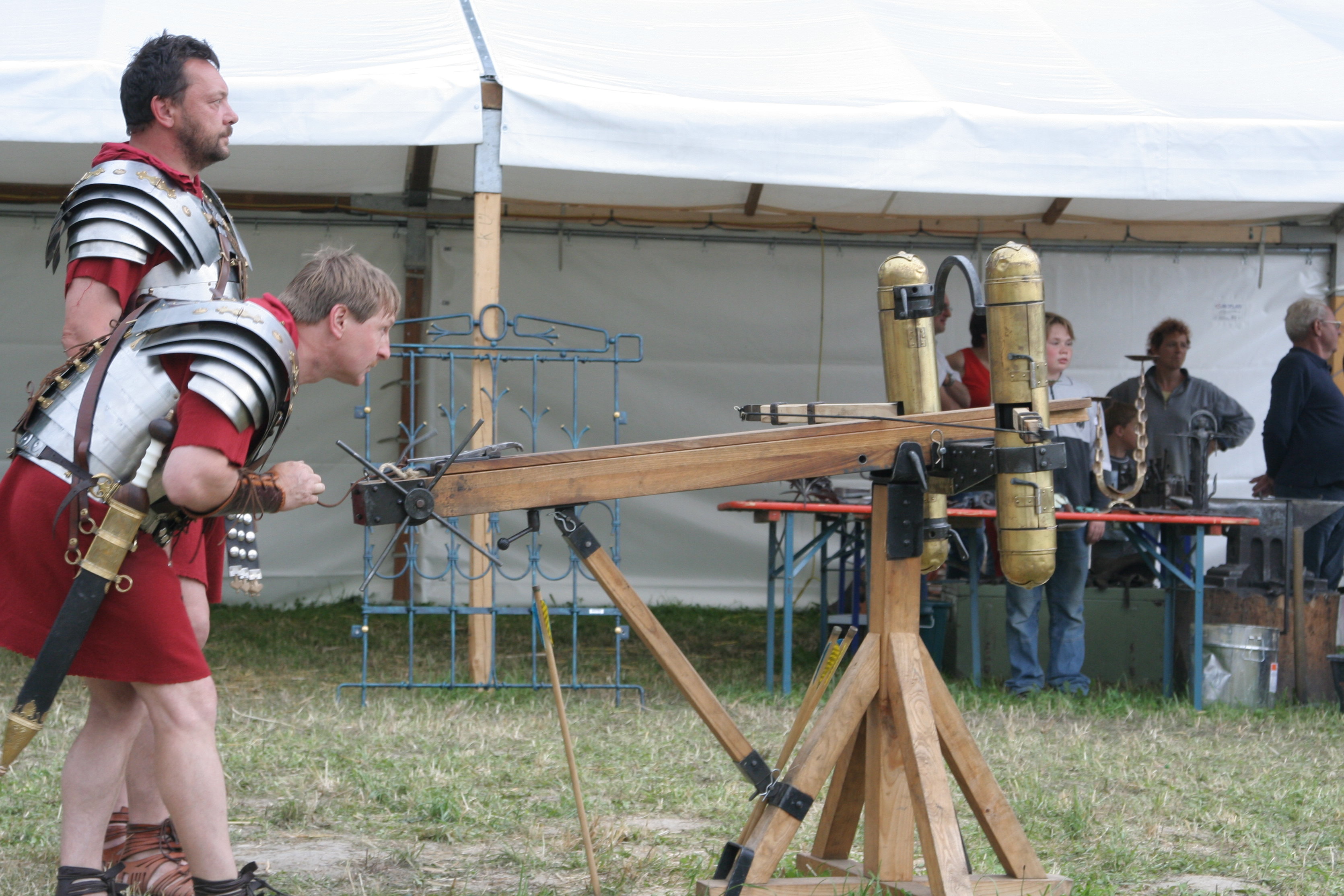
The Scorpio was the smallest of the artillery weapons, and was mostly used for sniping any one target within one hundred meters. It was basically a big crossbow whose bow apparatus consisted of two wooden arms connected to a torsion-mechanism. Its bolts could pierce the strongest armor, and the machine itself could be operated by one person. Every legion was supported by at least 60 Scorpios, giving the infantry a cover of deadly bolts to retreat under, should the battle prove contentious enough to warrant a second or third line engagement. It was mostly used to support Roman infantry in the field and in a siege, they were angled and fired in a parabolic fashion, quadrupling their range, but eliminating their precision. Still, the chance of getting instantly killed by one of 60 iron-tipped bolts that could rain from the sky any second was enough to cause the right kind of disruption within the besieged city.

The Ballistae was the Scorpio's steroid-popping big brother. Being much larger and more powerful, there were probably only a few Ballistae per legion, though reinforcements might bring more if there was a siege. In its early days, it hurled massive bolts over 460 meters, often impaling several men at once. Its purpose was mostly to cause fear in the beginning, though later it met with greater advancements which made it a very useful piece of field artillery. It was attached to wagons which would pull the terrible giant crossbow to wherever they could be deployed effectively, and let them rip into the enemy ranks.

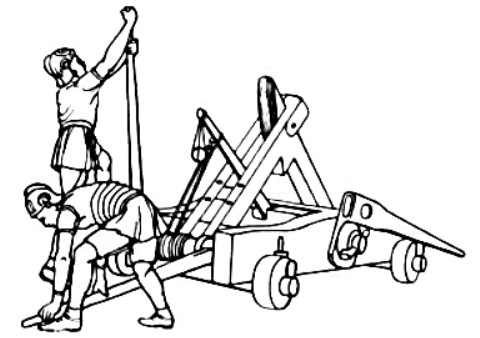
Let's face it: the real ultimate weapon of the ancient world was fire. Still a largely misunderstood and uncontrollable force in those days, the sight of fire alone could devastate an army's morale, much less the thought of having balls of the stuff thrown at them. The Onager existed for just this purpose. You may notice in the picture that the payload is contained in a sling, which increases its range, but pretty much destroys any sense of precision. It worked well enough to hurl pots of pitch over enemy walls to set alight whatever they happened to land on, wrecking food supplies, killing soldiers or civilians, and giving yet another calamity for besieged cities to fear.

In the Medieval period, many of these weapons would evolve in different ways; the Scorpio being replaced by the crossbow, the Ballistae by . . . well, better Ballistae, and the Onager by the catapult, which had a fixed bowl instead of a sling and was used to hurl hot coals or large boulders at whatever you want to die. As Hannibal learned the hard way, you can't take a city without laying a siege, and the Romans show us time and time again that it is always best to be prepared.

Pax vobiscum

Friday, May 28, 2010

Hail Caesar! - Rome's First Emperor

When Julius Caesar was stabbed to death during the famous Ides of March assassination in 44 BCE, he left a power vacuum big enough to suck Rome into yet another Civil War. After some initial sieges and skirmishes, which resulted in the deaths of the two sitting Consuls, this vacuum ended up being filled by three unlikely allies who were appointed to a kind of co-dictatorship in October, 43 BCE in hopes that they would check and balance each other over the course of their five-year term. What ensued should be no surprise to anyone who's been paying attention to the politics of the day: a temporary and uncomfortable alliance followed by massive Civil War.

Gaius Octavius Thurinus was Julius Caesar's grand-nephew, and renamed himself Gaius Julius Caesar after his great uncle adopted him, and I assume to confuse the later students of history. In any case, Octavius, as we shall call him, proved a worthy adversary for the other members of the Second Triumvirate, leading armies to victory against both the rebel armies of Caesar's assassins and Marcus Antonius.

Like many ancient people, the Romans would occasionally deify their dead leaders, and Caesar, though he was objectively ruthless, self-seeking, and a dangerous consolidator of power, was declared by the Senate to be a patron god of Rome on January 1, 42 BCE. Octavius, capitalizing on Caesar's honor, began referring to himself as the 'son of god' and no doubt won over several followers from Rome's middle and working class through his relationship with their late champion.

After Marcus Antonius was defeated at the Battle of Actium, Octavius was in a position to increase his influence and forever alter the Roman Republic. His power as Consul increased gradually, and he was smart enough to periodically return control to the Senate, as he did in 27 BCE. However, this Oligarchical body was made up of mostly sycophants and Caesarians, since the civil wars purged most of the old Republican guard. Plus, the soldiers in the provinces, over which Octavius had been named governor, were loyal to him personally and cared nothing for an ineffectual Senate that could not deliver on land reform or veteran benefits.

In January of 27 BCE, the Roman Senate bestowed the title of Augustus upon Octavius, a name which he would carry long after his death. The word Augustus comes from the same root word as Augur, a diviner who observed the flight of birds. The title was much more than a simple political office: it meant 'illustrious one,' and carried implications that Augustus Caesar not only held power over the politics of Rome, but over nature itself.

It is from these roots that all future Emperors of Rome would reign. And though Augustus Caesar's example was full of concessions and the avoidance of appearing supreme, his descendants would of course focus on his title, which implied that the Emperor was not merely a man, but a god.

Pax vobiscum

Wednesday, May 26, 2010

The Other Italians

Before the rise of Rome and its Empire, Italy was filled with a multitude of people groups, mostly tribal and nomadic, but united in themselves by common language and culture. One such people was the Samnites, whose culture was a combination of urban and tribal elements. They maintained their political independence until the Third Samnite War circa 290 BCE, when their land was taken by the Romans for good.

The Samnites worshiped the typical Greco-Roman Pantheon, especially Mars, Athena, and Hercules, and had the same tendency toward divination by birds and animal entrails. Their cities were surrounded by well-tended farms, while their shepherds would lead their flocks along a pre-determined grazing trail throughout the year.

Warfare was of utmost importance to these Latin tribesmen, and they had a reputation as ferocious fighters. Many believe that the Manipular system adopted by the Roman legions originally belonged to the Samnites, and they certainly understood the importance of army flexibility on the rough terrain of their homeland. They knew their lands well, and often used them to their advantage over the Romans and other peoples with whom they came into conflict.

Bravery served a dual purpose for these rugged shepherds as it directly affected their choice in marriage. Men who had performed great acts of bravery on the battlefield got first choice among the eligible women for a bride. Emotion in the ceremony itself was strictly forbidden, and men were expected to simply choose the woman they wanted with the approval of the tribal elders and priest.

Samnites fought with many weapons similar to Roman arms, including the javelin, spear, and rectangular shield (though theirs were tapered toward the bottom). However, they also excelled at using slings as well as the bow-and-arrow, crafts they no doubt perfected while protecting their herds from wild beasts or neighboring tribes. In one encounter with the Roman army, the Samnites had trapped several legions in a narrow pass called the Caudine Forks and positioned their archers high upon a nearby mountain to keep their enemy hemmed in.

The story goes that Gaius Pontius, the Samnite commander, was at an impasse when that Roman army surrendered to him. He dispatched a letter to his father, Herennius Pontius, a statesman and politician, to pick the old man's brain. Herennius responded in a letter that the Roman army should be freed, for which Rome would be grateful and possibly become an ally. Not liking this idea, Gaius sent another letter to his father, and this time the reply came back that the entire army should be executed, and Rome would then cease to be a threat for at least a generation. Gaius Pontius foolishly decided to try and have his cake and eat it, too, disarming the Romans and forcing them to pass under the “yoke”- a sort of doorway made of their own spears. The army returned unarmed and ashamed, but eager to have revenge and win back their lost honor. After honoring a five-year peace that they agreed to in their terms of surrender, they struck back hard at the Samnites and won the war, executing Gaius Pontius in the process.

Though they showed great promise as an up-and-coming civilization, the Samnites fell prey to their divided, tribal nature, and the Romans were able to play one family against another, successfully subduing their southern neighbors and incorporating them into Roman society as slaves, soldiers, and farmers.

Pax vobiscum

Monday, May 24, 2010

The Battle of Alesia

In 52 BCE, the Gauls had united in a last-ditch effort against the invaders. Any one tribe who stood up to the Romans in recent memory had been utterly defeated, but now there was a new hope. The tribes had convened a council and selected one man to lead the rebel army to victory and restore freedom to their war-torn homeland. And that man's name was Vercingetorix.

Using hit-and-run cavalry tactics while taking refuge in well-defended forts gave this rebel leader a few victories over the Roman army, led by the famous and able Gaius Julius Caesar. In one such engagement, Caesar's 12 legions had attempted to storm his position at Gergovia, Vercingetorix drove them back, killing 700 legionnaires in the process and nearly causing a mass route of the entire army. Caesar was clever, though, and chose from then on to hunt down small detachments of the larger Gallic army, whittling their forces down to a more manageable size. Vercingetorix went with his typical play of strategically withdrawing his troops to a fortified position: the town of Alesia, atop a small hill.

I can only imagine the thoughts that must have consumed this last, best hope for Gaulkind watching helplessly from the city walls as the Romans built their own walls to solidify their defense. He had to witness the slow deaths of the women and children of the city, who starved to death after being expelled from the city and were then forbidden to pass through the Roman camp. He dispatched scout cavalry in an attempt to slow the construction, hoping to last until the relieving Gallic army arrived. The situation was desperate, and his men growing close to insubordinate treachery when a Gallic army of 100,000 arrived to relieve the siege. Hope was in the air that at long last, the Romans would be driven back and they would be free once again.

The Romans were now facing a battle on two fronts, but they had the luxury of their two walls, which kept them very well protected from the combined forces of 180,000. Their own 60,000 legionnaires were disciplined and well-armed; their foreign auxiliaries ready to do their part. After a few skirmishes and one night attack, the Gauls took a few sections of the Roman trench. They prepared for an all-out assault on the weakest point of the fortifications – a section where the two walls met with boulders and other natural hindrances to construction, a place Caesar had attempted to conceal.

The relieving force assaulted first, charging straight into the infantry lines and meeting the Romans steel to steel. Caesar ordered his men to hold the line while riding behind their ranks and cheering them on. He then led a counter-attack which drove off Vercingetorix's besieged men, who had sallied out of Alesia to support their Gallic compatriots. His line, weakened by the men that Caesar took to defend their rear, began to fall back and Gaius had to roll the dice. In a move both brilliant and incredibly risky, he took 6,000 cavalry with him and circled around the massive Gallic horde of 60,000, flanking them and cutting deep into their assault line. The Roman infantry, seeing their commanders risking their necks, were inspired by their bravery and pushed forward, pinching the Gallic line and causing the undisciplined tribal army to rout. Roman cavalry took over from there, hunting the fleeing soldiers down without mercy and laying waste to any hope that Vercingetorix maintained of being freed from this terrible siege.

A few days later, the mighty Gallic warlord surrendered, giving up his sword and armor to Caesar, who gladly accepted. With this defeat, Gaius Julius Caesar would forever solidify Roman domination over the Gauls.

Pax vobiscum

Friday, May 21, 2010

Julius Caesar Part II: The Later Years

When we last left old Gaius Julius Caesar, he had just won Consulship for the year in 59 BCE by a nasty, corrupt election that left no Senator clean, including Caesar's most tireless opponent, the notoriously incorruptible Cato. Marcus Calpurnius Bibulus was elected to serve as the second Consul, but would prove to be an ineffective check against his fellow executive. Supporting Caesar were Crassus, to whom Julius owed his freedom, and Pompey, whom Caesar recruited by promising to support land redistribution, a wedge issue amongst the Senators, and one that Caesar would use to cast the elite into the role of petty oligarchs and himself as the egalitarian savior of Rome.

When Caesar proposed a series of reforms designed to redistribute tracts of land to the poor, Crassus supported it on the Senate floor, while Pompey garrisoned his soldiers inside the city, frightening the moderate Senators into passing the decree. Seeking divine intervention, Bibulus tried to declare foul omens and therefore end the assembly prematurely, but he was chased off by armed supporters of Caesar and a bucket of sewage was thrown onto him as he rushed to his home to remain until the end of his term. The law passed without further delay, and thus was the First Triumvirate born: an alliance of three ambitious and savvy populists who would ultimately turn on each other. Caesar and Bibulus' Consulship was so one-sided that the Romans jokingly referred to the year 59 BCE as the Consulship of Julius and Caesar.

Caesar's father-in-law was elected as Consul during the next term, and it was lucky for Caesar because the Optimate Senators were thirsty for his blood. Instead of being confined to stewardship of a nearby uninhabited forest, Caesar's friends saw to it that he was appointed the governor of Cisalpine Gaul and Illyricum, in northern Italy and just east of the Adriatic Sea. He was given command over four legions and was now prepared to fight his way out of his ever-increasing debt. He made war on some local tribes which had been arming themselves, and made some money from their spoils. His term as governor was made to be five years instead of the usual one, which was lucky because otherwise his debts would have made him a slave, and he would have faced prosecutions for his quasi-legal activities while serving as Consul.

His campaigns in Gaul led him all the way to Britain, which he invaded under the pretense that they had aided a local Gallic tribe against him, a shaky accusation against anyone other than the Britons, who were mostly Gauls themselves and very similar in culture. His first invasion didn't go well and he had to return to the mainland, but he succeeded following season, securing Roman-allied control over the southern portion of the island.

Meanwhile, back in Rome, Caesar's daughter Julia, whom he had married to Pompey to secure his alliance, died during childbirth in 54 BCE. He offered him his niece Octavia, but Pompey eventually refused. Crassus died the next year while trying to invade Parthia in the east. Pompey weighed his options carefully and chose to marry Cornelia, the daughter of Caesar's enemy Quintus Metellus Scipio. In 52 BCE, political violence in the city got so bad that Pompey was declared the sole Consul, an office very different from Dictator because a Consul is answerable for their actions in office while a Dictator is not. While in office, Pompey blocked an attempt by Caesar to serve as Consul in absentia, though this had been allowed in previous years. The Triumvirate was broken and the two men left would now fight over the real prize: Rome itself.

That same year, there was a massive rebellion in Gaul led by Vercingetorix, a charismatic and capable military leader who defeated the Roman legions on more than one occasion during the war. Eventually, the Gallic forces were defeated by superior technology through the extensive siegeworks in place at the Battle of Alesia and Vercingetorix was forced to surrender. I'd like to go into more detail here, but rest assured, there will be coverage of these battles in upcoming Military Mondays.

In 50 BCE, Pompey and the Senate ordered Caesar to lay down arms, disband his troops and return to Rome. Caesar believed that it was a trap; that Pompey, who had now joined his enemies, would lead the way in prosecuting Caesar for crimes real and fabricated. He was probably not far off, for at one point that year Pompey accused Caesar publicly of insubordination and treason. January 10, 49 BCE, Gaius Julius Caesar crossed the Rubicon River with one legion and set off the Civil War. When many of the cities in northern Italy surrendered willingly to the invading legion, Pompey and his Senator allies abandoned Rome and sailed for Greece, taking with them every ship in the harbors of southern Italy. And so Caesar, being unable to chase his quarry, set off to challenge Pompey's lieutenants in Iberia, declaring, “I go to fight an army without a leader, so as later I may fight a leader without an army.”

He swept up the remains of forces loyal to Pompey and the Optimates in Iberia and made passage to Greece, where he would square off against his old ally and former son-in-law. At the Battle of Dyrrachium the next year, Pompey's army, which outnumbered Caesar's own legions at least 3 to 1, easily broke through Caesar's battle lines and his army routed. Caesar himself withdrew, and Pompey probably could have ended the entire war then and there, but his years of alliance with Caesar had taught him to be wary of this crafty populist. He feared a trap, and so did not pursue the enemy legions. Even Caesar remarked later that victory had belonged to his enemies, if only one of them would have claimed it.

His forces resupplied and fought the Battle of Pharsalus, in which they won an impressive and decisive victory for Caesar. The Optimates' power now broken, they fled in all directions, while Pompey sailed to Egypt where he believed he might find refuge. Instead he was assassinated, and his head presented to Caesar by Pharaoh Ptolemy XIII, who believed the gift would win him Caesar's favor. It worked in the opposite, however, and Caesar soon cast his support for Ptolemy's sister, Cleopatra VII, helping her to secure the throne of Egypt before he left. Caesar maintained a close relationship with Cleopatra, and there are historical rumors that they had a secret love child. He could have never married the Egyptian queen, however, as she was not a Roman citizen.

There was still work to be done, so Caesar granted immunity to many of his former enemy Senators, while mopping up the remnants of Pompey's forces, defeating all military opposition by 45 BCE. He had been elected Dictator in 48 and again in 47 BCE. In 46 he was appointed as Dictator for an unprecedented 10-year term, which undoubtedly led to his downfall two years later.

On the 15th of March, 44 BCE, Caesar was attending a session of the Senate. A group of Senators had organized a conspiracy against this perpetual Dictator, calling themselves the Liberatores, or liberators. They lured Caesar into a false state of security by gathering around him to support a bill, and then proceeded to stab him repeatedly until he was dead. As many as 60 Senators participated in the assassination, and declared that Rome was now a free Republic once again.

Ultimately, Caesar's death did nothing to stem the tide of anti-Republican sentiment. In the old days of Rome, citizens were expected to be loyal to the State first, and many of the cautionary fables from the early years involve fathers ordering the executions of their own children if they betrayed the Republic. The shift from Republic to Empire was a gradual one, and as I said last week, Caesar is by no means the first ambitious Senator to have delusions of kingship. However, because the people had come to believe, generation after generation, that the Oligarchical Senators did not have their best interests at heart, they turned to Dictators and Emperors to right the wrongs that their own corrupt and bogged down bureaucracies had either created or failed to counteract. The fall of the Republic, and indeed Caesar's life as a whole, should send shivers down the spine of any government official, elected or otherwise, who fails to care for their citizens.


Pax vobiscum

Wednesday, May 19, 2010

The Iberians

The Gallic Celts who settled in Spain and mingled among the natives to create the Iberian culture changed very little about their culture in comparison to the Gauls who settled in modern-day France. So, rather than pick through the minutiae of differences between them and their north-eastern neighbors, I will give a short summary of their history and importance before showing several interesting pictures to display some of the more brilliant and unique aspects of the Iberian peoples.

The city of Gadiz was founded in 1104 BCE, according to tradition, and is therefore the oldest continually inhabited city in Western Europe. Its people were Phoenician colonists originally, but over time its population grew to include some local tribes who decided to give up nomadic herding for urban life. This seems to be a trend among the Gauls worldwide, that they eventually decide to build settlements instead of continuing to roam. The Phoenician-Iberian-Celts did very well for themselves, and Gadiz as well as other Spanish settlements became some of Carthage's most prosperous colonies. That's not to say that it was all fuzzy hugs with the Carthaginians; securing their cities from raiding tribes who were competing for resources meant conquering much of Spain, ensuring a healthy supply line for continued prosperity.

The Carthaginians were notorious for farming their wars out to mercenaries. Carthaginian soldiers would form the main line of their army, but they lacked the martial culture of Rome or even their more ancient colonists in Palestine (which you may know as the Philistines). They were much more interested in trade than war, so when war came about, they hired the mercenaries they needed to pursue their military agenda. The Iberian tribes which continued to live outside of Phoenician hegemony were offered a deal during the Second Punic War: fight for us and gain spoils and honest pay. However, try as he might, Hannibal did not have the logistical support necessary to successfully subdue Rome and the Second Punic War ended Carthaginian control over Iberia as part of the terms of peace. The Romans set up shop and used the massive, underpopulated region as their bread basket and plentiful source of metal.

This sword is called a falcata, and its weight is distributed in such a way that swinging it creates the same force and impact as swinging a larger battle axe. It dates to the 4th Century BCE.

The most useful of their weapons was adopted by the Romans around the 300's BCE and utilized more heavily in their army after the Second Punic War. The Iberian version of this sword was around 5 feet long, which the Romans shortened to 2-3 feet for the practical purpose of stabbing someone by going around their shield

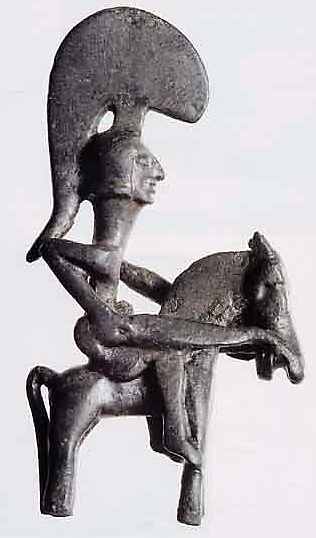
And lastly, this little bronze statue shows an Iberian knight on his horse, gladius in hand and plumed helmet looking very Greek. Clearly the Iberians had an equestrian class capable of purchasing and maintaining horses, indicating some level of class structure.

The Iberian peoples were Romanized at the first available opportunity, and lost most of their connections to the culture of the Gauls, who would not be conquered until Julius Caesar put an end to them once and for all in 50 BCE.

Pax vobiscum

Tuesday, May 18, 2010

Ancient Metallurgy

The manipulation of metal is one of the most important technological achievements of any civilization, whether ancient or modern. It's impact on both military and civilian life was so immense that entire periods of ancient history are named after the sorts of metals they were able to forge. The Bronze Age in Europe, for example, started in 2300 BCE and ended in 600 BCE. And the same way that modern advances often drive prices down for older technology, the Iron Age caused Bronze to become a more common, affordable commodity for soldier and farmer alike.

The ancient Europeans had many different methods for working metals long before the Romans added their own spice to the process. The earliest was probably hammering, where you just take two different malleable alloys and smash them together with a hammer until they've blended. Not the most efficient means, to be sure, but it was an effective, if time-consuming alternative to costlier methods involving furnaces and seals.

Provided you had a furnace, you could employ it to purify metals and weed out the slag, normally in preparation for working it. Smelting was commonly employed, a process where you seal the melting metal in a small container and separate the metal from the metal oxide. Before you smelted, however, you'd probably want to roast, which means almost literally barbecuing the metal over an open pit to eliminate the sulfur oxide before purifying the metal itself. After the metal has been melted and liberated of impurities, it would be cast into a mold where it would harden and become a plow, fork, helmet, or spearhead.

While the Romans certainly didn't create these and other primitive techniques, they built an empire upon the use of metals. Many of their early conquered lands were rich in metals of all sorts, and it wasn't long before captive slaves were sold to wealthy speculators who forced them to work the mines in Spain, Sicily, Britannia, and many other provinces. The mines were often dangerous, but it is interesting to note that the Romans appeared to have used a sort of hydraulic mining by utilizing their aqueducts and pushing water under some of the more metal-rich mountains especially in Spain. Just like with modern strip-mining, the result is almost offensive to behold.

Security of these mines was of top priority to the Roman government, whether Republican or Imperial. Many wars were fought over the resources they contained because the Romans knew that without a steady supply of metals, both precious and practical, the entire Empire would grind to a halt and even the city itself would be in danger. In fact, almost half of the time, they were fighting wars to ensure that they would be able to fight wars.

Pax vobiscum

Monday, May 17, 2010

The Disaster at Cannae

Just as our own Second World War overshadows the First, the Second Punic War made the First look like a ping-pong match. Hannibal Barca, the fearsome Carthaginian leader, had marched through the Alps, allied with several Gallic tribes, and made it his mission in life to humiliate every Roman army that tried to stop him. Thus, Quintus Fabius Maximus was given the title of prodictator, which means acting dictator, and given but one task: stop Hannibal. In hindsight, Fabius appears to be one of the wisest military men in Rome because after closely studying the Roman defeats at Trebia and Trasimene, he knew better than to allow Hannibal to decide the conditions of battle.

Instead of assaulting this army of 56,000 with his much larger force, he shadowed Hannibal during his march through southern Italy, staying up on high defensible ridges and mountains rather than meeting them openly. With enough patience, his strategy probably would have succeeded in either forcing Hannibal to fight on Roman terms, or flee home before his forces dwindled or mutinied. Hannibal tried everything to force a Roman confrontation, pillaging and raiding the countryside and devastating the landscape the Romans had fought so hard in securing a few generations before. However, Fabius was not like the previous hot-blooded Romans that Hannibal had so easily goaded into a fight they couldn't win. His patience meant that the Carthaginian forces had to spend the winter in southern Italy, cut off from their supply and forced to forage in the snow.

The rest of Rome was not sold on Fabius' pragmatism, however, and as soon as his term as prodictator was up, he was denied reelection and two Consuls served in the executive, both of whom favored an aggressive strategy against Hannibal. They were authorized to raise eight instead of the traditional four legions, which comes to 40,000 heavy infantry. In addition, their subservient Latin allies were levied for an additional 40,000 foot soldiers, along with 6,000 Roman and Allied cavalry, so that they outnumbered the Carthaginian troops almost 2 to 1.

Hannibal seized a valuable supply depot in Cannae and the huge Roman army came to face him in open battle. There was some contention among the two Consuls who led the army, with Varro favoring a pitched battle anywhere, anytime, and Paullus favoring a more prudent course of waiting for a better opportunity. On his day of command, Varro ordered his troops into action, changing their formation somewhat to accommodate his sense of tactics. Since they were fighting on an open plain, he had the maniples, who were normally spread out to allow for greater movement and flexibility, pushed together and had the Principes come up close behind the Hastati in an almost-phalanx way.

Hannibal advanced his line to meet the enemy, forming his troops into a “v” formation, pointing their axis toward the Roman line. Varro, believing that this would allow his troops to punch through the line and surround the enemy, advanced his own troops hurriedly, hoping to catch Hannibal off guard. However, as the bold Romans charged, the Carthaginian troops at the very front fell back to the solid line behind them, causing the Romans to charge faster and lose their cohesion, thinking that the enemy was already running away. This gave an opportunity for Hannibal's cavalry to do its work. They charged the opposing Roman cavalry, who were fewer in number and not near as well-equipped, and caused them to rout without much difficulty. Here's a handy diagram to illustrate:

Then they turned their attention to the battle-frenzied infantry line, flanking the Triarii in the rear as they charged forward. Before the Romans had time to react, they were surrounded on all sides, in the center of a deadly crush of arms from both footmen and cavalry. The army was utterly destroyed, according to Polybius around 70,000 died and 10,000 captured with only a few thousand escaping, while Hannibal's forces only suffered around 8-9,000 casualties.

The Senate felt the need to deal with Hannibal quickly because they feared that the other Latin cities would join with Hannibal if he were allowed to roam unchecked for too long. Ironically, it was his victory at Cannae that motivated many former allies of Rome to switch sides and declare for Carthage, including Macedonia, Syracuse, and several Latin cities. After this decisive victory, the Romans saw the need for prudence and pursued a Fabian policy of containment, which was Hannibal's ultimate undoing as he continually tried to replenish his forces for a siege that would never succeed. In the end, it was only by using Hannibal's own tactics against him that the Romans would ever see victory in the Second Punic War.
Pax vobiscum

Tuesday, May 11, 2010

Why do All Roads Lead to Rome?

The simple answer is that the Romans built them. There. Satisfied? I didn't think so. We see in the Romans a penchant to absorb and syncretize the things that they admired from other cultures, and in one respect, roads were no different. Government building of roads has been with humanity since at least the Ancient Persian Empire, and it is likely that the Etruscans brought a road-building ethic with them from Asia Minor, and that the Romans appropriated this idea. And if there was one thing that the politicians could all agree on, it was roads.

http://upload.wikimedia.org/wikipedia/commons/8/8c/PompeiiStreet.jpg

The Romans didn't just level dirt paths; they had a method of paving these roads which made them durable and easy to drive on. Merchants from all over mainland Europe used carts to transport goods, and sturdy, flat roads ensured that their more expensive breakable items would remain intact on the way to market. Travelers and pilgrims eager to visit the famous Temple of Saturn in the heart of Rome could now make the trip without fear of getting lost, since Augustus made the Temple the starting point for the marker stones. If the numbers on the stones got smaller, you were heading for Rome, hence the famous saying.

The politics of roads was always contentious, with many Patrician Senators using their vast treasuries to pave large, wide roads and name them after themselves. Like the Gladiatorial games, this was a good way to endear themselves to an underrepresented populace of mostly Plebeians. However, anyone who built a road in the early Republic was required to pay for its upkeep, which could be a problem if a wealthy Senator got involved in shady financial dealings that went south.

Eventually, the Roman Empire was connected by a large system of roads, which were eventually all made public property. Armies could march over the roads very easily compared to marching through dangerous forests and hunting paths. While this also helped the enemy armies of 'barbarians' to invade, the Romans made a habit of building a system of outposts and forts near choke points, and had a swift communication system to help ward off the smelly hordes. The roads lasted for centuries, some of them being preserved up to this present day.

http://upload.wikimedia.org/wikipedia/commons/thumb/d/df/Roman_Empire_125.svg/500px-Roman_Empire_125.svg.png


Friday, May 7, 2010

Archimedes

Unfortunately, Archimedes is one of those semi-mythical guys who wasn't written about heavily until hundreds of years after his death. What we do know about him is a combination of contemporary and later sources, all of which agree on at least one thing: he was crazy smart.

He approximated pi to an unprecedented degree, which by itself is one heck of an accomplishment. He built world-changing inventions, created new mathematical formulas which incorporated infinity and zero (two concepts which scared the daylights out of Aristotle), applied buoyancy, and created complicated pulley systems which allowed for the earliest cranes to be built. I have focused mostly on how his inventions applied to warfare and farming, but those were the two chief interests of the ancient Mediterranean, when you get right down to it.

Though he died an untimely death at the hands of a foolish Roman Legionnaire, his concepts and inventions continued to change history long after his death. That is, the inventions that they could duplicate continued to change the world. There were several items the plunderers found in his workshop which could not be re-created and were taken as trophies by Marcellus and his Captains. One of them was a sphere with gears and levers which could calculate the exact position of the known planets.


Pax vobiscum


Monday, May 3, 2010

The Siege of Syracuse

Located in south-eastern Sicily, Syracuse was an old Corinthian-Greek Colony with old-time values. Ruled over by kings and tyrants since its founding in 733 BCE, Syracuse enjoyed the many benefits of its central Mediterranean locale and became very wealthy through trade with Egypt, Rome, Carthage, Asia Minor, Palestine, and Spain. After the Pyrrhic war in 275 BCE, however, it was the sole remaining Greek settlement west of the Peninsula itself, and in a very tenuous position sandwiched between Rome and Carthage.

Syracuse survived for quite a while after Pyrrhus' final defeat because its leaders made smart alliances and used skilled diplomacy to ensure the protection of either Rome or Carthage. When the first Punic War broke out, Syracuse was at the center of the action and made an alliance with Carthage from fear of Rome. Luckily, Rome and Carthage fought each other so bitterly that by the time Rome got around to dealing with the unlucky Sicilian Greeks, they had already lost so many in battle that they were willing to settle for an apology and a cut of their trade. However, when the second Punic War broke out, Syracuse made the mistake of allying with Carthage again, and the Romans were determined to make them pay. However, Roman vengeance would come at a high cost to the Republic because of one resident of Syracuse whose mind possessed knowledge that could bring both great prosperity and very great destruction. This man's name was Archimedes.

I like to think of Archimedes as a sort of ancient world Da Vinci, except without the moral qualms about creating weapons. Where Da Vinci was purposefully putting gears in the wrong place so that his designs would ultimately fail, Archimedes was not only sketching these out, but utilizing them to a terrible degree of success. For this week's Famous Friday, we'll delve into Archimedes' discoveries in greater detail, but since it's Military Monday, let's focus on his original and horrific siege weapons.

The most famous of his weapons was The Claw, which utilized pulleys and complicated weight balancing to capsize Roman Triremes. Seriously, this crane-like weapon would hook onto the bow or stern of the boat, lift it out of the water, and send it crashing against the nearby rocks. Each boat carried about two hundred soldiers, so you can imagine the carnage that ensued when this happened over and over:


Another of his creations was an improved catapult. Again, using pulleys and counterweights, he was able to create an engine capable of throwing a 500 pound rock with much better accuracy than the inferior Roman scorpions and ballistae. He also contributed to the building of other weapons which could fire missiles and keep the Romans at bay.

The most controversial of his creations was his 'death ray.' Several authorities have tested it using various techniques, and some have been successful, while most have ended in a wash. Supposedly, Archimedes built a large array of bronze mirrors which could be turned, focusing their reflected light into a concentrated beam onto an approaching ship. The Roman ships, which were sealed with tar, caught on fire and sunk. While this does seem a bit far-fetched, I wouldn't put it past old Archie to give it a try. After all, it was Hiero II, the king of Syracuse and relative of Archimedes, who frequently challenged the genius and gave him the funding he needed to build better weapons since the first Punic War, so why wouldn't this mathematician try literally everything he could think of? Were there easier ways to light ships on fire? Yeah, lots. But if I were an invading Roman, I might think twice about mixing it up with an enemy who can light my ships on fire without shooting anything.

Syracuse eventually fell to sheer Roman determination, and Archimedes was killed, possibly while drawing circles in the sand. If not for him, the last Greek colony on Italian soil would surely have fallen in the first year, and Carthage wouldn't have stood a chance of surviving the Second Punic War. By the time the Roman army came to the gates of Carthage, they had suffered so many casualties from Syracuse and from fighting Hannibal for ten years that they allowed Carthage to live, albeit under severe economic sanctions. And when Carthage was finally leveled in the Third Punic War, there were no more brilliant mathematicians around to set Romans on fire from a distance.

Pax vobiscum