Showing posts with label Hannibal. Show all posts

Wednesday, January 9, 2013

Soldiers and Ghosts: A Review

When you have a hobby, you tend to get cocky about it.  You think about how smart or skilled you are to be pursuing something because you enjoy it and not because you're in school or because it's your job.  If you're not careful, you eventually begin to think that you can't possibly learn anything new about your subject.

I purchased Soldiers and Ghosts with an Amazon Gift Card last year, and I finally got around to reading it, thinking that it would be fun to read a fresh account of Cannae or read Hannibal's life story.  Again.  What I wasn't expecting was a psycho-cultural analysis of the motives behind the tactics of ancient warfare, starting with the early Greeks.  And I certainly wasn't expecting the first battle I read about to have taken place during the Vietnam War.

Spoiler Alert: the Ancient Romans weren't even involved in the Vietnam War for some reason.
It is a common assumption that warfare has always been about practicality and pragmatism.  The Greeks used the phalanx with great success, and we assume that they chose it primarily for its effectiveness.  However, we often forget that the Ancient people lived in a very different world than ours; a world of augury and divination, of mysticism and heavenly conflicts, of invisible forces that haunted their every step.  They did not look at the Olympic Pantheon as a rustic mythological belief system; it was what they believed.  It stands to reason that their motivations went way beyond simple pragmatic strategy.

My first clue to the Romans' lack of pragmatism is that they all seem to be wearing their baseball caps backward.
But J. E. Lendon puts it best when he explains it this way: "These [people of Papua New Guinea] are peoples who fight wars in ways we call ritualized, meaning they allow their beliefs to dictate a mode of fighting less ruthlessly efficient than we could devise for them.  There are other ways, too, in which beliefs draw modern armies away from purely efficient methods of killing: the reluctance, since World War I, of many armies to employ poison gas and the practice of preserving the lives of prisoners.  Such restraints are powerfully reinforced by the scorpion sting of the Golden Rule: soldiers do not want to be gassed themselves, and they want their own surrenders to be accepted.  But such restraints are grounded also in shared belief: the belief that war has rules, however fragile, and that there are appropriate ways of killing and methods of killing too horrible to be used." (pp.3-4, emphasis mine)

Other highlights and insights include:

  • "Sometimes the glory of the victor depends not only upon his observed performance, but also on the excellence of the defeated; this is a second, quite separate, mechanism for gaining glory in battle." (p. 26)
  • "But the ethos that lay underneath this cooperation [of the phalanx] was only superficially cooperative, for those who fought in the seemingly unheroic phalanx conceived of what they were doing in Homeric terms . . . if grave reliefs were our only evidence we would never imagine that the Greeks fought massed in the phalanx rather than as heroic individuals." (pp.44-45)
  • "Amidst the showers of spears and arrows and stones, amidst the running to and fro and confusion and stabbing by surprise, men of high standing would go down, killed anonymously by stray missiles and the spears of low wretches, trampled by horses, or crushed ingloriously by stray chariots.  In the confusion the high deeds of the brave would go unnoticed, along with the cringing of the cowardly." (p. 46)
  • "Yet it is not in spear fighting in which the hoplite competes but holding his place in the line, and the courage of holding one's place is perhaps the form of martial behavior whose success in the real world is most in the hands of the warrior and subject to the least external influence." (p. 53)
  • "The irony of Thermopylae is that, although the Spartans went to their deaths according to the hoplite code, they did not in their last hours fight entirely as hoplites, bravely holding their ground." (p. 66)
  • "Xenophon urges the hiring of foreign mercenary cavalry chiefly to inspire a sense of rivalry in the Athenian cavalry." (p. 103)
  • "Macedonian leaders had to fight with their own hands because that is how they commanded the obedience of their soldiers." (P. 137)
  • "Soldiers fight well not because they are compelled from above but because they do not want to let down their comrades." (p. 171)
  • "For disciplina [Roman Discipline] was not primarily a system of imposed or felt rules to make an unwarlike people place themselves in danger or to do something unnatural to them . . . it is conceived primarily as a brake to overly aggressive behavior." (p. 177)
  • "The Roman soldier did not primarily think of himself as part of a team, and he was not treated as such by his officers.  Rather, he regarded his comrades as his competitors in aggressive bravery." (p. 185)
  • "The manipular legion was the fruit of compromise resulting from the meeting of an imported method of fighting, the phalanx, with a people whose martial values, whether inherited or new-acquired, made fighting in the phalanx a heroic challenge for them." (p. 190)
  • "After a loss a Roman general might be prosecuted for personal cowardice, but not for tactical stupidity." (p. 207)
So, yeah.  I highly recommend reading this book if you're ready to go beyond the surface-level of Ancient-world tactics and strategies to learn about the cultural forces that drove them.  I'm pretty busy with other plans at the moment, but I'll probably have a few blog posts related to the claims in this book coming up in the near future, so look forward to that.

Friday, June 4, 2010

Scipio Africanus: A New Kind of Roman

Known to readers of this blog as 'that guy who finally beat Hannibal,' Scipio Africanus was much more than just another Roman military genius. He grew his hair long, wore his toga in an unorthodox style, preferred Greek culture and language to Latin, and became a model of later charismatic commanders like Gaius Marius, Lucius Cornelius Sulla, and Julius Caesar. Scipio introduced the cult of personality into Roman politics, and it was a cult that would outlive and ultimately destroy the Republic itself.

Scipio got his start at age 17, joining his father on campaign against the Carthaginian invaders. He was present at the battles of Ticinus, Trebia, and Cannae, all of which ended with decisive victories for Hannibal. In 211 BCE a mere five years after that crushing defeat at Cannae, Scipio went to the Senate and requested command over the new Roman army which was being sent to Spain (the previous army had been utterly destroyed by Hannibal's brother Hasdrubal). The other candidates kept their mouths shut, believing Spain to be a death sentence, now that it was once again so firmly under Carthaginian control. Scipio promptly captured New Carthage and proceeded to win goodwill for Roman occupation. He set captives free, and returned a young Celtiberian princess to her fiancé and family, thus earning that tribe's allegiance against the Carthaginians.

Wisely plotting his strategic course, he sought to defeat the three Carthaginian armies in the area one by one, knowing that they would too far outnumber his own legions if he faced them all at once. He faced off against Hasdrubal Barca in the battle of Baecula and gained a victory by using a similar technique that gave Hannibal the victory at Cannae. Hasdrubal withdrew and marched on Italy, and in a controversial move both now and then, Scipio Africanus refused to pursue. There have been many theories of why he did this, but I tend to believe that it was his strategic good sense that prevented him from risking being caught between the remnants of Hasdrubal's forces and those of Mago or Gisgo, the other two Carthaginian commanders in Spain.

After gaining more Celtiberian allies, he defeated the two other Carthaginian commanders at Ilipa (modern Seville) in 206 BCE, and consequently drove their commanders out of Spain entirely. In addition to recruiting the local tribes, Scipio also made overtures to Syphax and Massinissa, two Numidian princes who agreed to cease their support of Carthage and supply the Roman army with cavalry. This was a huge win for the Romans because Numidian cavalry of the time outmatched nearly all other types, and was one of the chief causes of Hannibal's many successes. Syphax later switched back to the Carthaginian side, marrying one of their noble-ladies to seal the deal, but Massinissa proved extremely helpful in the later invasion of Carthage itself.

Scipio was the ultimate success story for the new culture of Rome: a culture which was fast-growing among the military and plebs. The old Roman model of farmer/soldier was quickly eroding under the increasing power of the Senate and their abusive practices toward the soldiers and the poor. The conservatives in the Senate distrusted his charismatic Greek mannerisms and disliked his fame. When Scipio won at Zama and ended the Second Punic War, he was greeted as a national hero in Rome and given his famous moniker Africanus. Several dissident groups offered to nominate him as Dictator or Consul for Life, but to his credit, he refused. It seems that this radical, innovative commander and politician had some old-fashioned Roman virtue in him after all.

Pax vobiscum

Tuesday, June 1, 2010

To Siege, or Not to Siege?

The basic siege tactic is to wait around until your enemy gets desperate enough to surrender, rather than starve to death. Sure, it's effective if the city has no allies and no hope of relief, but if they're well supplied, you could be waiting for years while your homestead's crops wither and you contract dysentery. Therefore, since they excelled at every other form of combat, it makes perfect sense that the Romans would use their engineering skills and upgrade a few local weapons to make them capable of destroying walls, piercing armor, and making life for the besieged as uncomfortable as possible.

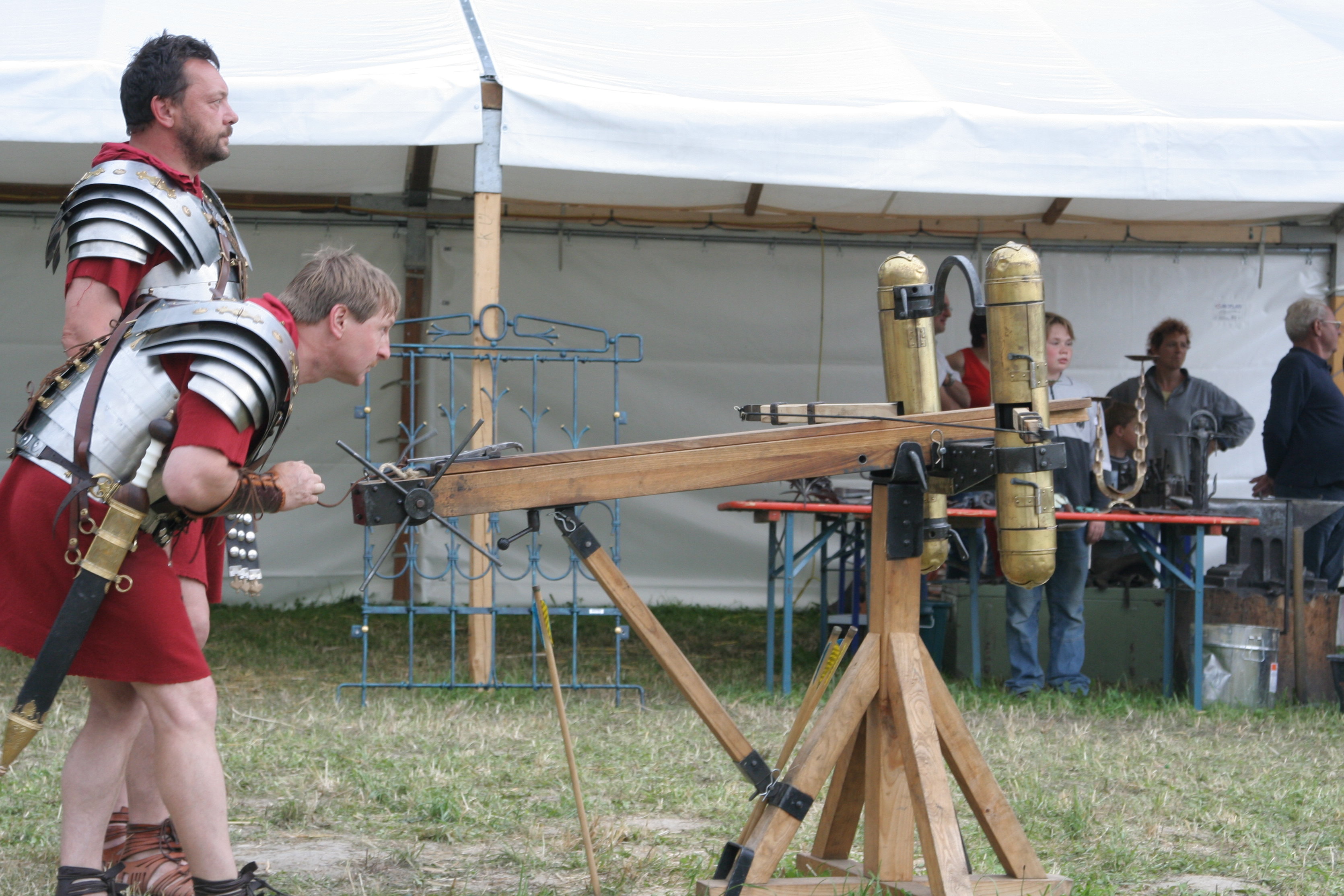
The Scorpio was the smallest of the artillery weapons, and was mostly used for sniping any one target within one hundred meters. It was basically a big crossbow whose bow apparatus consisted of two wooden arms connected to a torsion-mechanism. Its bolts could pierce the strongest armor, and the machine itself could be operated by one person. Every legion was supported by at least 60 Scorpios, giving the infantry a cover of deadly bolts to retreat under, should the battle prove contentious enough to warrant a second or third line engagement. It was mostly used to support Roman infantry in the field and in a siege, they were angled and fired in a parabolic fashion, quadrupling their range, but eliminating their precision. Still, the chance of getting instantly killed by one of 60 iron-tipped bolts that could rain from the sky any second was enough to cause the right kind of disruption within the besieged city.

The Ballistae was the Scorpio's steroid-popping big brother. Being much larger and more powerful, there were probably only a few Ballistae per legion, though reinforcements might bring more if there was a siege. In its early days, it hurled massive bolts over 460 meters, often impaling several men at once. Its purpose was mostly to cause fear in the beginning, though later it met with greater advancements which made it a very useful piece of field artillery. It was attached to wagons which would pull the terrible giant crossbow to wherever they could be deployed effectively, and let them rip into the enemy ranks.

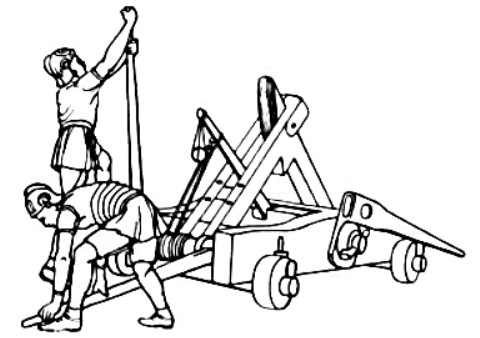
Let's face it: the real ultimate weapon of the ancient world was fire. Still a largely misunderstood and uncontrollable force in those days, the sight of fire alone could devastate an army's morale, much less the thought of having balls of the stuff thrown at them. The Onager existed for just this purpose. You may notice in the picture that the payload is contained in a sling, which increases its range, but pretty much destroys any sense of precision. It worked well enough to hurl pots of pitch over enemy walls to set alight whatever they happened to land on, wrecking food supplies, killing soldiers or civilians, and giving yet another calamity for besieged cities to fear.

In the Medieval period, many of these weapons would evolve in different ways; the Scorpio being replaced by the crossbow, the Ballistae by . . . well, better Ballistae, and the Onager by the catapult, which had a fixed bowl instead of a sling and was used to hurl hot coals or large boulders at whatever you want to die. As Hannibal learned the hard way, you can't take a city without laying a siege, and the Romans show us time and time again that it is always best to be prepared.

Pax vobiscum

Monday, May 31, 2010

The Genius of Hannibal

I thought I'd take some time out today to simply marvel at one of history's most famous tacticians. Hannibal's genius cannot be understated, in my opinion: he was a man far ahead of his time and culture, and had his family been positioned a little more favorably within Carthaginian politics, it seems likely that history would remember the Second Punic War as the event that ended Roman expansion and brought the rogue Italian superpower to heel, paving the way for Phoenician hegemony throughout the Mediterranean.

The Barca family had a reputation as fierce fighters and noble warriors. However, Carthaginian culture was largely based on trading and the mighty city trained only a small percentage of its residents as professional soldiers, hiring most of the work of battle out to mercenary groups. Hence, though Hannibal's father Hamilcar fought the last eight years of the First Punic War with virtually no support from Carthage itself, his sacrifice and continual victories counted for little in the eyes of Carthaginian politicians, who allowed him an expedition in Spain after the war mostly to get rid of him. Young Hannibal joined his father in this conquest, and spent most of his adolescent years encamped with the soldiers, who took a liking to the young warrior and trained him in every weapon they could. Thus, when Hannibal one day took up his father's reigns and led the army, he commanded strong personal loyalty from them and there is no report of mutiny among his troops to be found in recorded history.

I like to believe that Hannibal's military education was two-fold: he likely learned about the more efficient “guerilla” tactics from his father, and the more practical, battlefield realities from the encamped soldiers. Thus, we have events like the Battle of Trebia, in which Hannibal hid some allied forces to execute an ambush against the already engaged Roman infantry, whom he had also deprived of their morning breakfast and forced to walk through the freezing Trebia river. That battle alone combines many elements from Hannibal's likely upbringing: the ambush tactics his father perfected, plus knowing that an unfed army poses little threat to a well-supplied force.

The biggest innovation in Roman tactics of that time was the maniple system, which allowed different lines of infantry to assault the enemy's front lines while having an avenue to fall back should the battle prove difficult. While they did deploy cavalry on their wings, their only purpose was to engage the enemy cavalry. This helped to win many battles, but was still essentially focused on the enemy's front. Hannibal knew that his forces would eventually be facing larger numbers, and so he focused on mobility, harassment, and flanking.

His wisdom in fighting battles also extended to knowing when he could not win. While Fabius was struggling to contain him in southern Italy, Hannibal tricked one of the containment armies by attaching torches to a herd of oxen and driving them through the forest at night. Thinking it was the enemy army preparing an ambush, the legions followed the torches, determined to out-ambush this troublesome Carthaginian. While they were busy chasing oxen, Hannibal led his forces through the now undefended pass and made for resupply in the north.

The saying goes that amateurs study tactics, while professionals study logistics. Unfortunately for Hannibal, he never fully secured supply lines from Carthage, and had to repeatedly fight for resupply from the Gauls or whichever Italian city decided to join him that week. Though he spent an impressive ten years in Italy campaigning successfully against the Romans, it was only a matter of time until the Romans took the war to Carthage, giving command to the unorthodox general Scipio Africanus, who would use Hannibal's own tactics to gain a victory over Carthage and Hannibal at the Battle of Zama.

Pax vobiscum

Thursday, May 20, 2010

The Ultimate Sacrifice

This story from the Greek oral tradition stands out as one of the most heinous crimes of the Trojan War. King Agamemnon made a foolish boast against Artemis after shooting a stag through the heart with a single arrow. She cursed his upcoming expedition against Troy unless he made a sacrifice: his eldest daughter Iphegenia. He obliged, and the war was ultimately successful, but the cruel king himself was murdered when he returned home by avenging family members. There is a similar story in the Bible's Old Testament centering around Jephtha, a Charismatic Judge who swore to sacrifice the first creature that approached him when he returned home if God would grant him a victory over the Philistines. The first creature was his daughter, whom he sacrificed to Yahweh, an event that stands completely alone in Judeo-Christian scriptures. The Greeks, Hebrews, and Romans had come to feel that human sacrifice was wrong by the 500's BCE or before, and kept it out of their worship, exiling it to their oral traditions as cautionary tales rather than promotional stories.

All this is to say that the Phoenicians were not alone in sacrificing people to their gods, but they were getting lonelier when they extended that practice into the early 100's CE. Carthage was the most powerful of the old Phoenician colonies, and by the 300's BCE its power was slowly being crushed under the weight of political corruption and a vacuum in leadership. Having almost no native military power because of their tendency to hire foreign mercenaries to do their fighting, they could only appeal to their gods when Scipio Africanus was at their gates.

The Phoenician deities were of a much older variety than the Greco-Roman gods, being much more like the savage Titans than the diplomatic Olympians. Ba'al was their chief deity, and his very name is derived from the Semitic word El, which means god, and is used in Hebrew words like El Shaddai or Elohim, referring to Yahweh and his angels. His partner goddess was Tanit, whose symbol included a crescent moon and star not unlike the modern Islamic symbol. The Romans identified Ba'al as Saturn, the father of Jupiter who had been usurped by the Olympians years ago, and it seems likely that they factored this into their ideas of superiority to the Carthaginians.

To me, the evidence of child sacrifice in Carthage is very clear. There are mass graves filled with children whose bones have been charred by sacrificial fire. Those who try and make the case that the children had already died of some disease or natural cause before being cremated are ignoring the fact that no evidence of any disease has been found among the remaining bones. I know very well the desire to demonize the Romans and try to rewrite history based on how we would have liked it, but the facts are the facts, and I see no benefit to these attempts at making the Carthaginians into something they are not.

In the cult of Ba'al, children were sacrificed to gain special favor from the gods. The idea was that only blood could show your true devotion to the gods' fame, and what better way to show your true devotion than giving your own child? The Romans and Greeks certainly were no strangers to the idea of blood sacrifice, often killing bulls, birds, and other animals in acts of worship and for divination, but human sacrifice of any kind had long since been outlawed by the Punic Wars.

That is not to say that the Carthaginians always sacrificed their own children. There are accounts (from 800 BCE) of aristocrats buying slave children to sacrifice in place of their own, but in times of famine, war, and hardship the priests would encourage parents to give their youngest child to the fires of Ba'al. Ba'al was associated with the sun, and by extension, fire, which is why the children were killed with a ceremonial knife before being thrown into the blaze.

One bit of evidence that often escapes Carthaginian apologists is the account of young Hannibal joining his father for a campaign in Iberia. It is written that he begged his father repeatedly to join him, and that his father, bitter from the recent defeats in the First Punic War, agreed to take Hannibal only if he would swear an oath against friendship with Rome. Hannibal responded by placing his arm over a nearby open firepit and swearing that he would use fire and steel to arrest the destiny of Rome. While this story is probably mostly fiction, it displays a practice that seems logical for a people who worship a god of fire. What better way to swear an oath by such a god than by allowing the fire to singe you just a little bit to prove your devotion?

No matter how antiquated or barbaric it seems to us, sacrificing animals to appease gods can certainly be said to contribute to the later spread of Christianity, which presented Christ, the sinless man who served as a blood sacrifice for all who believe.

Pax vobiscum

Monday, May 17, 2010

The Disaster at Cannae

Just as our own Second World War overshadows the First, the Second Punic War made the First look like a ping-pong match. Hannibal Barca, the fearsome Carthaginian leader, had marched through the Alps, allied with several Gallic tribes, and made it his mission in life to humiliate every Roman army that tried to stop him. Thus, Quintus Fabius Maximus was given the title of prodictator, which means acting dictator, and given but one task: stop Hannibal. In hindsight, Fabius appears to be one of the wisest military men in Rome because after closely studying the Roman defeats at Trebia and Trasimene, he knew better than to allow Hannibal to decide the conditions of battle.

Instead of assaulting this army of 56,000 with his much larger force, he shadowed Hannibal during his march through southern Italy, staying up on high defensible ridges and mountains rather than meeting them openly. With enough patience, his strategy probably would have succeeded in either forcing Hannibal to fight on Roman terms, or flee home before his forces dwindled or mutinied. Hannibal tried everything to force a Roman confrontation, pillaging and raiding the countryside and devastating the landscape the Romans had fought so hard in securing a few generations before. However, Fabius was not like the previous hot-blooded Romans that Hannibal had so easily goaded into a fight they couldn't win. His patience meant that the Carthaginian forces had to spend the winter in southern Italy, cut off from their supply and forced to forage in the snow.

The rest of Rome was not sold on Fabius' pragmatism, however, and as soon as his term as prodictator was up, he was denied reelection and two Consuls served in the executive, both of whom favored an aggressive strategy against Hannibal. They were authorized to raise eight instead of the traditional four legions, which comes to 40,000 heavy infantry. In addition, their subservient Latin allies were levied for an additional 40,000 foot soldiers, along with 6,000 Roman and Allied cavalry, so that they outnumbered the Carthaginian troops almost 2 to 1.

Hannibal seized a valuable supply depot in Cannae and the huge Roman army came to face him in open battle. There was some contention among the two Consuls who led the army, with Varro favoring a pitched battle anywhere, anytime, and Paullus favoring a more prudent course of waiting for a better opportunity. On his day of command, Varro ordered his troops into action, changing their formation somewhat to accommodate his sense of tactics. Since they were fighting on an open plain, he had the maniples, who were normally spread out to allow for greater movement and flexibility, pushed together and had the Principes come up close behind the Hastati in an almost-phalanx way.

Hannibal advanced his line to meet the enemy, forming his troops into a “v” formation, pointing their axis toward the Roman line. Varro, believing that this would allow his troops to punch through the line and surround the enemy, advanced his own troops hurriedly, hoping to catch Hannibal off guard. However, as the bold Romans charged, the Carthaginian troops at the very front fell back to the solid line behind them, causing the Romans to charge faster and lose their cohesion, thinking that the enemy was already running away. This gave an opportunity for Hannibal's cavalry to do its work. They charged the opposing Roman cavalry, who were fewer in number and not near as well-equipped, and caused them to rout without much difficulty. Here's a handy diagram to illustrate:

Then they turned their attention to the battle-frenzied infantry line, flanking the Triarii in the rear as they charged forward. Before the Romans had time to react, they were surrounded on all sides, in the center of a deadly crush of arms from both footmen and cavalry. The army was utterly destroyed, according to Polybius around 70,000 died and 10,000 captured with only a few thousand escaping, while Hannibal's forces only suffered around 8-9,000 casualties.

The Senate felt the need to deal with Hannibal quickly because they feared that the other Latin cities would join with Hannibal if he were allowed to roam unchecked for too long. Ironically, it was his victory at Cannae that motivated many former allies of Rome to switch sides and declare for Carthage, including Macedonia, Syracuse, and several Latin cities. After this decisive victory, the Romans saw the need for prudence and pursued a Fabian policy of containment, which was Hannibal's ultimate undoing as he continually tried to replenish his forces for a siege that would never succeed. In the end, it was only by using Hannibal's own tactics against him that the Romans would ever see victory in the Second Punic War.
Pax vobiscum

Monday, May 3, 2010

The Siege of Syracuse

Located in south-eastern Sicily, Syracuse was an old Corinthian-Greek Colony with old-time values. Ruled over by kings and tyrants since its founding in 733 BCE, Syracuse enjoyed the many benefits of its central Mediterranean locale and became very wealthy through trade with Egypt, Rome, Carthage, Asia Minor, Palestine, and Spain. After the Pyrrhic war in 275 BCE, however, it was the sole remaining Greek settlement west of the Peninsula itself, and in a very tenuous position sandwiched between Rome and Carthage.

Syracuse survived for quite a while after Pyrrhus' final defeat because its leaders made smart alliances and used skilled diplomacy to ensure the protection of either Rome or Carthage. When the first Punic War broke out, Syracuse was at the center of the action and made an alliance with Carthage from fear of Rome. Luckily, Rome and Carthage fought each other so bitterly that by the time Rome got around to dealing with the unlucky Sicilian Greeks, they had already lost so many in battle that they were willing to settle for an apology and a cut of their trade. However, when the second Punic War broke out, Syracuse made the mistake of allying with Carthage again, and the Romans were determined to make them pay. However, Roman vengeance would come at a high cost to the Republic because of one resident of Syracuse whose mind possessed knowledge that could bring both great prosperity and very great destruction. This man's name was Archimedes.

I like to think of Archimedes as a sort of ancient world Da Vinci, except without the moral qualms about creating weapons. Where Da Vinci was purposefully putting gears in the wrong place so that his designs would ultimately fail, Archimedes was not only sketching these out, but utilizing them to a terrible degree of success. For this week's Famous Friday, we'll delve into Archimedes' discoveries in greater detail, but since it's Military Monday, let's focus on his original and horrific siege weapons.

The most famous of his weapons was The Claw, which utilized pulleys and complicated weight balancing to capsize Roman Triremes. Seriously, this crane-like weapon would hook onto the bow or stern of the boat, lift it out of the water, and send it crashing against the nearby rocks. Each boat carried about two hundred soldiers, so you can imagine the carnage that ensued when this happened over and over:


Another of his creations was an improved catapult. Again, using pulleys and counterweights, he was able to create an engine capable of throwing a 500 pound rock with much better accuracy than the inferior Roman scorpions and ballistae. He also contributed to the building of other weapons which could fire missiles and keep the Romans at bay.

The most controversial of his creations was his 'death ray.' Several authorities have tested it using various techniques, and some have been successful, while most have ended in a wash. Supposedly, Archimedes built a large array of bronze mirrors which could be turned, focusing their reflected light into a concentrated beam onto an approaching ship. The Roman ships, which were sealed with tar, caught on fire and sunk. While this does seem a bit far-fetched, I wouldn't put it past old Archie to give it a try. After all, it was Hiero II, the king of Syracuse and relative of Archimedes, who frequently challenged the genius and gave him the funding he needed to build better weapons since the first Punic War, so why wouldn't this mathematician try literally everything he could think of? Were there easier ways to light ships on fire? Yeah, lots. But if I were an invading Roman, I might think twice about mixing it up with an enemy who can light my ships on fire without shooting anything.

Syracuse eventually fell to sheer Roman determination, and Archimedes was killed, possibly while drawing circles in the sand. If not for him, the last Greek colony on Italian soil would surely have fallen in the first year, and Carthage wouldn't have stood a chance of surviving the Second Punic War. By the time the Roman army came to the gates of Carthage, they had suffered so many casualties from Syracuse and from fighting Hannibal for ten years that they allowed Carthage to live, albeit under severe economic sanctions. And when Carthage was finally leveled in the Third Punic War, there were no more brilliant mathematicians around to set Romans on fire from a distance.

Pax vobiscum