Showing posts with label logic. Show all posts

Monday, May 31, 2010

The Genius of Hannibal

I thought I'd take some time out today to simply marvel at one of history's most famous tacticians. Hannibal's genius cannot be understated, in my opinion: he was a man far ahead of his time and culture, and had his family been positioned a little more favorably within Carthaginian politics, it seems likely that history would remember the Second Punic War as the event that ended Roman expansion and brought the rogue Italian superpower to heel, paving the way for Phoenician hegemony throughout the Mediterranean.

The Barca family had a reputation as fierce fighters and noble warriors. However, Carthaginian culture was largely based on trading and the mighty city trained only a small percentage of its residents as professional soldiers, hiring most of the work of battle out to mercenary groups. Hence, though Hannibal's father Hamilcar fought the last eight years of the First Punic War with virtually no support from Carthage itself, his sacrifice and continual victories counted for little in the eyes of Carthaginian politicians, who allowed him an expedition in Spain after the war mostly to get rid of him. Young Hannibal joined his father in this conquest, and spent most of his adolescent years encamped with the soldiers, who took a liking to the young warrior and trained him in every weapon they could. Thus, when Hannibal one day took up his father's reigns and led the army, he commanded strong personal loyalty from them and there is no report of mutiny among his troops to be found in recorded history.

I like to believe that Hannibal's military education was two-fold: he likely learned about the more efficient “guerilla” tactics from his father, and the more practical, battlefield realities from the encamped soldiers. Thus, we have events like the Battle of Trebia, in which Hannibal hid some allied forces to execute an ambush against the already engaged Roman infantry, whom he had also deprived of their morning breakfast and forced to walk through the freezing Trebia river. That battle alone combines many elements from Hannibal's likely upbringing: the ambush tactics his father perfected, plus knowing that an unfed army poses little threat to a well-supplied force.

The biggest innovation in Roman tactics of that time was the maniple system, which allowed different lines of infantry to assault the enemy's front lines while having an avenue to fall back should the battle prove difficult. While they did deploy cavalry on their wings, their only purpose was to engage the enemy cavalry. This helped to win many battles, but was still essentially focused on the enemy's front. Hannibal knew that his forces would eventually be facing larger numbers, and so he focused on mobility, harassment, and flanking.

His wisdom in fighting battles also extended to knowing when he could not win. While Fabius was struggling to contain him in southern Italy, Hannibal tricked one of the containment armies by attaching torches to a herd of oxen and driving them through the forest at night. Thinking it was the enemy army preparing an ambush, the legions followed the torches, determined to out-ambush this troublesome Carthaginian. While they were busy chasing oxen, Hannibal led his forces through the now undefended pass and made for resupply in the north.

The saying goes that amateurs study tactics, while professionals study logistics. Unfortunately for Hannibal, he never fully secured supply lines from Carthage, and had to repeatedly fight for resupply from the Gauls or whichever Italian city decided to join him that week. Though he spent an impressive ten years in Italy campaigning successfully against the Romans, it was only a matter of time until the Romans took the war to Carthage, giving command to the unorthodox general Scipio Africanus, who would use Hannibal's own tactics to gain a victory over Carthage and Hannibal at the Battle of Zama.

Pax vobiscum

Tuesday, May 25, 2010

The Ancient Greek Steam Engine

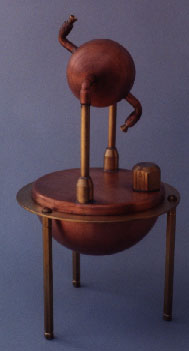
I can already hear you groaning. Here we go again, you're probably thinking. Another revisionist theory that Justin likes, big surprise. You may be surprised to learn, then, that this is no theory: sometime between 10 and 70 CE, Hero of Alexandria created what is believed to be the world's first steam engine. No joke, no hair-brained theory, just cold, hard, unforgiving historical facts. Still don't believe me? Just take a look at this illustration from his book:

Not sure what you're looking at? Well, it worked like this: you poured water into that bowl on the bottom, then build a flame underneath it and waited for awhile. Eventually, that water transforms into steam, which shoots up through the two pipes and into the circular object in the center, which was more like a pinwheel than a globe. The steam would travel out of the two spouts out of the pinwheel, causing it to spin. Presto, ancient Mediterranean steam engine!

In addition to this, Hero is also credited with the invention of the force pump, the syringe, a wind-powered organ, and the vending machine. So, the next time you buy yourself a soda or sodium-coated snack, think of Hero and wonder to yourself what else he may have jotted down on some note paper which was lost along with most of his work when the Serapeum was destroyed in 391 CE by a Christian mob.

Friday, May 7, 2010

Archimedes

Unfortunately, Archimedes is one of those semi-mythical guys who wasn't written about heavily until hundreds of years after his death. What we do know about him is a combination of contemporary and later sources, all of which agree on at least one thing: he was crazy smart.

He approximated pi to an unprecedented degree, which by itself is one heck of an accomplishment. He built world-changing inventions, created new mathematical formulas which incorporated infinity and zero (two concepts which scared the daylights out of Aristotle), applied buoyancy, and created complicated pulley systems which allowed for the earliest cranes to be built. I have focused mostly on how his inventions applied to warfare and farming, but those were the two chief interests of the ancient Mediterranean, when you get right down to it.

Though he died an untimely death at the hands of a foolish Roman Legionnaire, his concepts and inventions continued to change history long after his death. That is, the inventions that they could duplicate continued to change the world. There were several items the plunderers found in his workshop which could not be re-created and were taken as trophies by Marcellus and his Captains. One of them was a sphere with gears and levers which could calculate the exact position of the known planets.


Pax vobiscum


Wednesday, May 5, 2010

It's All Greek To Me!


How do you know what you know? Seriously, think of something you are sure is true right now. How did you come to know that truth? Do you believe that humans are basically good or evil? Do we have souls, or are we purely material, and what is the meaning of life? Is there a God, and is she in a good mood? With the economy the way it is, it's unlikely that most of us have had a lot of time to ponder the deeper meanings in life. Socrates would be greatly disappointed in us for this. And so would Archimedes.
The Socratic Method is the practical application of Socrates' belief in self-examination. It began circa 430 BCE, so the story goes, with a bunch of young Athenians who were trying to find the answers to life's biggest questions. They sought out Socrates, a bricklayer and veteran, who had a most curious way of discussing matters of truth. Rather than making quotable statements or using flowery words to push his point across, he asked questions. For example, if one of them stated that “Love always gives and never seeks to receive,” Socrates might answer, “If love never receives, what will it have left to give?” His entire point in life was to make people say, “Hmmmmm . . . .”
While he was mostly concerned with ethical and spiritual matters, he did use his questioning method as a way of trying to understand the world around him. Archimedes was born hundreds of years after Socrates' death, but it seems obvious from his discoveries that he used the same principles of critical thinking. One of the most famous stories (though it's believed to be Apocryphal) is that of the riddle that King Heiro II posed. A local goldsmith had forged a golden crown, and the King was suspicious that it was a fake. He asked Archimedes to find a way to prove it, so the mathematician went to work. He thought deeply about the subject, but couldn't come to a good conclusion, so he took a bath to relax before going at the problem again. While in the bath, he observed the water rising and falling, and realized that he could use the principle of buoyancy (which he basically created) to determine whether the crown was real or a cheap knock-off.
Greek thinking started with how to think, and it was only when the ancients strayed from the art of questioning that they plunged the known world into an intellectual dark age, with only a few bright lights like Archimedes to lead the way. Aristotle, a student of Plato (who was a student of Socrates) went about using inquisition to determine the natural world. After Alexander the Great, his student, took that knowledge with him to every place he conquered, it became concrete fact for the next thousand years. History loves irony, and so it stands that the scholastic line of Socrates ends with someone claiming absolute truth over the natural world.

Pax vobixcum