Showing posts with label Colonization. Show all posts

Tuesday, June 22, 2010

Adequate Aqueducts

In my study of history, it seems that there are at least two kinds of empires: the conquest empire and the sustainable empire. Famous warrior-kings like Alexander the Great forged conquest empires by marching their armies into foreign lands and conquering everything in sight. Alexander's in particular is an impressive conquest empire, but it fell apart as soon as he died, splintering into petty kingdoms ruled over by his former Generals. Sustainable empires, on the other hand, outlast their conquerors and fall into a pattern of subservience and reliance on their master kingdom. Rome had its share of both over the years, but places like Spain, Germany, Asia Minor, Sicily, North Africa, Greece, and regional Italy itself gradually fell into a permanent territorial status.

How does an army win a battle? Tactics. How does a nation win a war? Logistics. How does a country maintain a far-reaching empire? Engineering. Yes, if there's one thing the Romans had a monopoly on, it was practical engineering. Where the Greeks and Egyptians saw religion, the Romans saw potential. They specialized in making mysterious concepts like pi work for both their citizens and their conquered clients. One of their most amazing achievements was the Aqueduct.

In Rome alone, there was probably 500 km of aqueducts, allowing the city to support a million people. Throughout their empire, they regularly built and maintained these massive pipe and stone structures in order to ensure a potable water supply, as well as control over where the local went and who got to drink. When a city rebelled, step one of retaking it was taking the head of the aqueduct and cutting off their supply. Likewise, when Rome was attacked, the first step in defense was deploying the most elite troops to guard the water supply and ensure that a siege would prove too costly to maintain, especially if the attackers could not find a supply of their own.

In order to build a proper aqueduct, the surrounding land needed thorough surveying and measurement. The angles employed to ensure a 'just-right' flow of water were often very subtle, and the slightest overcompensation in the grade would either slow the supply to a trickle or cause an overflow which could lead to a nasty flood.

It is easy to find remains of the aqueducts in many parts of the ancient empire, including Spain and modern-day Turkey. What we see is only a fraction of what existed, and what still exists beneath our feet. Of all the aqueduct and piping laid by the Romans, most was underground and only a small percentage used those famous arches that we see still standing today.

Pax vobiscum

Thursday, June 10, 2010

Catching up: The Battle of Mylae and the Corvus

At the beginning of the First Punic War, Rome and Carthage both faced significant disadvantages to one another, and a kind of Cold War stalemate ensued for the first four years of the war. By 264 BCE, the Roman army had been honed into a victory machine in most land battles, particularly where rough, hilly terrain was the proving ground. This gave them many tactical victories in Sicily early on, the primary theater of the war, but the Carthaginians had been holding that land for many years, and developed a solid defensive strategy that left them well-fortified even if the local garrison had been routed. Carthaginian ships would arrive with fresh mercenary troops and supplies, making it difficult for the Romans to really gain any ground, since they didn't have a navy of their own to counter the enemy.

The story goes that some Carthaginian ships washed up on the Italian shore and were discovered by the Romans, who copied the design and made themselves ready for a sea invasion of North Africa or Iberia. However, siege weapons aboard boats were pretty useless in those days, so crews had to rely on ramming to tear their enemy's hulls and sink them in the Mediterranean, an art in which the Carthaginians were well-versed. Time and again, they sunk every Roman ship that dared cross into their space, breaking blockades with ease and resupplying their dwindling, demoralized armies in Sicily. So how does a land-based power defeat a naval power? By turning sea battles into land battles.

Roman engineers developed the Corvus, a swiveling draw-bridge device whose spiked tip could be smashed onto an enemy deck, attaching the two ships and allowing for legionnaires to take the ship. The Carthaginian fleet didn't know what hit them at Mylae: they lost almost half of their fleet to the Romans, who appropriated the vessels and bolstered their navy. Carthage's biggest advantage was lost, and the surprise of the Roman tactics cost them heavily. The war would drag on for nineteen more years, however, and end with Carthage being driven out of Sicily for good, causing them to intensify their colonization efforts in Spain and once again come into conflict with Rome.

While the Corvus remains one of the most brilliant innovations in ancient naval warfare, Carthage adjusted its sea tactics after several other disastrous encounters with Roman fleets. Roman innovation won the day, and the tired old Phoenician stronghold teetered one step closer to eventual annihilation.
Pax vobiscum

Wednesday, June 2, 2010

Phoenician Artifacts

We owe more to Phoenician culture than we'll probably ever know. They colonized the Mediterranean, developed the first widely-used phonetic alphabet, and developed one of the earliest urban civilizations west of the Fertile Crescent. It is thanks to them that the Romans began developing their massive Empire – most of which they took from the Carthaginians in war. Let's take a quick look at some of their more interesting artifacts.

This ceremonial mask of Ba'al Hammon was likely used in various rites and rituals designed to curry the favor of the Carthaginian chief deity. It is made from Terra Cotta. Date unknown

This coin dates somewhere between 310-290 BCE, and features the moon goddess Tanit, the highest of the goddesses worshiped in Carthage. She was the patron of life, fertility, and war, and is closely linked to Artemis of the Greeks, Diana of the Romans. Her symbol is very similar to the Egyptian Ankh.

This statue is meant to represent a man praying. It comes to us courtesy of the Phoenician colonists in the Balaeric Islands (near Spain) and is made of Terra Cotta and gold.

This is either a pendant or a brooch, and was discovered on the site of Carthage itself. It dates to the 3rd or 4th century BCE, and looks pretty cool. Whether it is meant to represent an average Carthaginian or is some kind of divine image remains unknown.

Pax vobiscum

Monday, May 24, 2010

The Battle of Alesia

In 52 BCE, the Gauls had united in a last-ditch effort against the invaders. Any one tribe who stood up to the Romans in recent memory had been utterly defeated, but now there was a new hope. The tribes had convened a council and selected one man to lead the rebel army to victory and restore freedom to their war-torn homeland. And that man's name was Vercingetorix.

Using hit-and-run cavalry tactics while taking refuge in well-defended forts gave this rebel leader a few victories over the Roman army, led by the famous and able Gaius Julius Caesar. In one such engagement, Caesar's 12 legions had attempted to storm his position at Gergovia, Vercingetorix drove them back, killing 700 legionnaires in the process and nearly causing a mass route of the entire army. Caesar was clever, though, and chose from then on to hunt down small detachments of the larger Gallic army, whittling their forces down to a more manageable size. Vercingetorix went with his typical play of strategically withdrawing his troops to a fortified position: the town of Alesia, atop a small hill.

I can only imagine the thoughts that must have consumed this last, best hope for Gaulkind watching helplessly from the city walls as the Romans built their own walls to solidify their defense. He had to witness the slow deaths of the women and children of the city, who starved to death after being expelled from the city and were then forbidden to pass through the Roman camp. He dispatched scout cavalry in an attempt to slow the construction, hoping to last until the relieving Gallic army arrived. The situation was desperate, and his men growing close to insubordinate treachery when a Gallic army of 100,000 arrived to relieve the siege. Hope was in the air that at long last, the Romans would be driven back and they would be free once again.

The Romans were now facing a battle on two fronts, but they had the luxury of their two walls, which kept them very well protected from the combined forces of 180,000. Their own 60,000 legionnaires were disciplined and well-armed; their foreign auxiliaries ready to do their part. After a few skirmishes and one night attack, the Gauls took a few sections of the Roman trench. They prepared for an all-out assault on the weakest point of the fortifications – a section where the two walls met with boulders and other natural hindrances to construction, a place Caesar had attempted to conceal.

The relieving force assaulted first, charging straight into the infantry lines and meeting the Romans steel to steel. Caesar ordered his men to hold the line while riding behind their ranks and cheering them on. He then led a counter-attack which drove off Vercingetorix's besieged men, who had sallied out of Alesia to support their Gallic compatriots. His line, weakened by the men that Caesar took to defend their rear, began to fall back and Gaius had to roll the dice. In a move both brilliant and incredibly risky, he took 6,000 cavalry with him and circled around the massive Gallic horde of 60,000, flanking them and cutting deep into their assault line. The Roman infantry, seeing their commanders risking their necks, were inspired by their bravery and pushed forward, pinching the Gallic line and causing the undisciplined tribal army to rout. Roman cavalry took over from there, hunting the fleeing soldiers down without mercy and laying waste to any hope that Vercingetorix maintained of being freed from this terrible siege.

A few days later, the mighty Gallic warlord surrendered, giving up his sword and armor to Caesar, who gladly accepted. With this defeat, Gaius Julius Caesar would forever solidify Roman domination over the Gauls.

Pax vobiscum

Thursday, May 20, 2010

The Ultimate Sacrifice

This story from the Greek oral tradition stands out as one of the most heinous crimes of the Trojan War. King Agamemnon made a foolish boast against Artemis after shooting a stag through the heart with a single arrow. She cursed his upcoming expedition against Troy unless he made a sacrifice: his eldest daughter Iphegenia. He obliged, and the war was ultimately successful, but the cruel king himself was murdered when he returned home by avenging family members. There is a similar story in the Bible's Old Testament centering around Jephtha, a Charismatic Judge who swore to sacrifice the first creature that approached him when he returned home if God would grant him a victory over the Philistines. The first creature was his daughter, whom he sacrificed to Yahweh, an event that stands completely alone in Judeo-Christian scriptures. The Greeks, Hebrews, and Romans had come to feel that human sacrifice was wrong by the 500's BCE or before, and kept it out of their worship, exiling it to their oral traditions as cautionary tales rather than promotional stories.

All this is to say that the Phoenicians were not alone in sacrificing people to their gods, but they were getting lonelier when they extended that practice into the early 100's CE. Carthage was the most powerful of the old Phoenician colonies, and by the 300's BCE its power was slowly being crushed under the weight of political corruption and a vacuum in leadership. Having almost no native military power because of their tendency to hire foreign mercenaries to do their fighting, they could only appeal to their gods when Scipio Africanus was at their gates.

The Phoenician deities were of a much older variety than the Greco-Roman gods, being much more like the savage Titans than the diplomatic Olympians. Ba'al was their chief deity, and his very name is derived from the Semitic word El, which means god, and is used in Hebrew words like El Shaddai or Elohim, referring to Yahweh and his angels. His partner goddess was Tanit, whose symbol included a crescent moon and star not unlike the modern Islamic symbol. The Romans identified Ba'al as Saturn, the father of Jupiter who had been usurped by the Olympians years ago, and it seems likely that they factored this into their ideas of superiority to the Carthaginians.

To me, the evidence of child sacrifice in Carthage is very clear. There are mass graves filled with children whose bones have been charred by sacrificial fire. Those who try and make the case that the children had already died of some disease or natural cause before being cremated are ignoring the fact that no evidence of any disease has been found among the remaining bones. I know very well the desire to demonize the Romans and try to rewrite history based on how we would have liked it, but the facts are the facts, and I see no benefit to these attempts at making the Carthaginians into something they are not.

In the cult of Ba'al, children were sacrificed to gain special favor from the gods. The idea was that only blood could show your true devotion to the gods' fame, and what better way to show your true devotion than giving your own child? The Romans and Greeks certainly were no strangers to the idea of blood sacrifice, often killing bulls, birds, and other animals in acts of worship and for divination, but human sacrifice of any kind had long since been outlawed by the Punic Wars.

That is not to say that the Carthaginians always sacrificed their own children. There are accounts (from 800 BCE) of aristocrats buying slave children to sacrifice in place of their own, but in times of famine, war, and hardship the priests would encourage parents to give their youngest child to the fires of Ba'al. Ba'al was associated with the sun, and by extension, fire, which is why the children were killed with a ceremonial knife before being thrown into the blaze.

One bit of evidence that often escapes Carthaginian apologists is the account of young Hannibal joining his father for a campaign in Iberia. It is written that he begged his father repeatedly to join him, and that his father, bitter from the recent defeats in the First Punic War, agreed to take Hannibal only if he would swear an oath against friendship with Rome. Hannibal responded by placing his arm over a nearby open firepit and swearing that he would use fire and steel to arrest the destiny of Rome. While this story is probably mostly fiction, it displays a practice that seems logical for a people who worship a god of fire. What better way to swear an oath by such a god than by allowing the fire to singe you just a little bit to prove your devotion?

No matter how antiquated or barbaric it seems to us, sacrificing animals to appease gods can certainly be said to contribute to the later spread of Christianity, which presented Christ, the sinless man who served as a blood sacrifice for all who believe.

Pax vobiscum

Wednesday, May 19, 2010

The Iberians

The Gallic Celts who settled in Spain and mingled among the natives to create the Iberian culture changed very little about their culture in comparison to the Gauls who settled in modern-day France. So, rather than pick through the minutiae of differences between them and their north-eastern neighbors, I will give a short summary of their history and importance before showing several interesting pictures to display some of the more brilliant and unique aspects of the Iberian peoples.

The city of Gadiz was founded in 1104 BCE, according to tradition, and is therefore the oldest continually inhabited city in Western Europe. Its people were Phoenician colonists originally, but over time its population grew to include some local tribes who decided to give up nomadic herding for urban life. This seems to be a trend among the Gauls worldwide, that they eventually decide to build settlements instead of continuing to roam. The Phoenician-Iberian-Celts did very well for themselves, and Gadiz as well as other Spanish settlements became some of Carthage's most prosperous colonies. That's not to say that it was all fuzzy hugs with the Carthaginians; securing their cities from raiding tribes who were competing for resources meant conquering much of Spain, ensuring a healthy supply line for continued prosperity.

The Carthaginians were notorious for farming their wars out to mercenaries. Carthaginian soldiers would form the main line of their army, but they lacked the martial culture of Rome or even their more ancient colonists in Palestine (which you may know as the Philistines). They were much more interested in trade than war, so when war came about, they hired the mercenaries they needed to pursue their military agenda. The Iberian tribes which continued to live outside of Phoenician hegemony were offered a deal during the Second Punic War: fight for us and gain spoils and honest pay. However, try as he might, Hannibal did not have the logistical support necessary to successfully subdue Rome and the Second Punic War ended Carthaginian control over Iberia as part of the terms of peace. The Romans set up shop and used the massive, underpopulated region as their bread basket and plentiful source of metal.

This sword is called a falcata, and its weight is distributed in such a way that swinging it creates the same force and impact as swinging a larger battle axe. It dates to the 4th Century BCE.

The most useful of their weapons was adopted by the Romans around the 300's BCE and utilized more heavily in their army after the Second Punic War. The Iberian version of this sword was around 5 feet long, which the Romans shortened to 2-3 feet for the practical purpose of stabbing someone by going around their shield

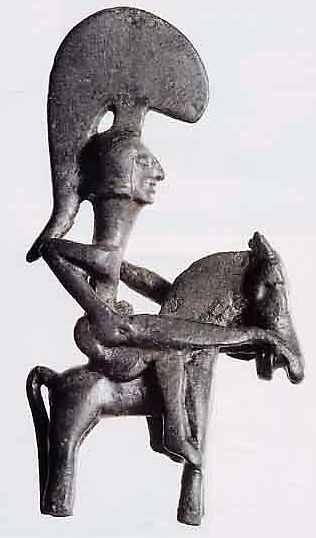
And lastly, this little bronze statue shows an Iberian knight on his horse, gladius in hand and plumed helmet looking very Greek. Clearly the Iberians had an equestrian class capable of purchasing and maintaining horses, indicating some level of class structure.

The Iberian peoples were Romanized at the first available opportunity, and lost most of their connections to the culture of the Gauls, who would not be conquered until Julius Caesar put an end to them once and for all in 50 BCE.

Pax vobiscum